If you’ve been paying any attention at all to the gaming landscape over the last year, you already know that the industry has been in a bit of a weird, uncomfortable spot. It’s felt like every week brings another headline about massive layoffs, or the slow-motion car crash of yet another high-profile live-service title that nobody really asked for. There’s been this general, lingering sense of “where do we even go from here?” But then, there’s Josef Fares. According to the latest feed over at Eurogamer, the man who famously told the Oscars exactly where to go has officially confirmed that Hazelight Studios is deep into development on their next title. And honestly? It’s the best news I’ve heard all February. It feels like a much-needed shot of adrenaline for a medium that’s been feeling a little too corporate lately.
I was scrolling through Twitter—or X, if you’re still actually trying to make that name happen—and there it was. A classic Fares photo that just radiated energy. He’s in a mocap studio, looking as hyped as ever, flanked by three actors wearing those ridiculous, ball-covered suits that make even the most serious performers look like they’re auditioning for a sci-fi comedy. The caption was characteristically blunt and devoid of any marketing fluff: “Next game in the making.” No corporate jargon, no vague five-year roadmap full of empty promises, just the raw reality of a creator who clearly knows he’s currently holding a winning hand. And after the absolute heater that was Split Fiction last year, why wouldn’t he be confident? He’s basically playing with house money at this point.
The tectonic shift left behind by Split Fiction’s massive 2025
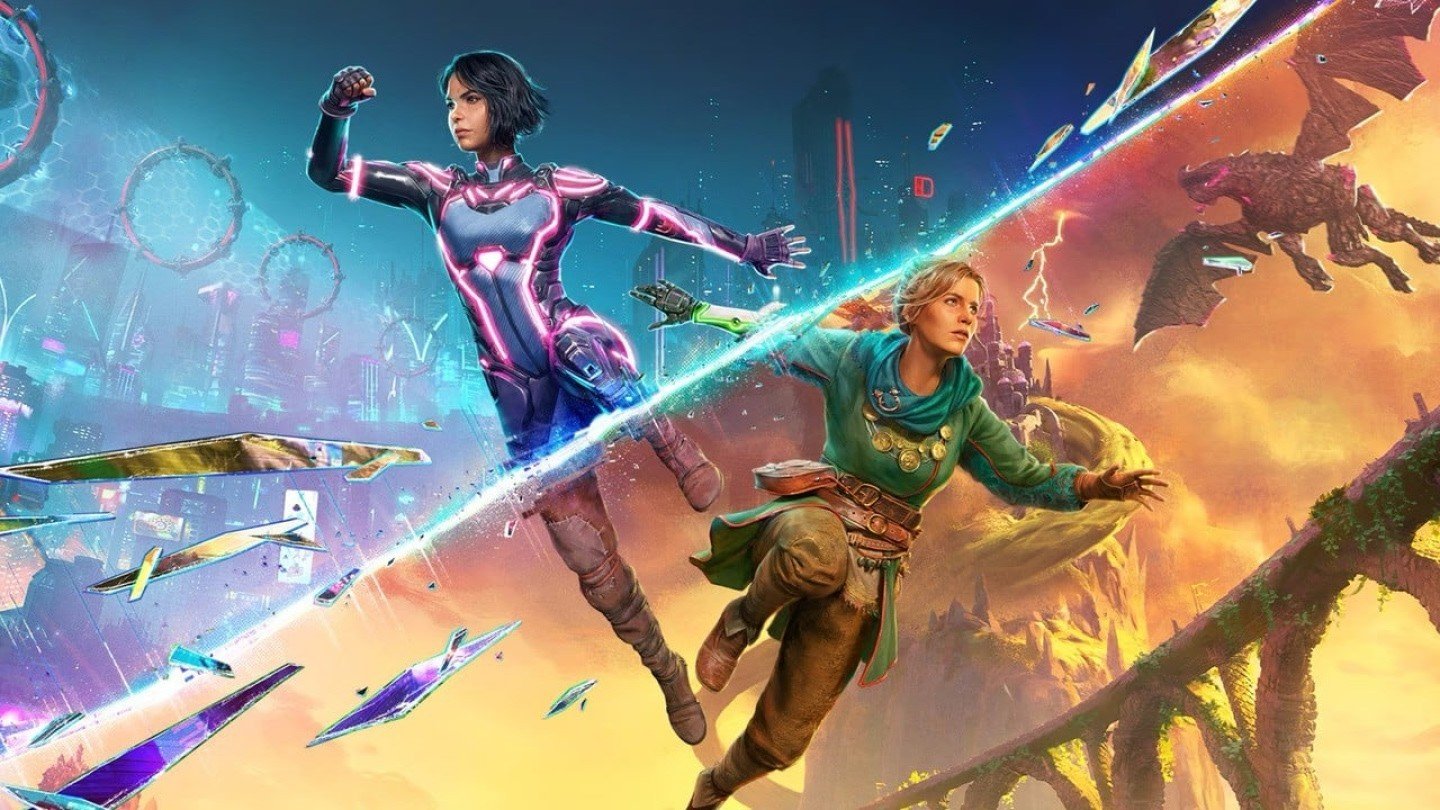
We really need to talk about Split Fiction for a second, because I think some people still don’t quite realize how much of a tectonic shift that game caused in the industry. It didn’t just “do well” by indie standards; it shattered the glass ceiling for what a dedicated, mandatory co-op experience can achieve in a market that’s usually obsessed with battle passes and solo-grind loops. According to the original reports, Split Fiction moved a staggering 2 million copies in just its first week on the shelves. A full million of those went out the door in the first 48 hours alone. For a game that literally requires two people to play—meaning you can’t even start the thing without a friend—those numbers are nothing short of legendary.
Even Electronic Arts, a company not exactly known for its sentimental attachment to niche or risky projects, had to sit up and take notice. During a quarterly financial report late last year, EA specifically called out Split Fiction as a cornerstone of their surprisingly strong Q4 in 2025. It sat right there on the slide alongside EA Sports FC 25 as a primary revenue driver. When you’re being mentioned in the same breath as the world’s biggest football sim, you’ve officially arrived at the big kids’ table. But the success wasn’t just about the bottom line; it was deeply cultural. As Katherine Castle put it so perfectly in her Eurogamer review, the game was “a testament to the power of human imagination.” It reminded all of us that games can be joyful, inventive, and—most importantly—genuinely shared experiences.
But why did it work so well when so many other co-op games fail to find an audience? I’d argue it’s because Hazelight understands something the rest of the industry seems to have forgotten: the “Friend Pass.” By letting one person buy the game and another play the entire thing for free, they removed the friction that usually kills co-op games before they even start. It’s a pro-consumer move that feels like a relic from a more generous, less greedy era of gaming, and yet, it’s exactly what made them millions in 2025. It turns out that when you treat your players with respect, they reward you by becoming your most vocal advocates.
Deciphering the three-actor riddle and the “third wheel” problem
Now, let’s get into the fun stuff—the speculation. If you look closely at that mocap photo Fares posted, there are three actors standing behind him. This is a massive departure from the Hazelight formula we’ve come to expect. A Way Out was a duo. It Takes Two was a duo. Split Fiction was, as the name implies, a duo. If Hazelight is moving toward a three-player dynamic, they are entering territory that is both dangerous and incredibly exciting. Designing a game for two people is already a mechanical challenge; designing one for three is a mathematical nightmare. How do you ensure no one feels like the “third wheel”? How do you balance puzzles so that everyone has a vital, unique role at all times?
A 2024 Statista report indicated that roughly 47% of console gamers in the US prioritize multiplayer features when they’re looking at new titles, but that interest usually splits between competitive shooters and massive, anonymous open-world RPGs. There is a massive, underserved gap for narrative-driven, small-group co-op that isn’t just about shooting things in the face. If Fares is building a three-player odyssey, he’s not just making a new game; he’s attempting to redefine the social geometry of our living rooms. We’ve seen what he can do with a pair of brothers or a divorcing couple. Imagine what he can do with a trio. Is it a love triangle? A heist crew? A messy family dynamic? The possibilities are honestly dizzying, and knowing Fares, it won’t be anything we expect.
“The only people who know more about it, aside from the developers, are those who first completed Split Fiction’s incredibly hard secret level.”
Source: Industry Insider Report, 2026
And let’s not forget that secret level. If you were one of the few dedicated souls who managed to grind through Split Fiction’s hidden endgame content, you supposedly got a brief, cryptic glimpse of what’s coming next. The community has been buzzing with theories about things like “inter-dimensional coordination” and “asymmetric storytelling,” but Hazelight has kept a tight lid on the specifics. It’s that rare kind of hype that feels earned and organic rather than manufactured by a massive marketing department with a hundred-million-dollar budget. It’s the kind of excitement that comes from players actually talking to each other.
The human element in an increasingly digital and lonely age
There’s a deeper, more personal reason why I’m so invested in whatever Hazelight is cooking up for the PS5 and PC. We’re living in an era where “multiplayer” often just means being dumped into a lobby with 99 strangers who are either muted or screaming into their mics. According to the Pew Research Center, nearly 40% of adults aged 18-29 play video games daily, often using it as their primary social outlet. Yet, so many of those experiences feel hollow. They’re designed to keep you on a digital treadmill, chasing the next skin or battle pass tier, not to actually make you talk to your friends or build a memory.
Hazelight games are fundamentally different. They force you to communicate. They force you to argue, to laugh, and occasionally to offer a sincere apology when you miss a jump for the tenth time and send you both back to the checkpoint. In Split Fiction, the “fiction” part of the title wasn’t just about the narrative—it was about the roles we played with each other in real life. By doubling down on this “forced” cooperation, Fares is making a bold statement about why we play games in the first place. We play to connect. And in 2026, with the world feeling as fragmented and isolated as it does, that connection is worth its weight in gold. It’s about more than just the “gameplay loop”; it’s about the conversation happening on the couch.
It’s also worth noting the technical side of things, because Hazelight isn’t just about the heart—they’ve got the chops too. The use of high-end mocap in these early stages suggests that they aren’t scaling back or playing it safe. They are leaning even further into the cinematic quality that made A Way Out feel like a playable prestige TV show. With the power of current-gen hardware finally being fully utilized by developers who actually know how to optimize, the visual fidelity of this “Next Game” is likely to be a significant step up even from the gorgeous It Takes Two. I fully expect we’ll see some truly wild implementation of haptic feedback and 3D audio to facilitate that co-op immersion, making the world feel as tactile as the relationships within it.
Predictions for the long road ahead
So, where does this leave us in the grand scheme of things? We know the game started development in early 2025. Given Hazelight’s usual three-to-four-year development cycle, we’re likely looking at a late 2027 or early 2028 release date. That sounds like a long way off, especially in our era of instant gratification, but in the world of AAA development, it’s practically tomorrow. My bet? We’ll see a formal title reveal and maybe a high-octane teaser trailer at The Game Awards later this year. It would be poetic, wouldn’t it? Fares returning to the very stage where he became an industry legend to show us the future of the genre he essentially saved from extinction.
I also strongly suspect we’ll see Hazelight push the “Friend Pass” concept even further than before. Maybe it won’t just be one friend playing for free; maybe it’ll be a “Party Pass” designed specifically for this rumored three-player setup. It’s a risky business model from a traditional corporate perspective, but as Split Fiction proved, when you give people a great experience without nickel-and-diming them for every little thing, they show up in droves. They tell their friends. They post about it. They essentially become your marketing team because they actually love what you’ve made. It’s the ultimate win-win.
Whatever it ends up being—whether it’s a roguelike co-op, a sprawling space opera, or a gritty psychological thriller—I’m already in. Josef Fares has earned that level of trust from me. He’s one of the few directors left who feels like he’s actually having fun making games, and that joy is infectious. It’s baked into the very code of his projects. In an industry that often feels like it’s losing its soul to algorithms, engagement metrics, and “retention strategies,” Hazelight Studios feels like a lighthouse. I can’t wait to see where the light points next, and I’ll be there on day one, controller in hand, probably apologizing to my friends for missing another jump.
Is the new Hazelight game a sequel to Split Fiction?
While nothing is officially confirmed yet, Josef Fares typically prefers creating entirely new IPs. Each of his games—Brothers, A Way Out, It Takes Two, and Split Fiction—has been a standalone story with its own unique mechanics and world-building. It is highly likely this new project is a brand-new universe with its own set of rules.
Will the new game be available on Xbox and Switch?
Hazelight has a very strong history of multi-platform releases, largely thanks to the EA Originals program which helps with distribution. While the PS5 was mentioned in the context of Split Fiction’s success, you should fully expect the new title to hit PC, Xbox Series X/S, and potentially whatever successor Nintendo has lined up for the Switch.
Can I play Hazelight games solo?
Generally speaking, no. Hazelight’s entire design philosophy is built around “pure co-op.” Games like It Takes Two and Split Fiction do not have a single-player mode at all, as the puzzles and narrative beats require two (or possibly three) distinct players to function. It’s about the cooperation, not just the completion.
This article is sourced from various news outlets and industry reports. The analysis and presentation represent our editorial perspective on the future of Hazelight Studios.
About the Author