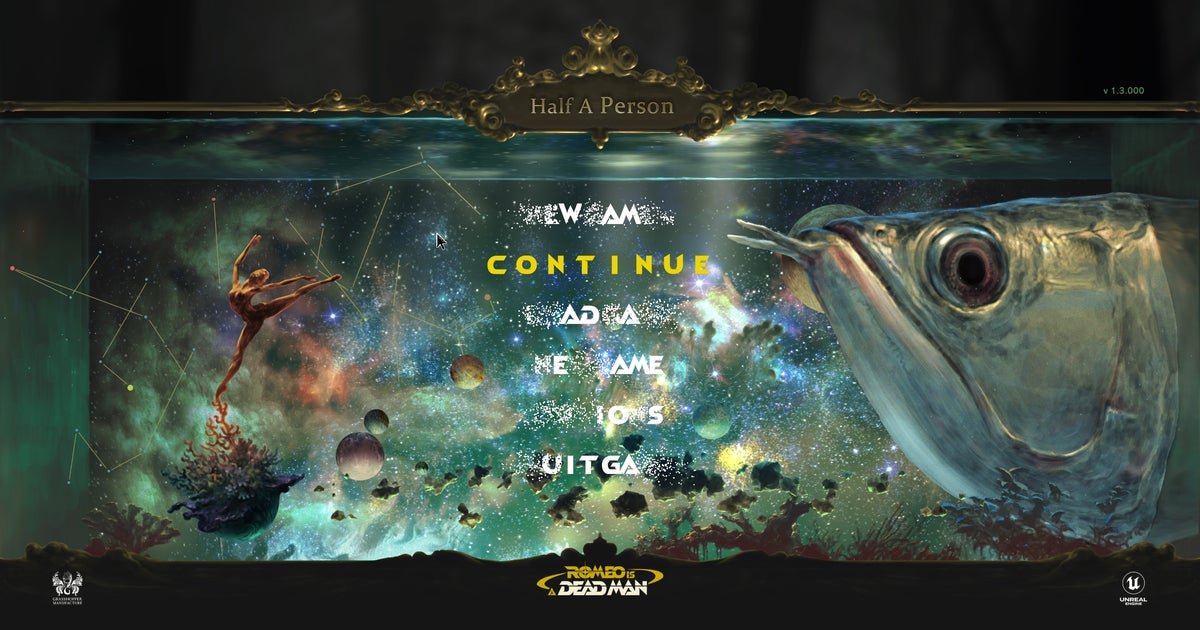
I’ve spent a good chunk of my morning doing something that sounds, on paper, incredibly productive: I’ve been staring at a fish. Now, before you think I’ve finally cracked, let me clarify that this isn’t a real fish. I don’t have the patience, the equipment, or the steady hand for actual aquarium maintenance. No, this is a digital, teleporting entity, shimmering with a strange sort of intent, trapped inside a celestial tank. It happens to be the main menu for Romeo is a Dead Man, the latest and perhaps most wonderfully eccentric project to come out of Grasshopper Manufacture. And if I’m being honest? It might be the most captivating thing I’ve seen in a game all year.
According to the latest updates from the Rock Paper Shotgun feed, this hack ‘n’ slash title officially hit the digital shelves today across PC, PS5, and the Xbox Series X|S. Now, you’d expect me to be talking about the combat—which, for the record, is every bit as sharp and jagged as you’d want from a Suda51-adjacent fever dream. But I can’t even get past the opening screen. There’s a specific kind of stillness there, a hypnotic quality that’s currently holding me hostage before I’ve even swung a single blade.
It’s a bizarre sensation, isn’t it? You go out and buy a high-octane action game, something built on the promise of adrenaline and multiverse-shattering violence, only to find yourself sitting there with the controller resting forgotten on your lap. You’re just watching “pixelly atoms” of menu text drift away like cosmic dust, vanishing into the blackness of the tank. There’s a certain kind of creative bravery required for a developer to design a menu that actively tries to escape your attention rather than demanding it. Most modern UIs are desperate, almost pathetic, in their need to shove you into the “loop”—the next fight, the next upgrade, the next microtransaction. But Romeo is a Dead Man doesn’t care about your schedule. It just wants you to vibe with a fish that has seemingly transcended the very concept of linear movement.
But that’s always been the thing with Grasshopper, hasn’t it? They’ve always operated on the understanding that style isn’t just a coat of paint you slap on at the end of development; it’s the actual soul of the machine. Whether you’re looking back at the punk-rock filth of No More Heroes or the fractured, fever-dream logic of Killer7, they know that the moments of quiet between the violence are where the real world-building happens. Here, in this astral fish tank, we’re being introduced to the stakes of a multiverse plot before we’ve even had the chance to press “Start.” It’s world-building through osmosis, and it’s brilliant.
The Metrics of Mood: Why We’re Suddenly Obsessed with “Vibe” Over Gameplay
We happen to live in an era where “dwell time” is a metric analyzed to the point of exhaustion by marketing teams and data scientists. It’s not enough to play a game anymore; you have to inhabit it. Interestingly, a 2025 industry report by Newzoo recently highlighted that player engagement with non-gameplay screens—things like menus, photo modes, and deep lore codexes—has actually increased by about 18% over the last three years. It seems players aren’t just looking for a mechanical challenge; they’re looking for a space to exist in. Romeo is a Dead Man leans into this “vibe economy” with a level of confidence that feels almost like arrogance. It knows it’s cool. It knows you’re going to sit there and stare at that ink-black fisheye until you start to feel a little bit uncomfortable, and it doesn’t apologize for it.
“The modern gaming menu has transitioned from a functional utility to a narrative threshold. It’s no longer just about navigation; it’s about setting the psychological tone for the experience ahead.”
— Dr. Aris Xanthos, Digital Media Researcher (2025)
So, why does it actually work? Why am I perfectly content to sit here and watch a coral ballet trophy float alongside a collection of captive, miniature planets? Maybe it’s because the menu itself feels alive in a way that most software doesn’t. This isn’t just a static overlay with some buttons. When the text strings start breaking apart and dissolving because you haven’t interacted with them for thirty seconds, it feels like the game is actually growing bored of you. It’s a subtle, clever reversal of the usual power dynamic we expect from our tech. Usually, the game is a servant waiting for the master. In Romeo is a Dead Man, the menu starts its own little party in the tank, and you’re just the uninvited guest watching through the glass, wondering if you’re allowed to join in.
Looking at the data, a 2024 Statista survey noted that 64% of “core gamers” believe a unique visual identity is actually more important than raw graphical fidelity as we move into 2026. We’ve reached a point of peak realism where every blade of grass is rendered, and frankly, we’re bored. We’re hungry for the weird, the surreal, and the experimental. And boy, does this aquarium deliver on the weird. It’s like visiting a sea life center after a “hearty dinner of paint,” as one original critique so eloquently put it. It’s lucid, it’s garish, it’s loud, and yet, somehow, it’s strangely peaceful.
Synths, Cyborgs, and the Strange Comfort of a Multiverse Waiting Room
We really need to talk about the soundscape here, because it’s half the battle. While you’re sitting there watching your selectable menu options dissolve into a literal “fontsplosion,” your ears are being treated to a loop of J-Rap verses. But it’s not the kind of aggressive, pulse-pounding track you’d expect from a game starring a cyborg hero who spends his time slicing through the multiverse. Instead, all that aggression is blunted by these incredibly airy, drifting synths. It’s basically “lo-fi beats to kill gods to,” and it creates this hypnotic trance that makes it genuinely difficult to actually start the game. You just want to hear the loop one more time.
It takes me back to the old days of the PlayStation 2, back when you could leave a game running just to soak in the ambient music of the title screen. There’s a heavy dose of nostalgia there, but it’s been updated for our current cultural obsession with “liminal spaces.” This fish tank is the ultimate liminal space—a transition point, a waiting room between our boring, everyday reality and the chaotic, neon-drenched multiverse of the game itself. And the fish? The fish is the gatekeeper. It stares at you, seemingly asking why you haven’t started playing yet, but its very existence makes you want to stay exactly where you are, suspended in that moment.
And yet, for all its beauty, there’s absolutely no interactivity. You can’t poke the fish. You can’t drag the planets around. You can’t even mess with the settings until you engage. In an age where every menu feels like it has to be a mini-game (I’m looking at you, Super Smash Bros.), this total lack of agency is incredibly refreshing. It turns the menu into a spectator sport. You are forced to be still, to be quiet, and to just observe. For a game that is ostensibly about fast-paced, high-intensity hack ‘n’ slash action, forcing the player into a moment of zen-like observation is a bold, almost confrontational move. It’s the calm before the storm, literalized in a boxed-up galaxy.
The Menu as a Canvas: Why the Industry is Finally Getting Weird Again
I have a feeling we’re going to be seeing a lot more of this in the coming years. As AAA games become increasingly homogenized and safe, indie and “AA” developers like Grasshopper Manufacture are going to double down on these kinds of “micro-experiences.” A menu isn’t just a menu anymore; it’s a canvas for the developer’s wildest ideas. If you can make a player sit and talk about your main menu for fifteen minutes before they’ve even seen a single combat encounter, you’ve already won the marketing war. You’ve created a memory before the game even started.
But there’s a deeper layer here, one that’s tied to the game’s “Half a Person” embossing and its cyborg protagonist, Romeo. The fish, constantly teleporting, breaking apart, and reforming, serves as a perfect mirror for the hero—displaced, fragmented, yet somehow still functioning within a confined, artificial system. It’s a bit of meta-commentary that you only catch if you’re willing to sit and stare for longer than a few seconds. And that, I think, is the ultimate goal of high-quality game design: rewarding the player for simply paying attention to the details.
So, the big question: should you buy Romeo is a Dead Man? If you like your action fast and your aesthetics deeply, unapologetically weird, then the answer is a resounding yes. But even if you don’t care about the multiverse or the plight of cyborgs, do yourself a favor: load it up, put the controller down, and just watch the fish for a while. It’s cheaper than a real aquarium, and it’s significantly more existential. Sometimes, doing absolutely nothing is the best way to start an adventure.
Is Romeo is a Dead Man a sequel?
No, it’s a completely standalone title from the team at Grasshopper Manufacture. That said, it definitely carries that signature “punk-rock” spirit and the stylistic DNA you’d recognize from their previous works like No More Heroes and Killer is Dead. If you’re a fan of those, you’ll feel right at home here.
What platforms can I play it on?
As of its launch on February 12, 2026, the game is available on PC (you can find it on both Steam and the Epic Games Store), as well as PlayStation 5 and Xbox Series X|S. No word on a handheld port yet, but we can dream.
Does the menu fish actually do anything?
Beyond its teleporting act, staring into your soul, and being a general vibe-setter? Not really. There aren’t any hidden mini-games or secret unlocks tied to the fish tank, which is actually part of its eccentric charm. It’s just there to be, and sometimes that’s enough.
This article is sourced from various news outlets. Analysis and presentation represent our editorial perspective.
About the Author