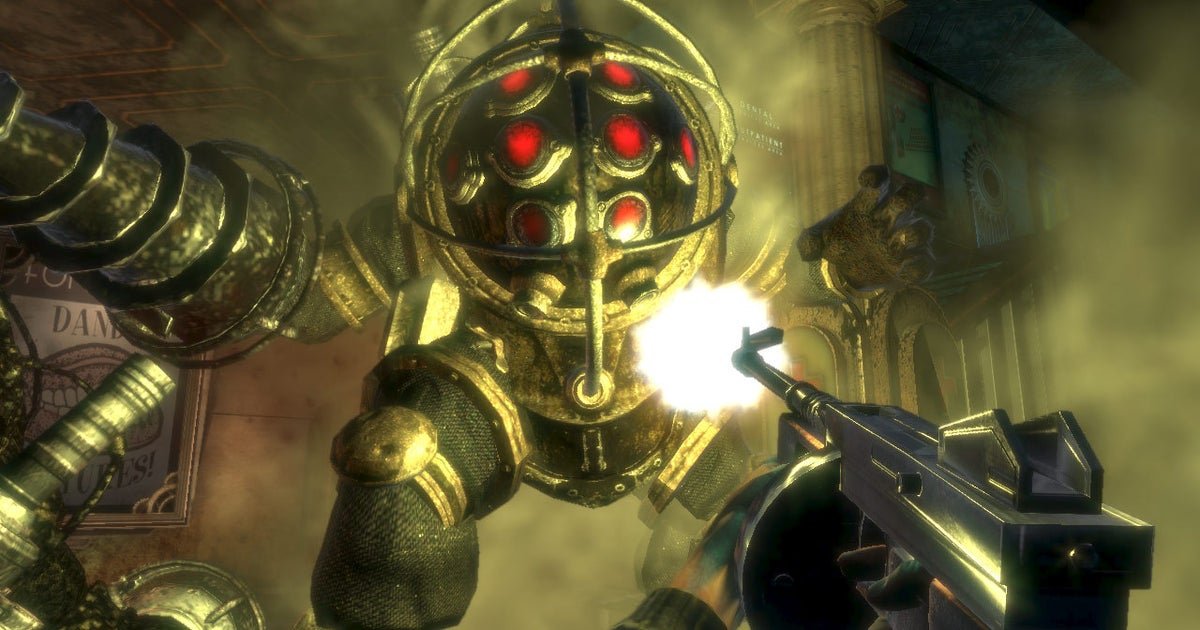
Somewhere beyond the sea, a massive headache is brewing in Hollywood. Fans of video game adaptations will recognize the pattern immediately — almost on instinct. The long-awaited live-action project gets announced, the internet briefly loses its mind, and then silence settles in like fog over Rapture.
As of early 2026, that agonizing quiet surrounding the BioShock movie isn’t exactly due to a lack of effort, per recent reporting from Eurogamer. Progress is happening behind closed doors. It’s just moving at the speed of a Big Daddy trudging through chest-deep mud. The primary culprit? A brutal scheduling collision and a sweeping corporate ambition to perfectly time the film’s release with the highly anticipated fourth BioShock game.
When you actually look at the logistical nightmare of aligning a major Hollywood production schedule with an unpredictable AAA game development cycle, it’s easy to see why executives at both companies are reportedly losing sleep. Two enormous machines, pointed at the same target, neither one fully in control of its own timeline.
Francis Lawrence Is the Bottleneck — And Everyone Knows It
Since Netflix announced they were taking a swing at the notoriously cursed project back in early 2022, fans have been starved for anything concrete. Francis Lawrence — the man in the director’s chair — is undeniably talented. Undeniably booked, too.
Over the last couple of years, Lawrence has been juggling a frankly staggering slate of projects. Two separate Hunger Games prequels. An adaptation of Stephen King’s The Long Walk. Tentative attachments to sequels for both I Am Legend and Constantine. That is a lot of big-budget plates spinning at once, and in practice, something had to wait.
BioShock waited.
Producer Roy Lee recently offered the clearest picture yet of where things actually stand, suggesting the BioShock film is very likely Lawrence’s next major undertaking the moment he surfaces from post-production.
“We would have gotten it made a few years back, but then other movies got in the way, with one being The Long Walk and the other being The Hunger Games prequel, which comes out this December,” Lee admitted in a recent conversation with Collider. “We’re just waiting for him to finish post-production, because he’s going to be working on it through at least September, and then jump back into it.”
— Roy Lee, Producer
For anyone who has tracked this project’s tortured journey — dating all the way back to Gore Verbinski’s scrapped R-rated attempt well over a decade ago — that’s genuinely reassuring. The movie isn’t dead. It’s just waiting in line, tapping its foot.
Rod Fergusson Doesn’t Show Up When Things Are Going Well
Here is where the story gets genuinely fascinating from an industry perspective. The film delay might actually be a quiet gift to Take-Two Interactive, the sprawling publisher that controls the franchise rights.
Take-Two and Netflix aren’t simply chasing a successful movie. They’re engineering a global media event — one that only works if the film and a brand-new BioShock game land on the world simultaneously. The ambition is breathtaking. So is the risk.
There’s one stubborn problem. Game development, as it turns out, does not care about your marketing calendar.
Cloud Chamber, the studio 2K specifically assembled to shepherd the new BioShock, has been grinding away since 2019. In game development terms, that’s an eternity. Rumors of engine swaps, creative overhauls, and full-scale reboots have trailed the project for years. Building a modern, narrative-heavy immersive sim for PS5, Xbox Series X, and high-end PC hardware is both technically punishing and eye-wateringly expensive — and the hands-on reality of that kind of development is that schedules slip, often badly.
Which explains exactly why Rod Fergusson was parachuted into Cloud Chamber in 2025.
If you follow the inside baseball of the games industry, Fergusson’s reputation precedes him by several rooms. He is the ultimate closer — the person you call when a massive AAA title is mired in development hell, struggling to lock its core loop, and hemorrhaging time. He did it for BioShock Infinite in an earlier chapter of his career. He did it for the Gears of War franchise at The Coalition. He did it for Diablo 4 at Blizzard. The pattern is consistent: when Fergusson shows up, a game that was lost starts finding its way to a gold master.
His arrival at Cloud Chamber was, simultaneously, a red flag and a neon sign. Red flag: the game was in trouble, possibly serious trouble. Neon sign: Take-Two is dead set on shipping it. Fergusson isn’t there to brainstorm inventive new plasmid mechanics or debate narrative themes. He’s there to cut the fat, tighten the pipeline, and drag the project across the finish line within the next couple of years — however uncomfortable that process gets.
The Billion-Dollar Transmedia Bet Both Companies Are Making
Why the frantic push to synchronize these two colossal projects? Cold data, mostly.
The entertainment landscape has shifted hard over the last several years. Standalone video game adaptations used to be a coin flip. Now, when executed with precision, they function as a Trojan horse — marketing vehicles disguised as prestige entertainment, designed to funnel audiences straight back to a controller. According to a 2024 report from the Pew Research Center on digital media habits, nearly 40% of streaming subscribers actively seek out the source material of a film or television adaptation within one week of watching it.
Amazon’s Fallout series made this point with blunt force. When the show dropped, player counts for decades-old Bethesda titles spiked dramatically on Steam and Xbox — overnight, without a single additional dollar spent on game marketing. Take-Two watched that happen and wants the same effect, supersized.
“I know that Netflix and Take-Two are very anxious to see the movie come out because they want to have the release coincide with some of the potential new incarnations of the game,” Roy Lee noted in his recent Collider interview.
The financial upside, when you map it out, is genuinely staggering. According to historical SEC filings from Take-Two Interactive, the BioShock franchise has moved roughly 42 million units worldwide since its debut — spanning original releases on PS3 and Xbox 360 all the way through remastered collections on the Nintendo Switch. That’s a proven, durable audience.
Now picture this: a $200 million blockbuster hits Netflix on a Friday. That same morning, a brand-new $70 BioShock game sits on the front page of the PlayStation Store. The Netflix algorithm amplifies the movie, the movie propels viewers toward their consoles, and Take-Two collects the receipts. The marketing loop closes on itself. No seams.
It’s the kind of synchronized release strategy that, if it actually works, rewrites the playbook for how publishers think about their IP for the foreseeable future.
Why They Quietly Killed a BioShock Remake That Should Have Been a Sure Thing
This aggressive transmedia push also clarifies one of the stranger recent casualties in the franchise’s history. Following the creative shakeup at 2K last year, reports emerged that a full-scale remake of the original 2007 BioShock had been quietly shelved — tossed out despite being, on paper, one of the safest bets in gaming.
Rebuilding Rapture from the ground up with modern ray-tracing and physics, releasing it on PS5 alongside a Netflix film? Sounds like an effortless slam dunk. The nostalgia alone would have moved units by the truckload.
Dig a little deeper, though, and the cancellation starts making uncomfortable sense from a brand management standpoint. Release a gleaming remake of a widely-beloved masterpiece right alongside a completely unproven fourth entry, and you’re essentially inviting players to vote with their wallets — and the safe, familiar choice tends to win. Players buy the remake for the nostalgia trip and glance past Cloud Chamber’s new title entirely. Take-Two needs every available pair of eyes, and every available wallet, aimed squarely at the franchise’s future rather than its past. Sentimentality is expensive when you’re trying to launch a new era.
The actual nature of BioShock 4 remains stubbornly opaque. Leaks over the years have gestured at everything from a 1960s Antarctic setting to deep roguelike architecture — but with Fergusson having spent the last year restructuring the project, those older leaks are almost certainly obsolete. Whatever the game was before he arrived, it’s likely something different now.
Who Blinks First? The Timeline Nobody Can Actually Control
For now, it’s a waiting game with no guaranteed outcome.
Francis Lawrence has to finish the color grading on a Hunger Games prequel before he can even think about Rapture. Rod Fergusson has to wrangle a sprawling development team into delivering a game that has been in production for the better part of a decade. Neither man controls the other’s calendar, and neither company can fully insulate their plan from the chaos that tends to arrive uninvited on productions of this scale — strikes, reshoots, technical crises, the kind of game-breaking bug that quietly adds six months to a ship date.
Is there a version of this where everything falls apart? Absolutely. One stumble on either side and the synchronized launch — the entire premise of the marketing strategy — collapses.
But if they pull it off? If Lawrence delivers a visually arresting descent into madness on Netflix the same week a sharp, polished new BioShock game lands on hard drives worldwide? That’s not just a win for two companies. That’s a proof of concept — a demonstration that transmedia coordination at this scale can actually be executed, not just theorized about in boardrooms. The entertainment industry would be taking notes for years.
Someone has to blink first. Right now, nobody seems willing.
Frequently Asked Questions
Is the BioShock movie going to be animated or live-action?
The upcoming Netflix adaptation is slated to be a live-action feature film. While Netflix has found considerable success with animated game adaptations like Arcane, BioShock is being developed as a high-budget live-action blockbuster — a meaningfully different and more expensive proposition.
Who is directing the Netflix BioShock movie?
Francis Lawrence is currently attached to direct. He is best known for helming a substantial portion of The Hunger Games franchise, along with films like I Am Legend and Constantine.
When is the new BioShock game coming out?
There is currently no official release date for the fourth BioShock game. Development is being handled by Cloud Chamber studios, and recent industry reporting suggests the publisher is actively working to align its launch window with the Netflix film — though, in practice, game development timelines rarely cooperate with that kind of ambition.
This article is sourced from various news outlets. Analysis and presentation represent our editorial perspective.
About the Author