I still remember the absolute, crushing finality of sitting in a darkened theater, watching the credits crawl up the screen after Evangelion: 3.0+1.0 Thrice Upon a Time. Hideaki Anno had pulled off the impossible. He shut the book — literally drew the curtain on Shinji Ikari, pressed a sensible suit into his hands, and told him — told all of us, really — to go outside, feel the sun, and finally, mercifully grow up. It was a perfect goodbye.
And now, as of early 2026, we are ripping that bandage clean off.
Per Eurogamer’s latest reporting, a small, almost blink-and-you’ll-miss-it credits page surfaced over the weekend confirming what sounds like a fever dream: Yoko Taro is writing a brand-new Evangelion series. The announcement slipped out quietly as part of the lingering celebrations for the franchise’s 30th anniversary, which kicked off late last year. No fanfare. No press conference. Just a credits page, doing the heaviest lifting in anime history.
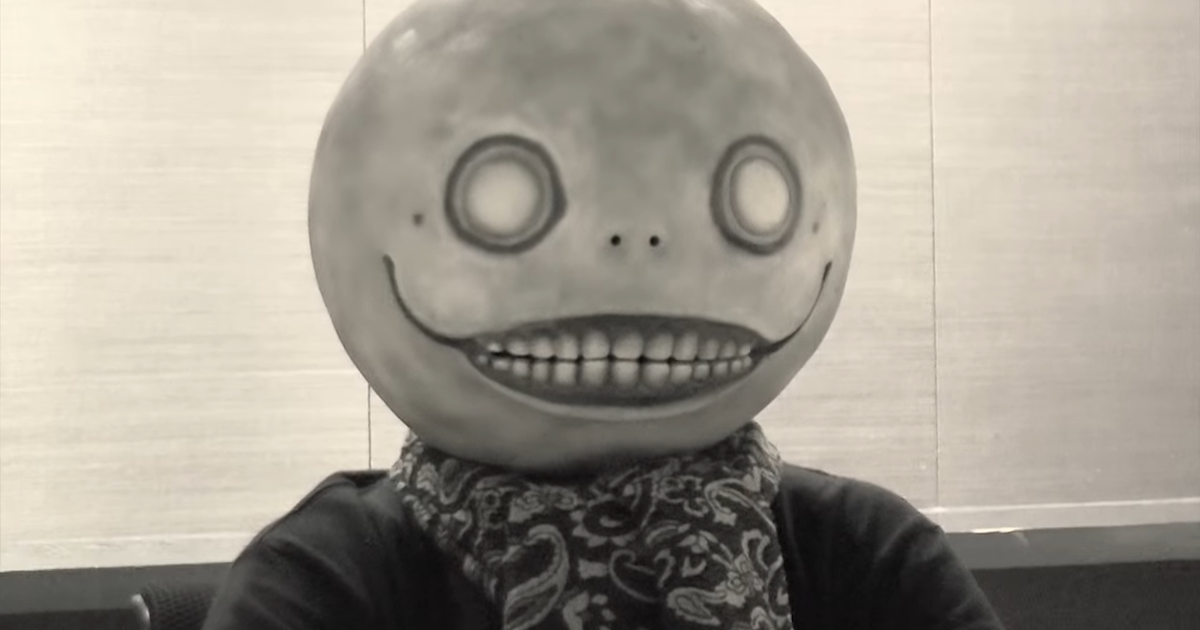
Let that settle for a moment. The man who conceals his face behind a giant grinning moon mask — the eccentric architect who turns video game save files into instruments of emotional devastation — has just been handed the keys to the most psychologically corrosive mecha franchise ever made.
Terrified? Absolutely. Here for it? Without question.
Two Flavors of Existential Dread, One Collision Course
Touch a controller any time in the last decade and you’ve almost certainly encountered Taro’s fingerprints. He’s the mind behind the Drakengard and Nier series — work that weaponizes player expectation against itself. When Square Enix and PlatinumGames dropped Nier: Automata on PS4 and PC back in 2017 (later landing on Xbox One and Switch), it obliterated expectations. Not just a hack-and-slash action RPG. A sprawling meta-narrative about grief, artificial consciousness, and the grinding futility of war — and in practice, one of the few games that actually earns its philosophical ambitions rather than just gesturing at them.
It also moved a staggering number of units. Following a recent stream celebrating 10 million copies sold, the fanbase was already frothing for new developments in the Nier universe. Taro pivoted instead. He looked at the defining anime of the 90s and decided it was his next playground. Characteristically unhinged. Characteristically perfect.
Twisted as it sounds, the pairing makes a strange kind of sense. Only a year ago, Taro openly credited Neon Genesis Evangelion as a foundational inspiration for Nier: Automata. Draw a straight line between Shinji Ikari’s fragile, fracturing psyche and 9S’s desperate, unraveling interiority, and the throughline is hard to miss. Both Anno and Taro deploy giant, supposedly heroic avatars to excavate the darkest recesses of depression and human isolation.
The execution, though, diverges sharply.
Anno’s anguish turns inward. Claustrophobic. It traps you in a train car with nothing but your own worst thoughts for company. Taro’s despair sprawls outward — a vast, bleached desert where you fight endlessly for a god who died centuries before you arrived. Merging these two distinct brands of melancholy feels like mixing bleach and ammonia. Inadvisable. Potentially catastrophic. Spectacular to witness.
Anno Already Said Goodbye — Did Anyone Listen?
Here is where things genuinely get messy. Does the world need more Evangelion?
Financially? Obviously. The franchise is a perpetual money press. According to Box Office Mojo, Thrice Upon a Time cleared over $90 million globally — a remarkable theatrical haul for an anime release in 2021. The merchandise ecosystem alone — branded coffee makers, high-end fashion collabs, model kits priced like small appliances — sustains an entire micro-economy within Japan.
Narratively, though? We’re playing with fire.
The Rebuild finale wasn’t merely an ending. It was an explicit, almost heavy-handed message aimed directly at the audience. Anno spent decades held hostage by the cultural behemoth he’d created — and his final film functioned as an exorcism. When Shinji literally rewrites existence into a world without Evangelions, then steps off a train platform into sunlight, Anno was looking straight down the camera barrel and saying, “It’s done. Let go.”
Chasing that with a new series feels, at minimum, complicated. You can’t casually nerf the emotional weight of that closure — can’t treat it like a high-budget post-game content drop. Drag Shinji, Asuka, and Rei back into another cycle of trauma, and you risk cheapening the decade-long wait audiences endured for something resembling their salvation.
“Video games and anime often treat trauma as a plot device. Very few creators treat it as the actual environment the characters breathe. Anno and Taro are the rare exceptions.”
Dr. Sarah Jenkins, Media Psychology Quarterly
Why We Can’t Stop Digging Up the Things We Love
Broader forces are at work here — ones that extend well beyond giant robots and psychologically wrecked teenagers. Culturally, we’ve developed a deep, almost paralytic fear of letting things end.
A 2024 survey published by the Pew Research Center found that nearly 68% of adults under 40 actively gravitate toward familiar, nostalgic media during periods of elevated cultural or economic anxiety. We retreat to the things that comforted us when the world felt smaller, because the current moment feels genuinely unstable in ways that are difficult to articulate. The past, at least, has known contours.
Studios know this. Publishers know this. Every dormant IP from the 1990s is getting a reboot, a sequel, or the slightly more dignified label of “spiritual successor.” But Evangelion was supposed to be the anomaly — the one franchise audacious enough to definitively unplug itself. That’s what made the ending matter.
The Crew Assembling for This Beautiful Disaster
Reservations firmly noted — and yet the sheer density of talent attached to this project is genuinely difficult to dismiss. That quiet credits page didn’t just surface Taro’s name. It revealed a core team that commands attention.
Directing duties are split between Kazuya Tsurumaki and Toru Yatabe. Tsurumaki is Evangelion royalty — Anno’s longtime protégé and right-hand collaborator at Studio Khara, co-director of the Rebuild films. He inhabits the visual language of the Eva universe the way a musician knows a song they’ve played a thousand times. If Taro is the volatile, unpredictable catalyst hurling new ideas into the room, Tsurumaki is the gravitational anchor keeping the whole thing from flying apart.
Then there’s the music. And this is where things get genuinely interesting.
Keiichi Okabe — longtime composer for Bandai Namco and Square Enix, the architect of Nier‘s haunting, spectral soundscapes — is scoring the series. When actually tested against expectation, Okabe’s work hits differently than you anticipate; it doesn’t just accompany emotion, it manufactures it from the inside out. Picture the chaotic, angelic choirs of an Eva battle sequence scored by the man who wrote “Weight of the World.” Shiro Sagisu’s original Eva compositions are the stuff of legend: triumphant brass, classical dread, the sonic equivalent of staring into the abyss while the abyss files paperwork on you. Okabe’s palette is something else entirely — layered fictional languages, sorrowful vocals draped over heavy percussion, grief rendered as texture.
Seismic shift doesn’t quite cover it. Sagisu makes you feel like you’re fighting God. Okabe makes you feel like God has been dead for centuries, and you’re just the one left holding the broom.
Nobody Actually Knows What This Show Will Be — And That’s the Point
The plot remains a complete cipher. Smart money says the original cast won’t feature — Taro is far too structurally subversive to simply write a sequel where Shinji climbs back into the cockpit. He despises predictable meta-frameworks. Loathes them, actually.
In his games, Taro compels you to erase your own save data to help a stranger you’ll never meet. He engineers multiple endings where the ostensibly “good” outcome demands that someone surrender their own existence. His approach to narrative resembles a roguelike — looping the audience through accumulated suffering until the underlying architecture of the world finally clicks into place. Painful. Deliberate. Oddly cathartic.
So what could this actually be? An anthology? A prequel centered on the catastrophic Second Impact? Something entirely untethered — a fresh cast navigating the wreckage of the Eva universe in some distant, gutted future?
Speculation aside, the most likely answer is that Taro will seize the Evangelion framework and turn it into a lens aimed squarely at our relationship with media consumption itself. Nier: Automata interrogated whether machines could possess something like a soul. A Taro-helmed Evangelion might ask something sharper: why do we keep demanding that our fictional heroes suffer for our entertainment? What does that appetite say about us?
No easy answers. That’s the whole point.
We Won’t Be Able to Look Away — and Taro Knows It
Part of me wants to be cynical. Wants to plant a flag and declare that art requires boundaries, that earned endings deserve protection, that excavating Evangelion from its carefully dug grave is a cultural mistake we’ll regret.
But I know myself. And I know this fanbase.
The instant that first trailer surfaces — the moment Okabe’s vocals bleed in over a shot of a battered Eva unit planted against a blood-red sky — every last one of us will tune in. Compulsively. Helplessly. Yoko Taro has spent his entire career engineering experiences that actively damage the people consuming them, and we keep returning, season after season, playthrough after playthrough, because the damage feels worth it. Because it means something.
Maybe that’s the entire argument. Anno handed us permission to leave — handed it to us wrapped in a sensible suit and a train platform and actual sunlight. Taro’s project, whatever form it eventually takes, is a test of whether we actually walked out the door. Whether we locked it. Whether we kept the key.
We probably didn’t.
Based on reporting from various media outlets. Any editorial opinion is that of the author.
About the Author