There is a hyper-specific moment early in Bungie’s new extraction shooter that sets the tone for everything that follows. Among the first things you see in the recent Marathon reboot playtest — per Rock Paper Shotgun‘s coverage — is a close-up of a barcoded moth. Just sitting there, as of early 2026, gleefully chowing down on some larval diodes.
Weird. Sticky. Oddly moving.
Honestly? That kooky little bug speaks to me on a deeply spiritual level right now. We are all that moth — spending our days crawling down overheated silicon canyons, nuzzling at microchips, trying to extract some scrap of meaning from a digital landscape that has grown increasingly hostile. Because this is the late-2020s tech scene. The whole world has seemingly morphed into one giant, humming GPU, entirely dedicated to generating algorithmic slop or predicting what kind of cereal you might want to buy next Tuesday.
Bungie’s return to the Marathon universe — hitting PC, PS5, and Xbox Series X — lets you shoot that reality right in the face. Blow it all to hell. But first, you have to survive the prologue.
You wake up as hardware, not a person
The game spits you out onto a weather-beaten hillside through a sequence that feels like a fever dream — a slick collision of old-school Modern Warfare military briefings and classic WipEout graphic design. Gone is any pretense of playing a person. Marathon casts you as a disembodied brain wirelessly piloting a choice of ribbed, heavily beveled cyberbodies.
These frames correspond to your standard RPG archetypes. The Vandal runs fast, plays disruptive, and lives for hit-and-run pressure. The Destroyer, by contrast, lumbers in like a walking armored vehicle — absorbing punishment, dishing it back in bulk.
Once you pocket your first handful of credits, you kick through a floor grill in a locked-down bunker and slide down a tube stamped with serial numbers. Literally exiting a mechanical womb. Almost immediately, red-eyed robot squads materialize, and you’re headshot-navigating through cracked plastic habitats, desperately combing for scrap.
That specific window — the early honeymoon chaos of any new looting game — is something I find genuinely beautiful. None of the loot makes a lick of sense yet. You die quickly, too busy squinting in bewilderment at the nobbly doodads crowding your inventory. What does this capacitor do? Why am I carrying twelve pounds of synthetic copper wire? Just nuzzle those chips, little bug. Keep nuzzling until the chaos becomes muscle memory.
The gunplay is fine. The dread is the point.
My first few hours in the Marathon server slam followed the usual extraction shooter rhythms. Walking away, though, I found myself caring less about the actual gunplay — a sturdy, unsurprising cycle of aiming down sights and managing special ability cooldowns — and far more about the sheer gravitational pull of the art direction.
Bungie has always been a studio defined by its skyboxes and environmental storytelling. In practice, what they’ve assembled here goes well beyond pretty backdrops. It channels — vaguely but intensely — my own mounting overwhelm at the current state of the computer industry.
This is a universe of flamboyant high technology and product design that is rotting in the rain, eating itself alive while we strip it for spare parts.
Editorial Desk
We are deep inside an era where the entire global economy hangs on a generative AI fixation, and the exhaustion is measurable. A 2025 Pew Research report found that nearly 68% of daily internet users reported feeling “exhausted or overwhelmed” by the constant presence of algorithmic generation in their daily workflows — per the Pew Research Internet & Technology project. That number is hard to ignore. Marathon accidentally weaponizes that exact feeling.
Your actual job in the game is to board a massive, long-lost interstellar ark and strip it to the studs — on behalf of various Terran and Martian corporations, each arriving with a faintly menacing acronym, a blocky pixel-art logo, and a sprawling tree of unlockable perks. There is, obviously, a deep overarching mystery to untangle about what happened to this colony vessel. But mostly? Gig worker. Space. Parts.
The AI in your skull works for someone else
The first faction you really get to know is called Cyberacme. Generous enough to grant you a perk that accelerates loot identification mid-match — but they also saddle you with something far more sinister.
They give you a Cortana. A Cortana of sorts, anyway.
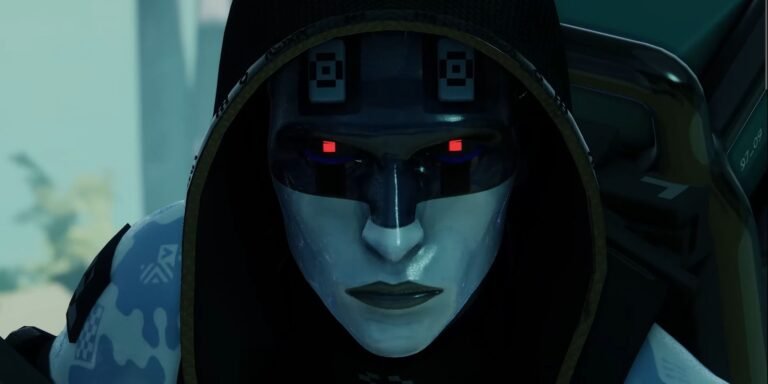
Her name is Oni. Disembodied AI head. Deeply unsettling vibe. Early on, she invites you to consider her “a friend… one you don’t yet remember.” Press X to doubt, frankly. Playing through those interactions — knowing full well that this piece of corporate software lives inside your mechanical skull, guiding you through a graveyard of human failure — generates a specific, low-grade dread that the gunplay alone never quite achieves. Given the shifting economics of live-service titles, the meta-narrative of blindly serving massive corporations to extract wealth feels rather pointed, especially coming from a Sony-owned studio in 2026. The irony isn’t subtle. It doesn’t try to be.
Smashed iMacs, rotting in a drizzle, forever
The Perimeter map deserves its own extended meditation.
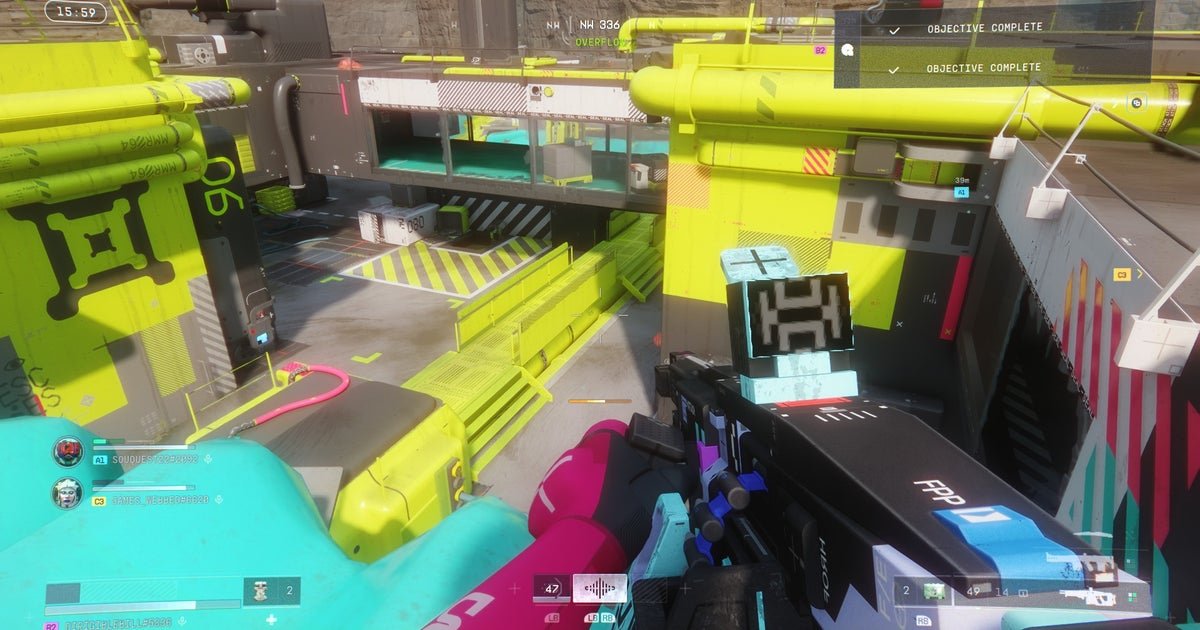
Opening up that zone during the server slam felt like stumbling into a graveyard of smashed iMacs left out in a relentless drizzle — terrain littered with hazard-yellow and electric-blue capacitors jutting from scree and coarse vegetation. As you navigate, it becomes genuinely difficult to determine whether the desolate “natural” geography is growing on top of the circuitry, or whether the circuitry is somehow pushing its way out of the dirt. The ambiguity, in practice, is the whole point.
At first pass, it is a completely fleshless world. Push deeper into the facility, though, and a distinct Gigery lustre bleeds into the curved, gelatinous interiors — bold, colored patches fitting together like an anatomical diagram of a synthetic lung. Organic and mechanical, spliced at the root.
And then there are the locals.
Pustulant, scuttling lifeforms haunt the crevices. They wait inside scarlet egg sacs, ready to ooze up a wall and ambush you mid-firefight, precisely when you’re already trading pulse rifle shots with a rival robot squad. Flood callbacks, obviously — the Halo lineage is impossible to shake. Blast a few of those critters, deploy your Destiny-style specials to obliterate a squad of bot reinforcements, then sprint to crack open a supply crate and goggle at yet more inventory doodads. The loop is relentless. Deliberately so.
Your backpack is the map in miniature
What accumulates in your inventory starts to mirror the map itself — scattered, fractured, each component meaningful in isolation but baffling as a whole. You piece together the backstory from half-empty coffee mugs and still-active terminals scattered across the Perimeter facility. There’s a heavy Forerunner resonance to the abandoned colony vessel premise — that same sense of stumbling through the aftermath of a civilization that peaked, overreached, and dissolved. And those ravening native lifeforms are almost certainly carrying more narrative weight than how satisfyingly they splatter under a light machine gun.
Still, what pulls me toward Marathon most powerfully right now is its function as an accidental visual essay.
We occupy a world that feels annexed by massive server farms and tech monopolies. According to a recent Reuters analysis of the global AI chip market, a single hardware manufacturer currently dictates the pacing of nearly every major technological advancement on earth. Entire digital worlds bloom or collapse when a company like Nvidia adjusts its trajectory — even as the everyday use-case for their principal product remains fiercely contested by the public. The concentration of that kind of power, when you actually sit with it, is genuinely staggering.
Marathon runs on that same festering, chaotic energy.
It deposits you inside a beautifully rendered machine that has completely broken down — and asks you to scurry through the wreckage of a tech utopia gone sour, grabbing handfuls of valuable copper before the whole structure caves in on your head. The cyberbodies, the corporate factions with their menacing acronyms, Oni whispering inside your skull about friendships you can’t remember: when actually tested against the current cultural moment, none of it reads as science fiction. It reads as light extrapolation.
Tiny bug. Enormous, humming ruin. Same as it ever was.
It might just be a video game. But right now, in 2026, it carries the weight of a documentary.
What platforms is the Marathon reboot available on?
Bungie is developing the game as a multi-platform release. The extraction shooter is dropping on PlayStation 5, Xbox Series X/S, and PC, with full cross-play and cross-save functionality baked in across all three platforms.
Do I need to have played the original 1990s Marathon games to understand this one?
Not at all. While the 2026 reboot is set in the same overarching universe — and peppers in deep lore nods for veteran fans — it is designed strictly as a fresh entry point. You play as a Runner (a cybernetic mercenary) navigating entirely new storylines built around planetary extraction and corporate espionage. The old games reward curiosity, but they’re homework you can skip.
Reporting draws from multiple verified sources. The editorial angle and commentary are our own.
About the Author