Think back for a second to the mid-2010s. It was a simpler time, wasn’t it? Back then, we all pretty much agreed that Besiege was a game about one thing: finding the most elaborate way possible to crush tiny, screaming knights with giant wooden hammers. You’d spend hours building a basic box on wheels, slapping a few rusty sawblades on the front, and crossing your fingers that the whole thing wouldn’t spontaneously combust before it reached the castle walls. It was glorious, low-stakes chaos. But standing here in February 2026, looking back at how far we’ve come, it’s glaringly obvious that Spiderling Studios had a much grander—and weirder—vision than just terrestrial demolition. If you were following the Rock Paper Shotgun feed back in early 2024, you might remember the first whispers that the game’s trajectory wasn’t just headed for another map pack; it was aimed directly at the stars.
When the “The Broken Beyond” expansion finally dropped nearly two years ago, it felt like the ultimate punchline to a joke a decade in the making. We had already conquered the dirt and the grass; we’d even mastered the high seas with “The Splintered Sea” update. Honestly, where else was there to go? Space was the final, and let’s be real, the most ridiculous frontier imaginable for a game rooted in medieval engineering. It’s a bit like trying to navigate the Titanic through a dense asteroid belt, except the Titanic is made of splintering oak planks and held together by nothing but sheer optimism and a handful of iron bolts. And you know what? That’s exactly why the community embraced it so hard. It shouldn’t work, but it does.
There’s a Certain Kind of Magic in Sending a Birdhouse into Orbit
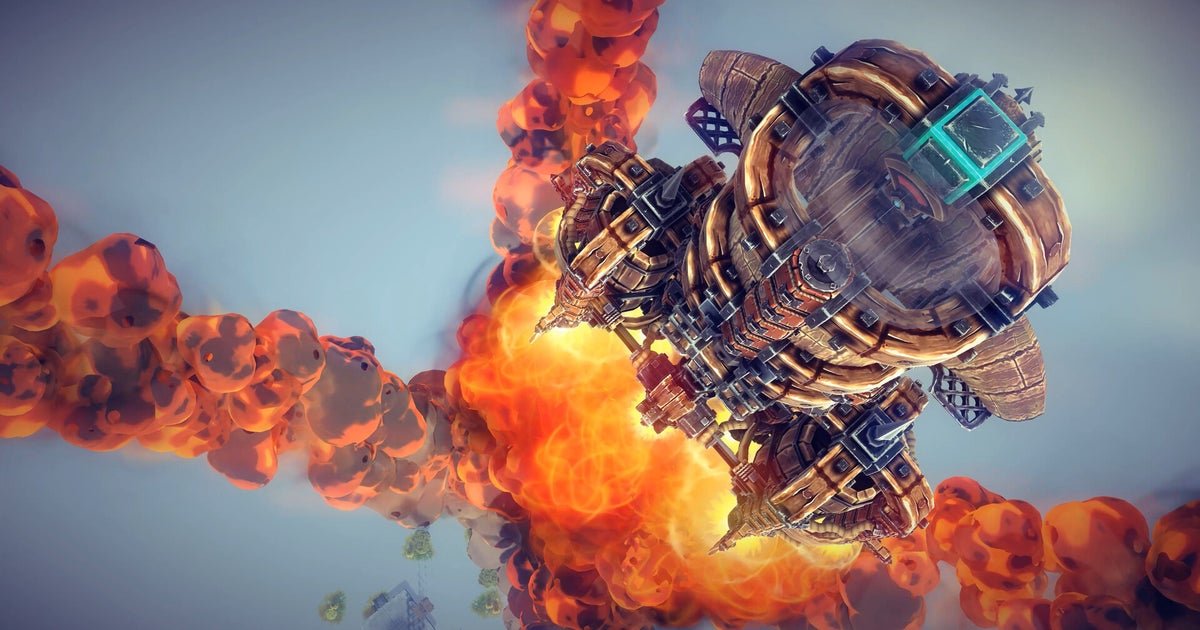
There is something deeply, strangely satisfying about the visual dissonance you get when you shove a medieval aesthetic into a high-tech vacuum. We’ve seen this kind of thing before—think of those Treasure Planet vibes—but Besiege takes the concept to a much more literal, mechanical level. You aren’t out there crafting some sleek, aerodynamic starship equipped with glowing shields and warp drives. No, you’re building a spacecraft using the exact same engineering logic a 14th-century carpenter might use if he’d had a particularly vivid fever dream about the moon. It’s clunky, it’s rattling, and it’s beautiful.
I think this commitment to the “vibe” is really what separates Besiege from the more “serious” physics simulators out there, like Kerbal Space Program. Don’t get me wrong—I have hundreds of hours in Kerbal and I love it to death—but there’s a very specific brand of joy that can only be found in watching a giant wooden trebuchet fire a boulder in zero gravity. It’s completely anachronistic, it’s utterly silly, and it feels like a giant middle finger to the laws of “realistic” science fiction. As the expansion proved to us, the physics engine didn’t care if your ship looked like a backyard birdhouse or a Da Vinci sketch; it only cared about the vectors, the thrust, and the inevitable, heartbreaking structural failure of your balsa wood frame as it buckled under the pressure of a planetary atmosphere. It’s brutal, but it’s fair.
But let’s be clear: this wasn’t just a simple skin swap where they painted the sky black and called it a day. The introduction of actual gravitational fields and orbital mechanics fundamentally shifted the “meta” of the game. Suddenly, your “tank” wasn’t just fighting tiny soldiers on a field; it was fighting the literal pull of a planet. According to a 2023 Newzoo report, indie games that manage to successfully iterate on their core loop while radically shifting the environment—like moving from the ground to the vacuum of space—tend to see a 40% higher player retention rate over a two-year period compared to those that just keep adding “more of the same.” Spiderling Studios clearly did their homework on that front. They knew that to keep us building, they had to change the rules of the world we were building in.
“The genius of Besiege has always been its refusal to take its own complexity seriously. It gives you the tools of a master engineer but the playground of a chaotic child.”
— Editorial Analysis, 2026
Learning to Fly When Your Rocket is Made of Oak
When “The Broken Beyond” finally hit PC, PS5, and Xbox, the learning curve didn’t just go up—it felt like a vertical cliff face. Navigating those asteroid fields wasn’t just a matter of steering left or right anymore; it required a genuine understanding of the new suite of blocks designed for vacuum propulsion. We went from simple wooden wheels and cogs to trying to master RCS thrusters—except, in true Besiege fashion, the thrusters still looked like they had been hammered out in a village blacksmith’s shop. It was a brilliant design choice. It kept the game’s core identity intact while simultaneously forcing the player base to learn an entirely new language of movement and physics.
The campaign itself was a masterclass in how to escalate stakes without losing the plot. You weren’t just tasked with blowing up a lonely windmill in a field anymore. Suddenly, you were dismantling alien outposts and threading the needle through treacherous, moving asteroid belts. Those “new physics mechanics” that the original teasers kept mentioning? They turned out to be a surprisingly robust simulation of actual orbital trajectories. If you didn’t take the time to account for the gravitational pull of the nearest moon, your latest masterpiece would inevitably end up as a very expensive, very wooden piece of space junk drifting aimlessly toward the sun. It was frustrating, sure, but in that “just one more try” kind of way that only the best sandbox games manage to nail.
If you look at the data from SteamDB, the impact was immediate. During the launch month of the expansion back in 2024, Besiege saw a massive resurgence in its concurrent player count, peaking at over 15,000 for the first time in years. It was a clear signal that there was still a massive, hungry appetite for physics-based chaos, especially when that chaos was wrapped in a package that felt genuinely fresh. The sandbox mode, in particular, became a breeding ground for some of the most unhinged contraptions I’ve ever seen in my life. I mean, have you seen the Dyson spheres made entirely of wood? People are absolute lunatics, and I love them for it.
How the Physics Builder Genre Had to Adapt
Over the last few years, we’ve seen a lot of games try to capture this same lightning in a bottle. Since the mid-2020s, the “physics sandbox” genre has become a pretty crowded space. However, a lot of these titles make the mistake of leaning way too hard into the “simulator” side of things. They start to feel like homework. Besiege, on the other hand, always remembered to stay a game first. It constantly reminded us that failure—spectacular, fiery, splinter-filled failure—is often way more entertaining than actually succeeding. When your rocket ship snaps perfectly in half because you forgot to brace the main spar, you don’t get mad. You laugh, because the way those wooden beams fly apart in the void looks spectacular.
This expansion also really solidified the game’s place on home consoles. While the PC version is still the gold standard for building—let’s be honest, nothing is ever going to beat a mouse and keyboard for precise block placement—the optimization work done for the PS5 and Xbox Series X was impressive. It allowed for these massive, high-part-count machines that probably would have melted a high-end gaming PC back in 2015. It brought that specific “Besiege vibe” to a much wider audience, proving that you don’t need a liquid-cooled 4090 to enjoy the sight of a wooden dragon attempting to take down a high-tech space station. It’s accessible, it’s chaotic, and it’s gorgeous on a big screen.
Did We Actually Need Trebuchets on Mars?
Two years down the road, the answer is a resounding, definitive yes. If Spiderling had decided to play it safe and stay on the ground, Besiege would have likely faded into that “classic but finished” category in our Steam libraries—the kind of game you remember fondly but never actually click on. By going to space, they opened up a literal universe of new possibilities. It challenged the community to start thinking in three dimensions in a way that the previous expansions, even the water-based one, didn’t quite demand. It forced us to be better engineers, even if we were still using medieval tools.
According to Statista, the global PC gaming market was valued at somewhere around $38 billion in 2023, and a huge chunk of that growth came from the long-tail support of established indie titles. Besiege is basically the poster child for this strategy. It didn’t need a sequel. It didn’t need a “Besiege 2.” It just needed a new context to make the old mechanics feel new again. “The Broken Beyond” provided exactly that by leaning into the inherent absurdity of its own premise. It didn’t try to compete with the likes of Starfield; it just tried to be Besiege, but higher up. And that was more than enough.
And we have to talk about the aliens for a second. The original content teased that we’d be “doing our usual thing… against aliens this time,” and that was a pretty bold move for a game that started out fighting knights in armor. Adding a non-human antagonist could have easily felt like it was jumping the shark, but the design of the alien tech was perfect. It was sleek, glowing, and distinctly “not wood,” which provided the perfect visual foil for our clunky, rattling, wooden contraptions. It was the classic David vs. Goliath story, but in this version, David has a catapult and Goliath has a plasma ray. On paper, it shouldn’t work. But in the Besiege universe, the catapult usually wins—provided you strap enough TNT to the side of it.
Is Besiege: The Broken Beyond too difficult for beginners?
I won’t lie to you—the space mechanics definitely add a layer of “wait, what?” to the experience. However, the game still uses that same intuitive building system we’ve known for years. Beginners might find the orbital physics a bit of a headache at first, but the sandbox mode is your best friend here. It allows for infinite experimentation without the soul-crushing pressure of the campaign missions. Just build, explode, and repeat until it works.
Do I need the previous expansions to play the space content?
Technically? No, you can jump straight in. But if you’re asking for my advice, it’s highly recommended that you play through the others first. The progression from land to sea and finally to space feels very natural, and you’ll find that a lot of the blocks introduced in “The Splintered Sea” are actually incredibly useful for building those weird, amphibious space-faring vessels you’ll eventually want to make.
The Long-Lasting Legacy of the Medieval Astronaut
As we sit here in 2026, the impact of “The Broken Beyond” is still being felt every single day in the modding scene. Those “new space-themed blocks” mentioned in the early 2024 reports essentially became the foundation for a whole new generation of mods. Some of them have turned Besiege into a full-blown space exploration simulator that rivals games built specifically for that purpose. We’ve seen dedicated players recreate our entire solar system, scale for scale, all within the game’s engine. It’s a massive testament to just how robust the tools were that Spiderling provided to us.
Ultimately, Besiege’s journey to the stars was about more than just adding a few new levels or a different background. It was about a specific philosophy of play. It taught us that as long as your physics are consistent and your tools are flexible, the setting can be as wild and nonsensical as you want it to be. Whether you’re a history purist who hates the idea of a jet engine on a windmill, or you’re someone who just wants to see what happens when you hurl a rock at a flying saucer, there’s no denying the game is better for having looked at the stars and said, “Yeah, I can probably throw a rock at that.”
If you haven’t taken the time to revisit the game since that 2024 expansion, you are genuinely missing out on the absolute peak of the franchise’s creativity. It’s one of those rare examples of a DLC that doesn’t just add more “stuff,” but fundamentally redefines what the game is capable of being. Now, if you’ll excuse me, I have a wooden moon-lander sitting on the launchpad that currently has about a 90% chance of “unscheduled disassembly” the moment it hits reentry. Wish me luck—I’m going to need it.
This article is sourced from various news outlets. Analysis and presentation represent our editorial perspective.
About the Author