There is something inherently unsettling about the ocean at night, isn’t there? It’s not just the absence of light; it’s the sheer, crushing scale of it all. You realize, quite suddenly, that you’re just a tiny speck floating on a vast and completely indifferent canvas. According to the folks over at IGN Video Games, Reanimal—the latest descent into psychological madness from the team at Tarsier Studios—understands this primal, gut-level fear better than almost any game we’ve seen in the last few years. It doesn’t start with a tutorial or a gentle nudge. Instead, it starts with a hole, a group of terrified children, and a boy with a hangman’s noose draped around his neck. It’s not exactly what you’d call a “warm welcome,” but then again, if you’ve spent any time with the Little Nightmares series, you probably weren’t expecting a hug anyway.
The game kicks off with an opening sequence that feels less like a traditional introduction and more like a fever dream you can’t wake up from. You find yourself piloting a small, fragile boat through a fog so thick it feels physical, guided only by the rhythmic, haunting pulse of red buoys. It’s lonely. It’s quiet. It’s deeply, almost suffocatingly atmospheric. And then, out of the mist, you find her: a girl wearing a hare mask. There is no dialogue to explain the situation, just a frantic, violent struggle on the floor of the boat before a tentative, shaky peace is finally reached. “I thought you were dead,” the boy eventually says. It’s one of the very few lines of dialogue you’ll actually get in this game, and it immediately sets a tone of shared trauma that carries through the entire experience. Honestly, by the time I finally reached the credits, I’d almost forgotten how quiet and still that opening was, but that beginning is the absolute key to everything that follows. It anchors the horror in something human.
Leaving the Dollhouse Behind: How Tarsier Found Its Own Voice
Let’s address the elephant in the room: Tarsier Studios and their legacy. After they moved on from the Little Nightmares franchise, there was a lot of skeptical chatter in the industry about whether they could actually capture that same lightning in a bottle twice. Is it possible to replicate that specific brand of dread without the familiar yellow raincoat? Well, Reanimal isn’t just a spiritual successor; it feels like a total refinement of their craft. It’s what happens when a studio stops worrying about the pressures of building a global “brand” and starts focusing entirely on perfecting a very specific type of atmospheric, lingering dread. If Little Nightmares was primarily about the exaggerated fears of a child navigating an oversized adult world, Reanimal feels like it’s about the jagged, permanent scars those fears leave behind once the childhood is gone.
The game is currently available on PC, PS5, and Xbox Series X/S, and to be perfectly honest, the technical leap from their previous work is impossible to ignore. The environments are denser, the lighting feels more oppressive and heavy, and the sense of scale is far more intimidating than anything they’ve done before. You aren’t just navigating a creepy dollhouse anymore; you’re trapped in a world that feels like it’s actively, hungrily trying to swallow you whole. And while the DNA of their earlier work is visible everywhere—the unnervingly long limbs, the distorted, melting faces, the tactile nature of the puzzles—there’s a newfound maturity here. It’s less about the “ooh, look at the scary monster” tropes and more about a lingering, existential question: “Why does this horrible place feel so familiar?”
“Hell is not other people. Hell is yourself.”
Ludwig Wittgenstein (via Reanimal)
That quote, which flashes across the screen early in the journey, isn’t just pretension or window dressing. It’s the entire thesis statement for the game. As you navigate through crumbling industrial ruins and forests made of jagged, skeletal trees, you start to realize that the monsters aren’t just external threats waiting in the shadows. They are physical manifestations of something much deeper and more personal. Interestingly, according to a 2024 Statista report, the survival horror genre saw a significant 12% increase in market share over the last two years. This growth was largely driven by titles that choose to lean into psychological depth and environmental storytelling rather than relying on cheap, predictable jump scares. Tarsier is riding that specific wave perfectly, proving that players are hungry for horror that actually stays with them after they turn off the console.
Shared Trauma: Why You Shouldn’t Play This Alone (Even If You Can)
One of the boldest and most rewarding choices in Reanimal is its heavy focus on co-op gameplay. Sure, you can technically play it alone if you want to, but the game is so clearly designed for two human beings to experience together. I played through the entire thing with a partner, and it fundamentally changed the way I perceived the horror. In an era where local “couch” co-op is often treated as a forgotten relic, a “nice-to-have” feature, or a complete afterthought, Reanimal makes it feel essential to the narrative’s weight. You’re not just two players sharing a screen; you’re two siblings who desperately need each other to survive a nightmare. Whether it’s boosting each other up to a high ledge or one person frantically holding a heavy lever while the other person sprints past a rotating blade, the mechanics constantly reinforce that bond. You feel the stakes because you’re responsible for someone else.
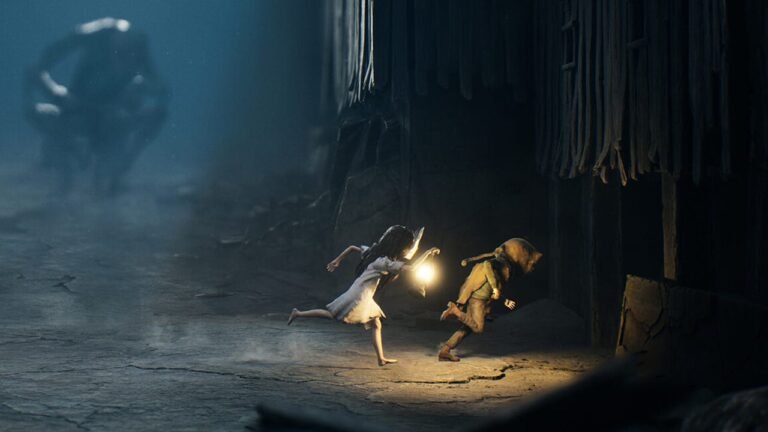
There’s a subtle but absolutely brilliant mechanical difference between the two characters that I haven’t seen discussed enough. The girl has the ability to clip her lantern to her hip, which leaves her hands free to carry objects or interact with the world. The boy, however, has to manually put his lighter away if he needs to use his hands for anything else. It sounds like a tiny, insignificant detail on paper, but when you’re standing in the middle of a pitch-black forest with something growling in the bushes, it becomes a major tactical decision. “Do you want the light, or do you want to carry the gear?” we’d find ourselves whispering to each other. It creates a level of organic communication and tension that a computer-controlled AI just can’t replicate. A 2023 Newzoo report actually found that 46% of gamers across all platforms cite “playing with others” as a primary motivation for their hobby, yet the industry continues to push harder toward solo, live-service models. Reanimal feels like a deliberate middle finger to that trend, and I absolutely love it for that. It values the person sitting next to you on the couch.
Playing with a real person also adds a layer of “human imperfection” that fits the horror genre so perfectly. When your friend panics and accidentally drops the lantern at the exact moment a skinless pig-man starts chasing you, it’s not a “bug” or a mechanical failure—it’s a memory. It makes the successes feel truly earned and the failures feel like a shared, personal tragedy. It’s a constant reminder that we aren’t alone in the dark, even if the dark is trying its absolute hardest to separate us and break that connection. That’s the kind of emergent storytelling you just can’t script.
The Refreshing Silence of a Game That Actually Trusts You
One of the things I appreciate most about Reanimal is its flat-out refusal to treat the player like a child. There is no HUD. There is no mini-map. There are no “press X to win” prompts cluttering up the beautiful, terrible screen. Tarsier trusts you to actually look at the world they’ve built and figure it out for yourself. The camera is often fixed, acting like a director’s eye, showing you exactly what you need to see—or perhaps more importantly, exactly what they want you to see. It’s cinematic in the truest, most artistic sense of the word. You aren’t just playing a game; you’re moving through a carefully composed frame.
The puzzles are elegant because they feel logical within the context of the world. You aren’t hunting for arbitrary “Red Keycards” or glowing “Blue Orbs” to progress. Instead, you’re looking for a missing wheel for a rusted handcar or trying to find a way to drain a flooded, stagnant room. It feels grounded and tactile in a way that many horror games struggle to achieve. But don’t let that apparent simplicity fool you. The tension comes from the environment itself, not from complex menus. When you’re wading through a flooded city and you see a massive, bloated shape moving slowly beneath the surface of the water, you don’t need a tutorial box to pop up and tell you to get to high ground. You just run. Your instincts take over, and that’s a testament to how well-designed this world really is.
Is Reanimal a sequel to Little Nightmares?
Technically speaking, no. It’s a completely brand-new IP from Tarsier Studios. However, it shares a very similar art style, gameplay loop, and haunting atmosphere, making it a spiritual successor in every single way that actually matters to the fans. If you liked their previous work, you will feel right at home here—even if that home is currently on fire and full of monsters.
Can I play Reanimal entirely solo?
Yes, the game fully supports solo play with an AI companion taking over the second role. However, the developers and critics alike strongly suggest that the intended experience is two-player co-op, either locally or online. To fully appreciate the character dynamics and the tactical tension, you really should try to find a partner to dive into the abyss with you.
Finding the Art in the Abhorrent: Designing a Better Nightmare
We really need to talk about the creature design, because it is on another level entirely. Tarsier has always had a specific knack for making things look “wrong” in a way that sticks in the back of your brain long after you’ve stopped playing. In Reanimal, they’ve somehow outdone themselves. There’s a man-pig creature that slithers across the ground like a snake, and a towering, spindly figure with a sagging, expressionless mask for a face that skitters after you like a giant spider. These aren’t just “monsters” in the traditional sense; they feel like perversions of the human form itself. They represent the “animal” side of us—the base, ugly instincts of hunger, fear, and cruelty that we try to hide away. They feel like they belong in this world, which makes them infinitely scarier.
What’s truly impressive is how the game manages to make these horrors look beautiful. The visual composition here is world-class. A ruined city submerged in dark, oily water; an active warzone seen from the low perspective of a terrified child; a dark forest where the trees look like reaching, desperate fingers—it’s all breathtakingly realized. It’s the kind of game where you’ll frequently find yourself stopping just to take a screenshot, only to realize a second later that the “artistic” thing you’re photographing is actually a pile of discarded human “skins.” It’s a weird, dark, and deeply specific aesthetic that Tarsier has essentially trademarked at this point. No one else does “grotesque-but-gorgeous” quite like them.
And then there’s the sound design. Oh, the sound. The low, rhythmic creak of the boat, the wet, heavy slap of something moving in the dark, the ragged, heavy breathing of the children as they hide in a cramped cupboard. It’s an auditory assault that does at least 50% of the heavy lifting when it comes to the scare factor. The soundscape is so layered and intentional that it feels like a character in its own right. If you aren’t playing this with a good pair of noise-canceling headphones, you’re honestly doing it wrong. You need to hear the things you can’t see.
The Verdict: Is Reanimal the Defining Horror Experience of 2026?
As we move further into 2026, it’s becoming increasingly clear that the “AA” space—the middle ground between indie and massive blockbusters—is where the real innovation in gaming is happening. While the massive AAA studios are busy trying to figure out how to monetize every single second of your playtime with battle passes and microtransactions, studios like Tarsier are busy making art. Reanimal doesn’t have a battle pass. It doesn’t have cosmetic DLC (well, aside from some creepy masks you can find hidden in the world). It just has a story to tell—a dark, twisted, and beautiful story about two kids trying to save their friends from a hell of their own making. It’s refreshing to see a game that is so confident in its own vision.
Is it perfect? No, of course not. Sometimes the fixed camera angles can make depth perception a bit tricky during the more demanding platforming sections, and some players might find the “clumsy,” frantic nature of the combat a bit frustrating. But to be honest, those feel like intentional choices rather than mistakes. You aren’t playing as a superhero or a trained soldier; you’re playing as a kid. You’re supposed to feel clumsy. You’re supposed to feel small and vulnerable. That’s the whole point of the experience. If you were powerful, it wouldn’t be horror.
If you’re looking for a game that will stay with you, lurking in the back of your mind long after the credits roll—a game that will make you look at your own “hare mask” and wonder what parts of yourself you’re hiding—Reanimal is it. It’s a triumph of atmosphere and shared experience. Just make sure you bring a friend you trust. It’s dangerous to go alone into the abyss, and it’s much harder to face your own reflection when there’s no one there to pull you back from the edge.
This article is sourced from various news outlets, including IGN Video Games. Analysis and presentation represent our editorial perspective on the current state of horror gaming.
About the Author