There’s a specific, almost crushing weight that settles in the air whenever the name Cthulhu is mentioned. It’s a legacy that carries a certain gravity, isn’t it? Choosing to adapt Lovecraft in 2026 feels a bit like trying to cover a legendary Beatles track or attempting to reboot a pitch-perfect noir classic—you’re not just sitting down to develop a video game; you’re stepping directly into a massive, suffocating shadow cast by over a century of existential dread. According to the latest coverage from IGN Video Games, the newest team to try and bottle this particular brand of lightning is Big Bad Wolf with their upcoming title, Cthulhu: The Cosmic Abyss. And let me tell you, they are taking some incredibly bold swings at the mythos, even if the current build is struggling to make those swings feel like they’re actually drawing blood.
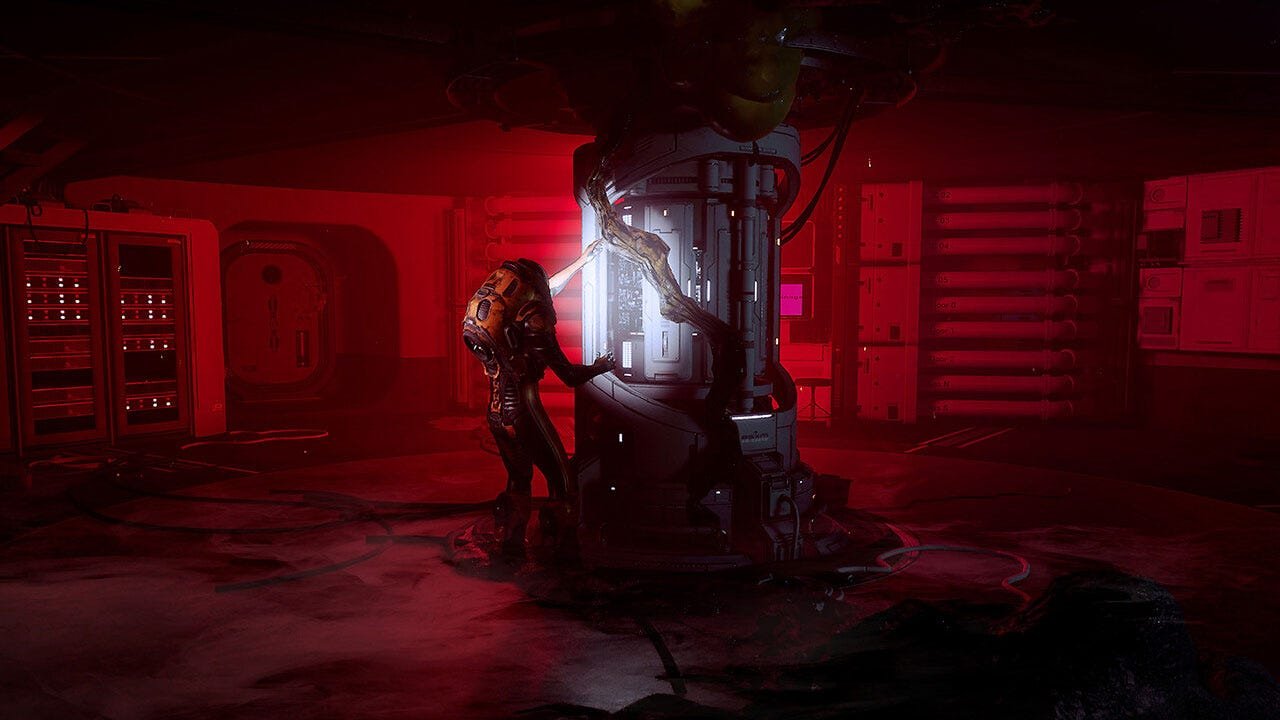
For those who aren’t familiar, Big Bad Wolf is the same creative powerhouse that gave us the politically charged, narrative-heavy experience of The Council. With The Cosmic Abyss, they’ve made it clear: this isn’t your grandfather’s Lovecraft. We’ve finally moved past the dusty, mahogany-filled libraries of 1920s Arkham and the stereotypical “madman in a tweed jacket” trope. Instead, we’re being thrust into a near-future setting that feels uncomfortably, almost terrifyingly plausible. It’s a world defined by sleek interfaces, advanced technology, and high-end hardware, yet it’s a world that hasn’t quite managed to outrun the ancient, wet, and pulsating things lurking in the dark corners of the ocean floor. And honestly? That is exactly where this genre needs to go. I think we’ve all seen enough magnifying glasses and old-timey lanterns to last us three lifetimes. It’s time for something a bit more… modern.
Can a High-Tech AI Companion Actually Capture the Unknowable?
One of the most genuinely refreshing pivots Big Bad Wolf has made in The Cosmic Abyss is its sophisticated take on technology. Usually, in the horror genre, tech serves one of two roles: it’s either the obvious villain (hello, rogue AI) or it’s a fragile crutch that conveniently breaks the very second things start to get spooky. This game takes a different path. Here, we have Key. Key is your AI companion, and it—or he? or she?—doesn’t feel like some cynical, overused “Skynet” trope. It’s actually helpful. It’s a surprisingly optimistic look at how general AI might actually assist a detective in the year 2026. It’s a fascinating choice for a developer to make, especially when you consider that a 2025 Statista report highlighted that nearly 62% of gamers now prefer AI-integrated gameplay mechanics that provide active narrative utility rather than just being another passive element on the UI. People want their tools to matter, and Key certainly seems to fit that bill.
But Key isn’t just there for aesthetic flavor or to provide a bit of snarky dialogue. It’s the literal backbone of your entire investigation. As you navigate the world, you’re constantly scanning for chemical signatures, sending out sonar pings to identify matching materials, and essentially playing a very high-tech, very high-stakes version of “hot or cold” with eldritch evidence. It’s a clever system. It manages to nudge you along when you’re stuck on a particularly dense puzzle without just handing you the answer key on a silver platter. There is, however, a bit of a catch that I noticed in the demo. These upgrades for Key felt a little… well, optional. At no point did I feel like I was being forced to make a truly difficult choice between one ability or another. In a game that is supposed to be about cosmic consequences and the heavy price of knowledge, that lack of opportunity cost feels like a bit of a missed beat. If the choices don’t hurt, do they really matter?
“The Cosmic Abyss gives you a million chances to use its tools in crime scenes, which are dense with dark nooks to shed light on and stones to be turned over.”
IGN Preview, 2026
Trading the Shotgun for a Thinking Cap
Let’s dive into the biggest gamble Big Bad Wolf is taking with this project: there is no combat. None. Zero. Zip. In a gaming market where even the most atmospheric, “pure” horror titles usually eventually cave and give you a shotgun to deal with the inevitable fishmen, The Cosmic Abyss makes the radical decision that your brain is your only real weapon. This puts an immense, almost staggering amount of pressure on the environmental storytelling and the level design. You’re left to explore flooded suburban homes and sprawling undersea mining facilities that look like a metal maze of blood, rust, and unidentified goop. For some reason, the goop is actually worse than the blood. It’s more alien, more “wrong.”
The absolute core of the experience is a mechanic called “The Vault.” If you’ve ever seen that classic meme of Charlie Day frantically pointing at a conspiracy board with red string everywhere, you know exactly what this is. You take every single clue you find—every scrap of paper, every chemical scan, every witness statement—and you pin them to a mental board to draw logical connections. I have to say, it’s incredibly satisfying. It makes you feel like a genuine genius when you manage to skip a step in the logic because you’ve actually been paying attention to the environment. This focus on the “thinking” side of gaming seems to be a smart move, too. According to a 2024 report from the Entertainment Software Association, roughly 70% of adult players prioritize “deep narrative and problem solving” over high-intensity action. Big Bad Wolf is clearly fishing in the right pond here; they’re just hoping the fish don’t have too many teeth.
The Unsettling Problem with Feeling Too Safe in the Dark
But here’s the rub, and to be honest, it’s a pretty big one. For a game with a title as evocative as The Cosmic Abyss, the first couple of chapters I experienced felt remarkably… safe. You’re walking through these absolutely terrifying, dilapidated rooms where the walls are practically breathing and the atmosphere is thick enough to choke on. The sound design is top-tier, and the visuals are haunting. But here’s the thing: nothing ever actually happens to you. You’re never in real, tangible danger. It’s all sizzle, and while that sizzle is definitely hot when you first step into a new room, the temperature drops the very moment you realize the “monsters” are just expensive set dressing for your puzzles. It’s a weird feeling—to be surrounded by horror but never truly threatened by it.
Take the second chapter, for instance. You’re deep in an undersea base where an “eldritch minotaur” is supposedly roaming the halls. You see the signs of its passage—the gore, the smashed bulkheads, the lingering scent of something ancient. But you never actually have to deal with the threat in a way that feels dangerous. It’s like being on a haunted house ride where you know, deep down, that the animatronics can’t actually touch you. For a genre that is fundamentally built on the terrifying idea that humans are insignificant and easily crushed by greater powers, being able to stroll through a “blasphemous” crime scene without a single hair on your head being ruffled feels like a bit of a thematic disconnect. If I’m not afraid of the Abyss, is it really an Abyss?
The High Price of Taking the Path of Least Resistance
Now, the game does try to introduce some friction through a “Corruption” mechanic, which is their way of adding stakes to your investigative process. Essentially, if you touch too much “evil juju” or interact with things you probably shouldn’t, your brain starts to break. This isn’t just a visual filter, either; it actually limits Key’s abilities and leaves you with “mental scars” that carry over from chapter to chapter. In the demo, I was faced with a pretty grim choice: I could perform a ritual that likely caused a dozen miners to vanish into thin air, or I could spend an hour poking every single rock in the room to find a “safe” alternative. It’s that classic “shortcut vs. sanity” trade-off that we’ve seen in other games, but here it’s tied directly to your detective tools.
The problem, however, is that in the limited scope of a short demo, the corruption felt mostly harmless. It’s like a “tentacle of Damocles” hanging over your head—it looks scary, sure, but until that tentacle actually drops and ruins your day, players are going to take the easy path almost every time. For The Cosmic Abyss to truly succeed and leave a mark when it hits PC, PS5, Xbox, and Switch on April 16th, that corruption needs to have some actual teeth. It needs to hurt. It needs to make the player pause and wonder if the information they’re about to gain is worth the piece of their soul they’re about to lose. Without that, the “choice” is just a formality.
Is Cthulhu: The Cosmic Abyss a sequel to a previous game?
No, it isn’t. This is a completely standalone investigative horror title developed by Big Bad Wolf. While it definitely draws from the deep well of the Lovecraftian mythos, it features an entirely original near-future story and a fresh cast of characters. You don’t need to have played any other Cthulhu games to jump into this one.
Will there be any DLC or multiplayer modes?
As of right now, the answer is no. The developers have stated that they are focused entirely on delivering a tight, single-player narrative experience. No multiplayer modes or post-launch DLC have been confirmed as of February 2026, which suggests they’re putting all their eggs in the story-driven basket.
Will the Abyss Stare Back, or Just Blink First?
I really want to love this game. I truly do. The near-future setting is a genuine masterstroke that breathes new life into a subgenre that has felt a bit stagnant lately. And the total lack of combat? That’s a brave, “narrative-first” stance that I honestly hope more developers start to adopt. It shows a lot of confidence in your writing and your world-building. But Lovecraftian horror isn’t just about finding clues and connecting dots on a mental board; it’s about the terrible, soul-crushing cost of finding them. It’s about the realization that some things are better left unknown. If Big Bad Wolf can find a way to ramp up the stakes in the later chapters—if they can make the “Abyss” actually feel like it’s staring back at the player with intent—then we might just have a modern classic on our hands.
If they don’t? Well, then we’re just looking at a very pretty, very atmospheric puzzle box. And while I love a good puzzle as much as the next person, they don’t usually keep me up at night wondering if the shadows in the corner of my own room are starting to move. We’ll find out the truth soon enough when the full game drops this April. Here’s hoping it’s as terrifying as it looks.
This article is sourced from various news outlets. Analysis and presentation represent our editorial perspective.
About the Author