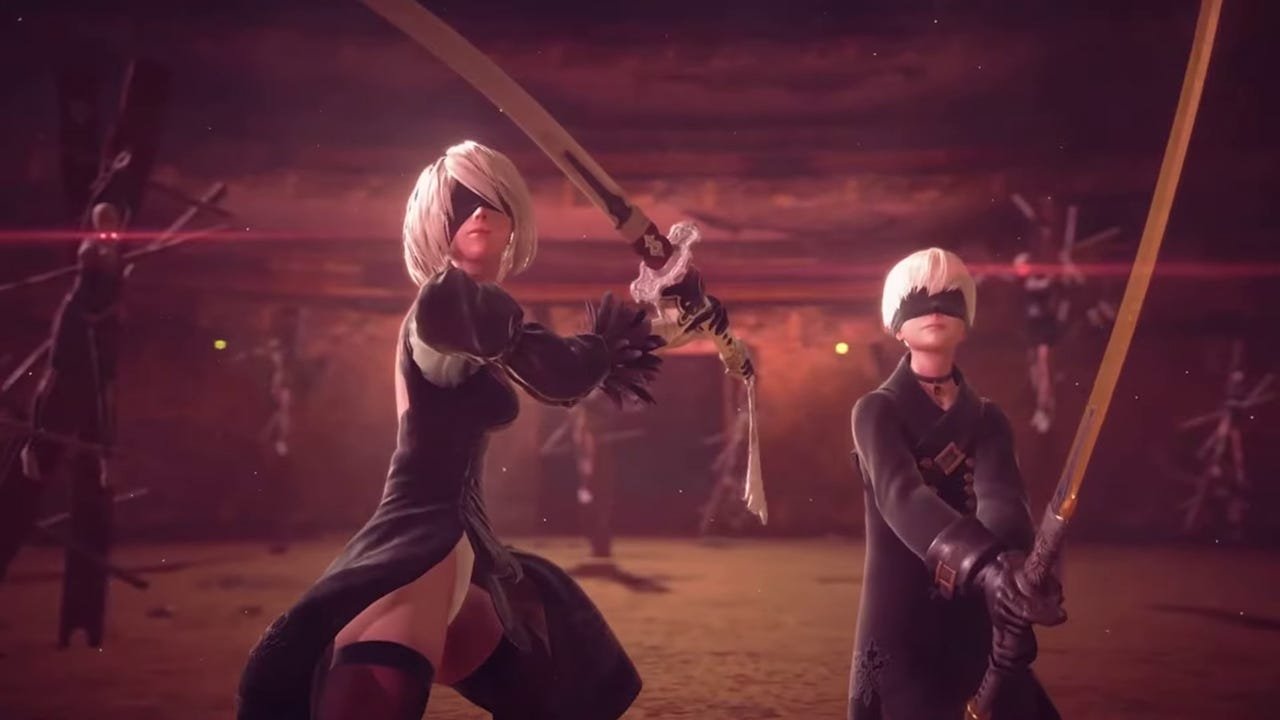
It’s honestly a bit surreal to realize that it’s been nine years since we first stepped into the heavy, gothic boots of 2B and 9S. In the fast-moving world of video games, nine years feels like an absolute eternity—long enough for two entire console generations to shift and for the industry’s “live service” fever dream to rise, peak, and, in many ways, finally start to break. Yet, here we are in 2026, still talking about a game that many critics originally dismissed as nothing more than a “niche sequel to a cult classic.” According to recent data from IGN Video Games, Nier: Automata has officially crossed the 10 million copies sold mark. It’s a staggering achievement, especially for a title that wears its existential weirdness like a proud badge of honor.
I remember the 2017 launch like it happened yesterday morning. Back then, PlatinumGames was the undisputed darling of the action genre, and Yoko Taro was that wonderfully eccentric director known more for his giant moon mask and his habit of deleting player save files for emotional impact than for mainstream success. It was a match made in heaven—or perhaps a very stylish, high-octane version of hell. Square Enix shared the big news this week through a celebratory tweet and a six-minute retrospective video, confirming that the journey of the YoRHa androids has resonated with a far larger, more diverse audience than anyone ever dared to predict during development.
But while we’re all raising a glass to the 10 million milestone, there’s a definitely a bittersweet tang in the air. That same announcement confirmed that Nier Replicant ver.1.22474487139, the 2021 remake, has moved two million copies. Now, those are healthy numbers—the kind that would usually signal to a publisher that a massive, big-budget sequel should be right around the corner. And yet, for the Nier faithful, the wait for a true “AAA” successor has started to feel like a very slow, very hot walk through the Desert Zone without a single fast-travel point in sight.
Beyond the Aesthetic: Why This Story Refuses to Fade Away
How does a single-player, narrative-heavy RPG from 2017 manage to keep selling millions of copies nearly a decade after its debut? It’s not just about the “waifu” culture or the striking character designs, though let’s be honest, those visual hooks certainly helped move units on the PlayStation 4 and PC back in the day. The real secret, I think, lies in the “evergreen” nature of Yoko Taro’s storytelling. According to a 2023 Circana report, “evergreen” titles—games that maintain consistent sales years after launch—often rely on powerful word-of-mouth and deep discounts during seasonal sales on platforms like Steam and the Nintendo Switch. Automata fits that description to a T.
Automata has become the quintessential “you just have to play this” game. It’s the one you recommend to your friend who insists that games can’t be high art, or the one you gift to someone just to see their reaction when the credits roll for the third (or fourth, or fifth) time. It’s a game about philosophy, the soul, and the crushing cycle of life and death, all wrapped in some of the most fluid, satisfying combat PlatinumGames has ever produced. Whether you played it on the original PS4, the Xbox One, or the surprisingly competent Switch port that launched a few years back, the experience has a way of sticking with you long after the power is off.
Interestingly, a 2024 Statista report found that the global action RPG market has seen a 15% year-over-year growth in “legacy” title engagement. This suggests that players are increasingly looking backward at established, complete masterpieces rather than gambling their time and money on the latest $70 seasonal pass. Nier: Automata has benefited immensely from this shift in consumer behavior. It’s a complete, finished package in an era of fragmented, “fix-it-later” releases.
The Endless Tease and the Danger of the Transmedia Sprawl
The celebratory video Square Enix released ends with a cryptic, tantalizing line: “Nier: Automata to be continued…” On paper, that should have us all screaming from the rooftops in excitement. But if you’ve been a Nier fan for the last nine years, you’ve learned that “continued” can mean a lot of things. We’ve seen this story “continued” in almost every medium imaginable except for a major console game. We’ve had the Ver1.1a anime, multiple orchestral concerts that weave in essential side stories, stage plays in Japan, and even a mobile game, Nier Re[in]carnation, which was effectively a direct sequel but has since been shut down, leaving its story in a bit of a digital limbo.
“The story has been told and sequelized through many different mediums at this point… but no full-blown PC/console game has emerged in the last nine years.”
— Rebekah Valentine, IGN
This is what I’ve started calling the “transmedia trap.” When a franchise becomes this successful, publishers often try to spread the IP as thin as possible to capture every cent from every possible demographic. And while the anime was genuinely fantastic and the concerts are a religious experience for fans of Keiichi Okabe’s haunting soundtrack, they aren’t games. There is a specific kind of magic that happens when you are the one holding the controller, making the choice to sacrifice your data to help another player. You just can’t replicate that feeling in a 22-minute TV episode, no matter how good the animation is.
At this point, the teasing note feels a bit like a carrot on a stick. We’ve been here before. We’ve seen the cryptic tweets and the “hints” buried in DLC for other games. At some point, the “To Be Continued” needs to manifest as a 100GB download on a PS5 or a high-end PC, or the fan fatigue is going to start setting in for real. We want to play the story, not just watch it.
The Human Cost of Creative Genius in a Risk-Averse Industry
It’s easy to point the finger at Square Enix for “milking” the franchise, but we also have to consider the human element behind the scenes. Yoko Taro himself has sounded increasingly weary in his recent interviews. He’s gone on record saying he’s tried to get several new projects off the ground, only to have them canceled before they could even be announced. It’s a heartbreaking reality of the modern industry: even if you’ve sold 10 million copies of a certified masterpiece, your next “weird” idea might still be seen as too big a risk by a board of directors looking at a spreadsheet.
The industry in 2026 is a completely different beast than it was back in 2017. Budgets have ballooned to astronomical levels, and the pressure to include “recurring revenue” models is higher than it’s ever been. Would a Nier 3 even be allowed to be as experimental and uncompromising as Automata was? Or would it be pressured by the suits to include a battle pass and “cosmetic pods” for $19.99? Perhaps the reason we haven’t seen a sequel yet is that Taro is actively protecting the soul of the series from the very industry that now wants to exploit its success. If that’s the case, I can’t say I blame him.
I’d honestly rather wait another five years for a game that actually has something profound to say than get a soulless, “AAA” sequel every three years like clockwork. But man, the silence is starting to get awfully loud.
More Than Just Numbers: A Win for the Weird and the Wonderful
Despite my cynical grumbling about the lack of a sequel, we shouldn’t overlook what 10 million sales actually represents in the grand scheme of things. It represents a genuine shift in the gaming zeitgeist. Nier: Automata is a game that breaks the fourth wall, forces you to play as different characters just to see the “real” ending, and explores the existential dread of being a machine programmed to die for a god that doesn’t even exist.
The fact that 10 million people bought into that—that they embraced the “nutty ideas” and the “frenzied, bullet-hell combat”—is a massive victory for creative risk-taking. In an era where many big-budget games feel like they were designed by a committee of marketers and polished by an algorithm, Nier feels human. It’s messy, it’s occasionally nonsensical, and it’s deeply, painfully emotional. It’s everything we say we want from the medium, yet so rarely get.
If Square Enix is paying any attention at all, the lesson shouldn’t just be “Nier makes money.” The lesson should be “Creative freedom makes icons.” Automata didn’t succeed because it followed a trend or checked off boxes on a focus group list; it succeeded because it was so stubbornly, unapologetically itself that the world had no choice but to take notice.
Will there be a Nier: Automata 2?
While Square Enix has teased that the story will “be continued,” there has been no official announcement of a direct video game sequel for PC or consoles as of 2026. For now, the story continues to expand via anime, stage plays, and the lore found in mobile titles.
Is Nier: Automata still worth playing in 2026?
Absolutely. If anything, the game’s themes of AI, existentialism, and what it means to be human are more relevant today than they were at launch. The combat remains top-tier, and the “The End of YoRHa” edition provides a smooth, complete experience on all modern platforms.
Final Reflections: Glory to Mankind (and Good Games)
So, where do we go from here? We wait. We listen to the soundtrack on repeat for the thousandth time. We maybe re-read the “Grimoire NieR” lore books to find details we missed. We celebrate the fact that a weird little game about androids in French maid outfits questioning the nature of existence became a genuine global phenomenon.
Ten million copies isn’t just a number on a corporate spreadsheet; it’s ten million people who had their hearts broken by a robot named Pascal. It’s ten million people who realized that “Ending E” is one of the greatest, most moving moments in the history of interactive entertainment. Whether or not we ever get that shiny AAA sequel we’re all dreaming of, Nier: Automata has already won the long game. It has achieved immortality in the only way that actually matters: by staying in our heads and our hearts long after we’ve turned off the console and put the controller down.
But seriously, Square Enix… give Yoko Taro the budget he needs. We’re more than ready.
This article is sourced from various news outlets. Analysis and presentation represent our editorial perspective.
About the Author