There’s an old, somewhat cynical saying in the comedy world that no joke ever really survives its second telling. If you’ve ever had the misfortune of sitting through a lackluster movie sequel—the kind that desperately tries to catch lightning in a bottle for a second time but only ends up with a soggy cardboard box and a confused audience—you know exactly what I’m talking about. Comedy is, by its very nature, incredibly fragile. It thrives on the element of surprise, the sudden subversion of what we expect to happen, and a very specific, almost rhythmic kind of momentum. When you try to manufacture that magic again, you often end up with something like Zoolander 2 instead of the rare, glorious success of a 22 Jump Street.
According to recent insights from IGN Video Games, High On Life 2 finds itself caught in this exact type of gravitational pull. It is a game that clearly, almost desperately, wants to evolve beyond its predecessor. And to be fair? In some mechanical ways, it actually manages to do just that. But in the messy transition from being a “surprise” indie-style sleeper hit to a full-blown, high-stakes franchise, it feels like some of the original’s scruffy, unpolished charm has been traded in. In its place is a narrative that feels like it’s trying just a little bit too hard to prove it’s still funny. Don’t get me wrong—it’s still a total riot at times—but the “high” isn’t quite as pure as the first hit.
The game, developed by the team at Squanch Games and currently available across PC, PS5, and the Xbox Series X/S, picks up pretty much right where we left off. Or, at the very least, it makes a valiant effort to. After a breakneck, chaotic intro that does its best to recap the first game’s absolute absurdity for anyone who might have missed it, we’re thrust headlong into a brand-new conflict. This time around, instead of taking on a galactic drug cartel, we’re squaring off against a massive, soul-crushing pharmaceutical corporation. It’s actually a pretty clever pivot by the writers—trading the well-worn “drugs are bad” trope for a more modern “big pharma is worse” angle. This shift gives the roughly 10-hour campaign a slightly more grounded satirical edge—if you can even use the word “grounded” for a game like this. But as I spent more and more time in this neon-drenched world, I couldn’t help but notice some significant cracks forming in the foundation.
The Sentient Skateboard is the Upgrade I Didn’t Know I Needed (Until It Started Swearing at Me)
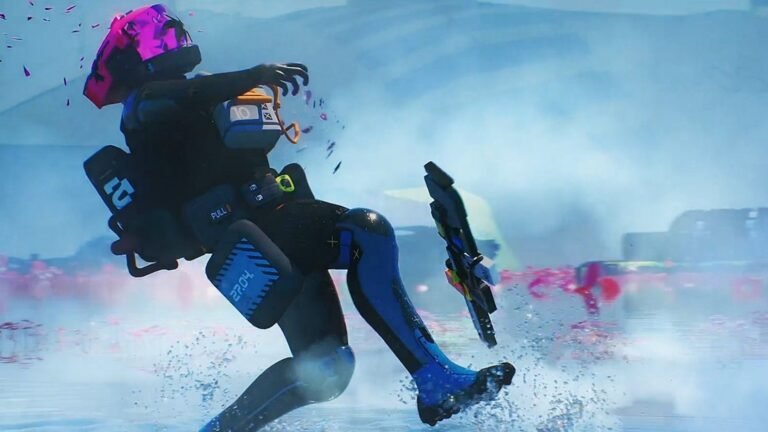
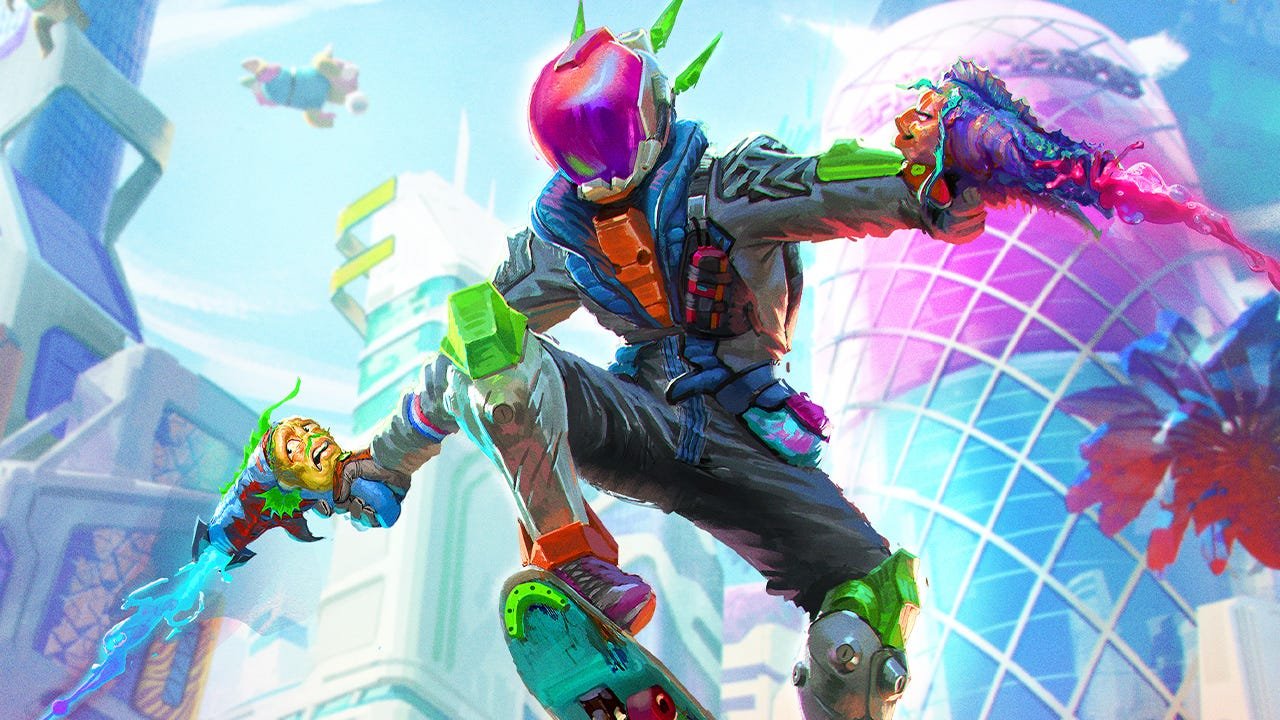
If there’s one thing High On Life 2 gets absolutely, undeniably right, it’s the way you move through the world. Let’s be honest: in the first game, getting from point A to point B could sometimes feel a little… well, sluggish. It was fine, but it wasn’t exactly thrilling. This time? They’ve given us a skateboard. And it’s not just some inanimate piece of wood; it’s a sentient, foul-mouthed travel companion that completely redefines how you interact with every single inch of the environment. You’re no longer just trudging through alien landscapes; you’re grinding rails, wall-riding, and catching massive air like you’ve been dropped into a neon-soaked, R-rated fever dream of a Tony Hawk’s Pro Skater level. It changes the entire “vibe” of exploration in a way that feels fresh and, frankly, essential.
It’s a bold mechanical shift, and it’s one that seems backed by industry data. A 2024 Statista report highlighted that the action-adventure genre accounts for over 30% of global video game sales, largely because successful developers are constantly iterating on core movement mechanics to keep players from getting bored. Squanch Games clearly took that lesson to heart. The skateboarding feels fluid, responsive, and totally integrated into the world. It turns every level into a giant playground, making the simple act of traversal one of the absolute highlights of the entire experience. I’ll be honest—I can’t imagine going back to the first game’s slower pace after experiencing this. It’s a literal game-changer.
But—and there is almost always a “but” when we’re talking about this game—the skateboard doesn’t always play nice with the combat systems. When you’re forced to juggle high-speed rail grinding with the already chaotic, projectile-heavy gunplay, the screen can quickly devolve into what some might call an absolute “diarrhea of pixels.” It’s overwhelming. The game expects you to never stop moving, but the combat arenas are frequently claustrophobic, cluttered with odd bits of geometry that enemies (and sometimes you) get stuck behind. It’s a strange paradox: the game gives you the tools to move like a literal god of the skatepark, but then frequently traps you in rooms where you’re constantly bumping into the metaphorical furniture. It’s exhilarating, sure, but it’s also exhausting.
The Burden of the Punchline: When Talking Guns Stop Being Quite So Funny
Of course, we have to talk about the real stars of the show: the Gatlians. The talking guns are back in full force, and I have to say, the new additions to the roster are genuinely fantastic pieces of character design. We’re introduced to Travis, a down-on-his-luck pistol voiced by the always-hilarious Ken Marino. His personal character arc—which, in a classic Squanch twist, involves reuniting with his estranged wife to unlock a dual-wielding mechanic—is easily one of the most satisfying and genuinely funny parts of the entire game. Then there’s Sheath, a burst-fire weapon with a “trick hole” harpoon attack that’s just as useful for solving platforming puzzles as it is for impaling space-skeletons. The creativity on display with the weapons is still top-tier.
And yet, despite the great voice acting, the writing itself feels a bit… uneven this time around. The first game worked so well because the very concept of talking guns was so fresh, bizarre, and unexpected. But now? The novelty has started to wear off. We know the schtick. We’re used to the weapons screaming at us. To compensate for that lost “wow” factor, the sequel leans much more heavily into long-winded monologues and “tell, don’t show” storytelling. There are far too many moments where the game stops dead in its tracks just to explain a joke or a character’s motive, which is pretty much the ultimate sin in comedy. It feels a bit like being in a D&D campaign where the DM is trying so hard to make sure you see his “really cool twist” that he forgets to actually let the players play the game.
“High On Life 2 is at its best when it’s trying weird and creative things, like a boss fight that takes place inside your own settings menu, but it falters when it tries to explain why those things are funny.”
Editorial Analysis, February 2026
That boss fight mentioned above, by the way, is a total masterclass in meta-humor. Voiced by the legendary Richard Kind, the boss literally invades your user interface, messing with your mouse sensitivity and volume settings while you’re desperately trying to line up a shot. It’s frustrating, it’s hilarious, and it’s exactly the kind of fourth-wall-breaking madness I wanted more of. It’s these specific flashes of brilliance that keep you pushed through the experience, even when the broader narrative starts to feel like a random series of curse words thrown together in a desperate search for a punchline that never quite arrives.
Technical Debt and the Struggle to Keep the Frame Rate Up
We really need to have a serious conversation about the game’s performance. As of February 2026, we’ve come to expect a certain baseline level of polish from major releases, but High On Life 2 feels, at times, like it’s held together by little more than duct tape and good intentions. During my time with the game, I hit several significant framerate dips that actually froze the screen for seconds at a time—which is a nightmare in a high-speed shooter. There were more than a few bugs that required me to reload my last checkpoint just to progress, and the sheer amount of visual “noise” on the screen often made it difficult to tell what I was even supposed to be looking at or shooting.
According to a 2025 analysis of digital entertainment trends, player patience for this kind of technical instability has reached an all-time low. Over 60% of players now report that they will completely abandon a new title within the first week if game-breaking bugs aren’t addressed immediately. While Squanch Games has promised a robust day-one patch, history has shown us that these kinds of deep-seated optimization issues rarely just vanish overnight. It’s a real shame, honestly. When the game is actually running smoothly—when you’re soaring through the air on your board and your shotgun (perfectly voiced by J.B. Smoove) is screaming words of encouragement—it’s an absolute blast. But those moments of pure fun are too often interrupted by a stuttering engine and technical hiccups that pull you right out of the experience.
Is it a Worthy Follow-Up or Just a Second Helping?
So, where does that actually leave us? At the end of the day, High On Life 2 is a classic example of the “more of the same, but different” sequel. It doubles down on the chaos and the movement, which I think is a huge win for the series. The addition of the skateboard is a genuine stroke of genius, and I honestly hope other developers take note and steal the idea for their own games. But the writing lacks the tight focus of the original, and those technical issues are becoming increasingly hard to ignore in the current gaming landscape. It’s a game that seemingly thrives on its own messiness, but sometimes that messiness gets in the way of the actual fun.
If you absolutely loved the first game, you’re going to find plenty to enjoy here. The new Gatlians are fantastic, the meta-humor still hits the mark occasionally, and the world is just as vibrant, gross, and imaginative as ever. But if you were coming into this hoping for a more polished, refined, and sophisticated experience, you might find yourself wishing they’d spent a little less time writing jokes and a little more time stabilizing the frame rate. It’s a fun ride, for sure, but you might want to bring your own motion sickness pills—both for the high-speed skateboarding and the occasional “absolute diarrhea of pixels.”
Is High On Life 2 coming to Nintendo Switch?
While the game has officially launched on PC, PS5, and the Xbox Series X/S, we haven’t seen an official announcement for a Nintendo Switch port just yet. Given the current performance struggles on much more powerful hardware, a Switch version would likely require some pretty significant optimization work or perhaps a cloud-based release to even be playable.
Do I need to play the first game to understand what’s going on in the sequel?
Not necessarily, though it helps. The game features a very fast-paced intro that tries to recap the major plot points, but you’ll definitely have a better appreciation for returning characters like Gus—and the general weirdness of the world-building—if you’ve spent some time with the original first.
How long is the campaign in High On Life 2?
If you’re just sticking to the main story, it’ll take you roughly 10 hours to wrap things up. However, if you’re a completionist looking to track down every last collectible and finish every bizarre side quest (including that infamous bridge troll mission), you can probably expect to spend closer to 15-18 hours in this world.
This article is sourced from various news outlets. Analysis and presentation represent our editorial perspective.
About the Author