Look, I’ll be straight with you – when Capcom announced another Monster Hunter game, I rolled my eyes so hard I nearly saw my own brain. “Here we go again,” I thought, “another grind fest where I’ll spend 40 hours just to craft a slightly better sword.” But then something weird happened during Mission 2-1 (A Looming Shadow) when I was tracking this absolute unit called Balahara through the Oilwell Basin. My HP was ticking down from the heat, I was chugging Cold Drinks like a frat boy at spring break, and this massive leviathan just… disappeared into a sand pit. I circled around for a solid three minutes before realizing it was UNDER me, waiting to ambush. When it erupted from the sand, my character got launched so hard I actually jumped in my chair. That’s when it clicked – this wasn’t just another Monster Hunter reskin. This was something different. I’m writing this after pumping about 18-20 hours into Monster Hunter: Wilds on my RTX 4060 rig (paired with an Intel i7-12700 and 16GB RAM, running the game on Ver 1.04). Full disclosure: I’m a casual gamer who mainly plays when I’ve got time between work and, you know, actual life. So if you’re looking for some hardcore speedrunner perspective, this ain’t it. This is the view from someone who expected to bounce off this game in five hours and instead found myself setting alarms to hunt one more monster before bed.
First Impressions After 10 Hours
Going into Wilds, my expectations were basically “Monster Hunter World but with better graphics and probably more confusing menus.” The series has this reputation for being impenetrable to newcomers, right? You need a PhD in Monster Physiology just to understand which end of your weapon does the damage.
What actually surprised me was how much smoother the onboarding felt. That first mission (Desert Trotters) where you hunt the Chatacabra? It’s basically a guided tutorial that doesn’t feel like you’re being spoon-fed. The game just drops you in the Windward Plains, gives you a weapon, and says “go bonk this amphibian thing with the sticky tongue.” No hour-long cutscene about the ancient prophecy or whatever. You’re hunting within ten minutes.
The Seikret mount completely changed my expectations too. In previous Monster Hunter games, traversal was this tedious slog where you’d spend half your playtime just running to the monster. Now? I’m zipping across the map, using items while riding, and the mount actually feels like a companion rather than just a vehicle. My buddy who’s deep into the MH community warned me that purists were complaining about this being “too casual,” but honestly? Those people can fight me. Anything that reduces the boring parts so I can get to the actual hunting faster is a win in my book.
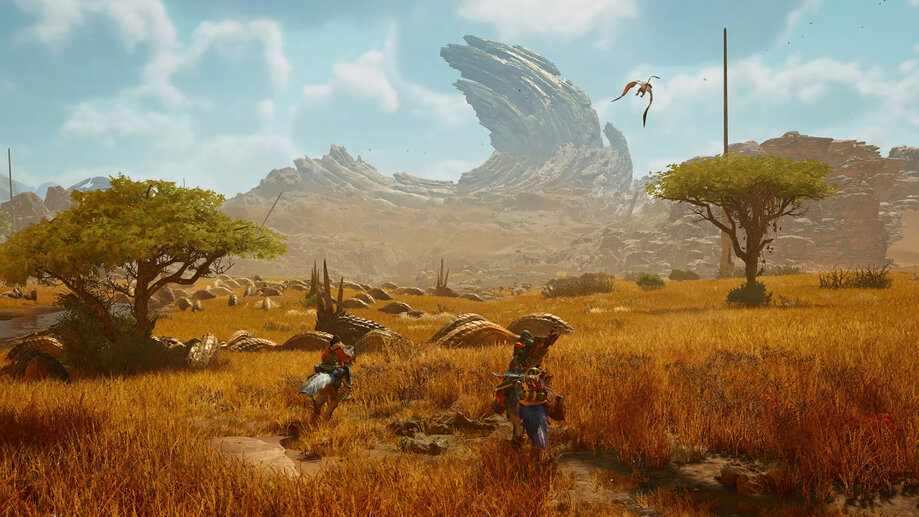
The graphics on my RTX 4060 were… okay, look, they’re not going to blow your mind if you’ve been playing latest stuff. I’m running High settings (not Ultra – my 16GB RAM starts sweating on Ultra) and getting a pretty stable 75-90 fps in most areas. The Scarlet Forest looks gorgeous with all the red foliage, but the Windward Plains can feel a bit empty and samey. Still, when a monster like Quematrice lights up with fire effects during combat, it’s pretty damn satisfying to watch.
What Actually Works
Focus Mode is a Game-Changer
I can’t stress this enough – the new Focus Mode mechanic saved this game for me. Traditionally, Monster Hunter combat felt like I was swinging a pool noodle at a very angry mountain that may or may not have a weak point somewhere. Focus Mode lets you actually TARGET specific wounds and monster parts with precision.
There’s this mission in Chapter 1 where you fight Lala Barina (the giant spider thing in the Scarlet Forest), and I was using the Charge Blade – my go-to because it makes me feel like I’ve any idea what I’m doing. Without Focus Mode, I’d be wildly swinging at its legs hoping something breaks. WITH Focus Mode, I could specifically target the web sacs on its abdomen, break them, and suddenly it couldn’t spam those paralysis webs anymore. That moment of “oh THAT’S how you’re supposed to fight this thing” was genuinely satisfying.
The system isn’t perfect – there’s a weird bug where sometimes the Focus Mode reticle just… disappears mid-fight. Happened to me three times during the Congalala hunt (yes, the farting monkey, don’t ask). I had to toggle it off and on again to fix it. Annoying? Absolutely. Game-breaking? Nah.
Weapon Swapping Adds Actual Strategy
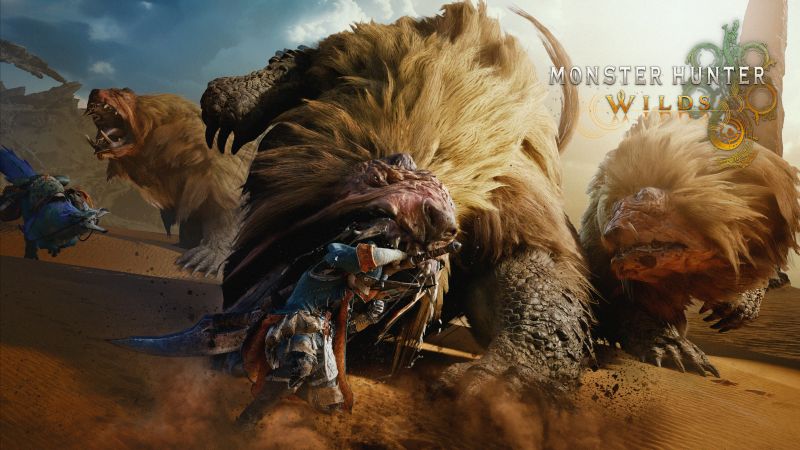
Being able to carry two weapons on your Seikret is brilliant and I don’t understand why this wasn’t always a thing. I typically run Great Sword (for big chunky damage) and Switch Axe (for when I need to be more mobile). During the Doshaguma pack hunt – which, by the way, is absolute chaos with three of these bears ganging up on you – I could switch between weapons based on whether I was fighting one isolated or dealing with the pack.
The cool part is this encourages experimentation. I picked up the Insect Glaive for the first time ever because I knew I could fall back to my Great Sword if I hated it. Turns out the Insect Glaive is stupid fun for aerial attacks, especially against tall monsters like Uth Duna. Would I’ve tried it if it meant committing to an entire hunt with an unfamiliar weapon? Probably not.
The Forbidden Lands Actually Feel Alive
Here’s something I didn’t expect to care about: the environmental storytelling. The whole setup about this region being cut off from the Guild for a thousand years, the White Wraith mystery, Nata’s backstory – it’s surprisingly engaging for a game series that historically treated plot as an afterthought.
The weather system isn’t just window dressing either. When those extreme weather shifts hit during a hunt, it changes the entire dynamic. I was fighting a Quematrice in the Windward Plains when a sandstorm rolled in. Visibility dropped to basically nothing, my Seikret got spooked, and I had to rely on audio cues to dodge fire attacks. It was tense in a way that felt organic, not scripted.
The dynamic pop-up camps are clutch too. Being able to restock mid-hunt without trudging back to base camp? Chef’s kiss. Though I did encounter a hilarious glitch where my camp spawned partially inside a rock formation and I got stuck trying to access the item box. Had to abandon the quest and restart. Not ideal when you’re 20 minutes into a tough hunt.
The Frustrating Parts
The Progression Gating is Annoying
Okay, this drives me nuts. The game progressively unlocks features like the Smithy, Cooking, and Multiplayer through story missions. I get the tutorial logic, but I’m 8 hours in and I still can’t access all the crafting options because I haven’t hit the right story beat yet? Come on.
I wanted to craft some Fire weapons after farming Quematrice materials (because I heard they’re good against later monsters), but the specific upgrade path was locked behind Mission 1-6 or something. So I had to push through story content I wasn’t super interested in just to unlock basic crafting. For a game that’s supposedly about player freedom and hunting what you want, this feels unnecessarily restrictive.
Environmental Hazards Get Old Fast
Remember when I praised the environmental mechanics? Yeah, that praise has limits. The Oilwell Basin’s constant HP drain and Iceshard Cliffs’ stamina depletion are interesting the first time. By the fifth hunt in these areas, it’s just tedious inventory management.
I burned through so many Cold Drinks and Hot Drinks that I started farming the materials just to keep up. It’s not challenging – it’s busywork. There’s a difference. And if you forget to restock before a hunt? Hope you enjoy carting back to camp mid-fight or just… dying from the environment instead of the actual monster. Very cool, much fun.
Also, the Iceshard Cliffs have this thing where your stamina cap decreases faster, which means you’re constantly eating rations. I get that it’s “realistic” or whatever, but it just makes fights drag because I’m spending more time managing meters than actually fighting.
Performance Hiccups at the Worst Times
On my RTX 4060 setup, the game mostly runs fine, but there are these weird frame drops that seem to happen during the most critical moments. I’m talking about sudden dips from 85 fps to 45 fps right when a monster is winding up for a big attack. It’s happened enough that I don’t think it’s coincidence – something about the attack animations or particle effects just tanks performance briefly.
Loading times between areas are also inconsistent. Sometimes it’s 5-7 seconds (totally fine), other times it’s pushing 15-20 seconds, and I’ve no idea why. I’m running the game off an SSD, so it’s not a hardware issue on my end. My guess is it’s related to the smooth map transitions, but whatever the cause, it’s noticeable and breaks immersion.
The file size is also chunky – sitting at around 140GB on my drive. For a game that I play casually, that’s a hefty commitment when I’ve got other stuff installed.
Real Talk: The Monetization
Let’s talk money because this is where Monster Hunter: Wilds gets interesting. It’s a premium game with standard AAA pricing – we’re looking at $70 for the base version. No gacha, no loot boxes, no pay-to-win nonsense. The only microtransactions are cosmetic DLC (hairstyles, stickers, armor skins) which is… honestly fine? I don’t love that cosmetics aren’t just unlockable in-game, but I’ll take cosmetic DLC over predatory mechanics any day.
The real monetization model seems to be the live-service approach with Title Updates. The research mentions we’re already on Version 1.04 and Title Update 4, which suggests regular content drops post-launch. Based on how Monster Hunter World and Rise handled this, we’re probably looking at new monsters, quests, and gear added every few months. Some will be free, some might be paid expansions.
Here’s my honest take: the $70 price tag is steep, especially for casual players. If you’re someone who’s going to sink 100+ hours into this, min-maxing builds and farming endgame content, it’s absolutely worth it. For me, as a casual who’s mainly interested in the campaign and maybe some post-game hunts? It’s borderline. I don’t regret the purchase after 20 hours, but I can see myself dropping off once I’ve seen most of the monsters and completed the main story. The cosmetic DLC hasn’t tempted me at all – my hunter looks fine in the default gear, and I’m not paying extra for a new haircut.
Would I recommend spending on this? If you’re a Monster Hunter fan, you already bought it. If you’re new to the series and curious, maybe wait for a sale or try it on a friend’s account first. The game doesn’t pressure you to spend beyond the initial purchase, which is refreshing, but $70 is still $70.
Comparing to Similar Games
The obvious comparison is Monster Hunter World and Monster Hunter Rise. Wilds feels like it’s trying to split the difference between World’s weighty, grounded combat and Rise’s more arcadey, mobility-focused approach. The Seikret mount is basically Rise’s Palamute but with more functionality. The Focus Mode is new, but the core loop is still “track monster, fight monster, carve parts, craft gear, repeat.”
Where Wilds pulls ahead is the environmental integration. The Forbidden Lands feel more dynamic than World’s Ancient Forest or Rise’s Shrine Ruins. The weather system, the pop-up camps, the smooth story integration – it all adds up to a more cohesive experience… But if you bounced off previous Monster Hunter games because of the grind or the complexity, Wilds probably won’t convert you. It’s more accessible than older entries, but it’s still very much a Monster Hunter game.
The other comparison is something like Dauntless, the free-to-play Monster Hunter-like. Wilds blows it out of the water in terms of production value, monster variety, and depth. But Dauntless is free, and Wilds is $70. If you’re on a budget and just want to experience the hunting gameplay loop, Dauntless is a viable alternative. If you want the premium experience with all the bells and whistles, Wilds is the move.
Bottom Line + FAQ
After 20 hours, Monster Hunter: Wilds has earned my respect despite my initial skepticism. It’s not perfect – the progression gating is annoying, environmental hazards overstay their welcome, and the $70 price tag is a barrier for casual players. But the core hunting loop is satisfying, the new mechanics like Focus Mode and weapon swapping add genuine depth, and the Forbidden Lands setting kept me more engaged than I expected. If you’re a series veteran, this is an easy recommendation. If you’re new and willing to invest the time (and money), Wilds is probably the most approachable entry point the series has ever had. Just expect to spend your first few hours learning systems and your next hundred trying to craft that one specific armor set.
Can I play this solo or do I need friends?
Completely soloable, and that’s how I’ve played all 20 hours so far. The game scales monster HP based on whether you’re solo or in a group, so you’re not gimped for playing alone. That said, some of the tougher hunts (especially the pack fights like Doshaguma) would probably be easier with teammates. Multiplayer unlocks through story progression though, so you can’t jump into co-op immediately.
How’s the performance on mid-range PCs?
On my RTX 4060 with an i7-12700 and 16GB RAM, I’m getting 75-90 fps on High settings in most areas. There are frame drops during big particle effects (down to 45 fps sometimes), but it’s playable. Ultra settings made my RAM sweat, so I’d recommend High for similar specs. Loading times vary between 5-20 seconds depending on the area.
Is the grind as bad as older Monster Hunter games?
It’s still grindy, don’t get me wrong. If you want to craft a full armor set, expect to hunt the same monster 5-8 times for all the materials. But the Seikret mount and streamlined gathering make it less tedious than before. The weapon swapping also means you can experiment without fully committing, which reduces the “I wasted 10 hours grinding for a weapon I hate” factor.
What’s the deal with the environmental damage in Oilwell Basin and Iceshard Cliffs?
The Oilwell Basin (hot zone) drains your HP over time unless you drink Cold Drinks. Iceshard Cliffs (cold zone) depletes stamina faster and reduces your max stamina. Honestly? It’s more annoying than challenging after the first few hunts. Stock up on the appropriate drinks before heading into these zones, or you’ll spend the whole fight managing meters instead of fighting.
Worth $70 or should I wait for a sale?
If you’re a Monster Hunter fan or willing to sink 50+ hours into the game, $70 is fair for the amount of content. For casual players like me who’ll probably tap out after the main story and some post-game hunts, it’s steep. I’d say wait for a sale unless you’re really excited about the series. The game isn’t going anywhere, and a few months down the line you might snag it for $50 or less.
About the Author