<a href="https://assets-prd.ignimgs.com/2026/02/09/wuthering-heights-thumb-1770676492032.jpg?width=1280&format=jpg&auto=webp&quality=80" target="_blank" rel="noopener">Image Source</a>
Emerald Fennell is nothing if not consistent. She’s built a whole brand out of neon lights, provocative themes, and gorgeous people making truly terrible life choices in architectural masterpieces. But with her latest swing at the classics, it feels like she might have finally met her match in the bleak, wind-swept hills of Yorkshire. According to IGN All, the new “Wuthering Heights”—and yes, the quotation marks are apparently part of the official title—is hitting theaters on February 13. It’s already causing a bit of a stir among the literary faithful, and honestly? Not the good kind.
Back in 1850, Charlotte Brontë had to step in and remind the world that her sister Emily was the real genius behind the madness, noting that the book’s “import and nature were misunderstood.” Fast forward nearly two centuries, and it feels like we’re right back where we started. Fennell’s adaptation isn’t just “fast and loose”; it’s a total departure from the soul of the source material. It’s less of a Gothic masterpiece and more of a “Gothic Barbie Dreamhouse” that swaps generational trauma for something that looks suspiciously like high-end fan fiction.
When “Vibes” Collide with Victorian Trauma
Look, we all knew this was coming. After the viral success of Saltburn, it was inevitable that Fennell would bring that same “vibe-over-everything” energy to the Moors. But there’s a fundamental problem with treating Wuthering Heights like a glossy music video. The original novel is brutal. It’s an unflinching look at class, racism, and a love so toxic it literally haunts the next generation. It’s dirty. It’s mean. It’s definitely not meant to be “fun.”
Fennell, however, seems to have traded the grit for glitter. By opening the film with a public hanging treated like a spectator sport—complete with kids laughing at a “stiffy”—she sets a tone that feels more like a cynical Gen Z dark comedy than a Victorian tragedy. It’s a choice, certainly. But it’s a choice that strips away the weight of the Earnshaw family’s misery. When you lean this hard into the “edgy” and the sexualized, you lose the quiet, creeping horror that makes the book so enduring.
And clearly, there’s a method to the madness. According to a 2023 Statista survey, nearly 60% of moviegoers aged 18-34 say visual aesthetic is the primary reason they go to the theater, often outweighing things like plot fidelity. Fennell understands this data perfectly. She’s making a movie for the Instagram era, where a single shot of Margot Robbie looking ethereal in a period dress matters more than the actual dialogue. But at what cost? When you prioritize the “look” over the “feel,” you end up with a beautiful shell that has nothing inside.
“The immature but very real powers revealed in Wuthering Heights were scarcely recognised… Its import and nature were misunderstood.”
— Charlotte Brontë, 1850
A Mid-life Crisis on the Moors? The Casting Conundrum
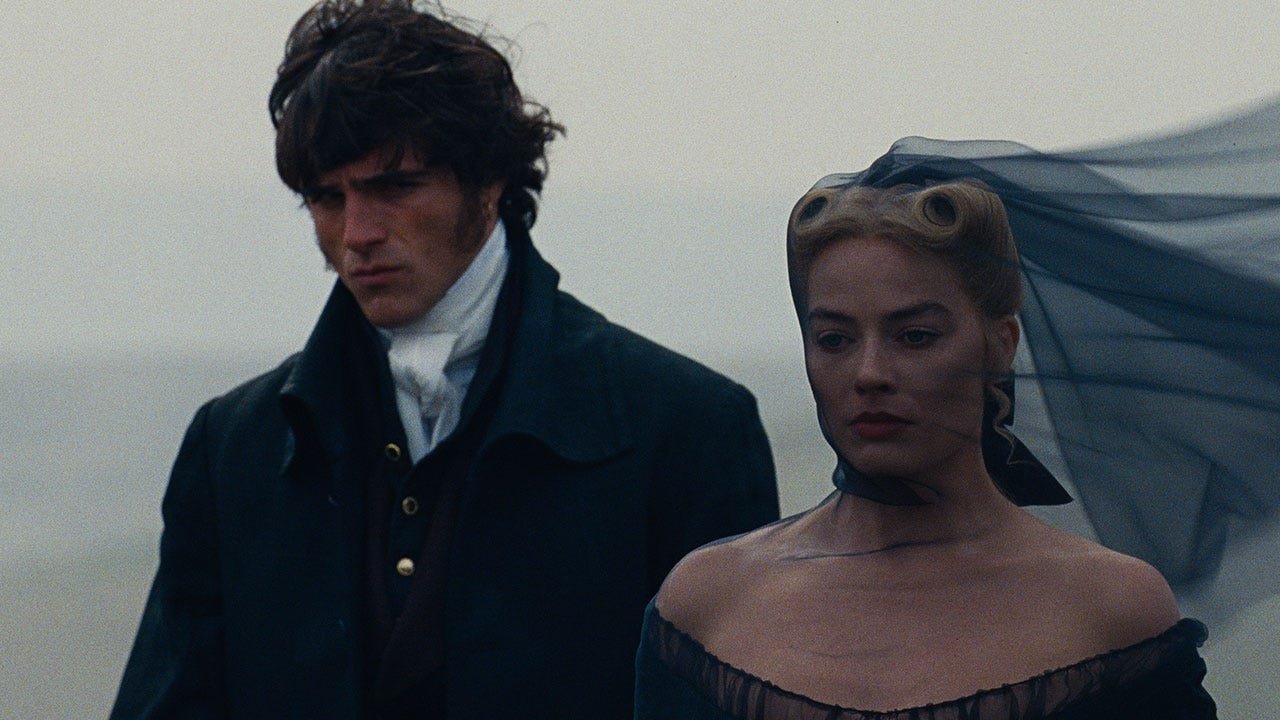
We need to talk about the casting, because it’s the elephant in the room—or rather, the very attractive, very 30-something elephant on the Moors. Margot Robbie is a generational talent, and Jacob Elordi is currently the internet’s favorite leading man. But casting them as Catherine and Heathcliff feels like a fundamental misunderstanding of who these characters are. Catherine and Heathcliff are defined by their youthful recklessness; they are teenagers who make world-shattering mistakes because they simply don’t know any better.
Robbie is 35. She looks amazing, obviously, but she doesn’t exude the naive, “have my cake and eat it too” energy of a teenage girl who thinks she can marry for money and keep her soulmate on the side. When Catherine makes those choices at 18, it’s a tragedy. When she does it at 35, it’s just a mid-life crisis. It changes the stakes entirely. Instead of a story about the devastating impact of societal pressure on young hearts, it becomes a story about two adults who really should have known better by now.
Then there’s the Heathcliff of it all. The novel describes him as a “dark-skinned gipsy” and even a “little Lascar”—a term for sailors from the Indian subcontinent. For decades, Hollywood has whitewashed this character, and Fennell’s decision to cast Jacob Elordi continues that frustrating trend. It’s not just about diversity for diversity’s sake; Heathcliff’s “otherness” is the catalyst for the entire plot. His rage is born from the way a racist, classist society treats him. When you cast a white actor, you have to find other ways to explain his mistreatment, and in this film, that nuance is mostly replaced by generic “bad boy” tropes.
The irony is that the film actually has actors who would have fit the roles perfectly. Shazad Latif, who plays Edgar Linton, is a mixed British-Pakistani actor who actually fits the physical profile Brontë wrote for Heathcliff. Imagine the tension if the roles were reversed—if the “low-born” Heathcliff was played by Latif and the “posh” Edgar by Elordi. It would have added a layer of social commentary that the film desperately lacks. Instead, Latif is relegated to “window dressing,” a box-ticking exercise in diversity that gives him almost nothing to do. The same goes for Alison Oliver as Isabella. She brings a “deviant edge” to her infatuation with Heathcliff that feels much closer to the spirit of the book than anything Robbie is allowed to do. It makes you wonder: did Fennell cast Robbie and Elordi because they were right for the roles, or because they were the biggest names available? In an industry where star power often trumps artistic vision, the answer seems obvious.
Synth-Pop and the Death of Gothic Dread
If you’re a fan of the Gothic, you probably appreciate a certain level of atmosphere. You want the fog, the damp stones, and the feeling that the house itself is alive. While cinematographer Linus Sandgren captures the beauty of the Yorkshire Moors, the production design of Thrushcross Grange is… well, it’s a lot. It’s been described as a “Gothic Barbie Dreamhouse,” and that feels painfully accurate. The costumes are beautiful, but they look like they belong in a Tim Burton film or a high-fashion editorial, not a story about 18th-century rural England.
And then there’s the music. Charli xcx is a pop icon, but her pulsating original songs feel jarringly out of place here. It’s another example of Fennell trying to make the classics “cool” for a modern audience. But the thing is, Wuthering Heights is already cool. It’s one of the most radical, punk-rock books ever written. It doesn’t need a synth-pop beat to make it relevant; it just needs a director who trusts the source material.
Interestingly, a 2022 UK Publishers Association report noted a 50% increase in classic literature sales linked to social media trends like “BookTok.” This shows there is a massive appetite for these stories among younger generations, but they don’t need the stories to be “dumbed down” or turned into smutty romance novels. They want the intensity and the complexity that made these books
About the Author