I’m staring at three card choices after obliterating a pack of cultists in Act 2. Demon Form. The big daddy power card that literally every Ironclad guide on Reddit screams about. This should be a no-brainer, right? Except my deck is currently a janky mess of like 35 cards because I kept taking “good stuff” without a plan, I’ve got maybe two decent AoE attacks for handling the stupid Bronze Automaton boss I know is coming, and Demon Form takes three energy and five turns to actually DO anything. I hover over it for a solid thirty seconds before taking a Shrug It Off instead—my fifth source of block in a deck that desperately needed it three floors ago. I lost that run on floor 47 to the Automaton anyway. But that moment of hesitation, that split-second of actually understanding WHY I needed to skip the “best card” for something boring? That’s when Slay the Spire clicked for me. This game isn’t about collecting the shiniest cards or forcing some YouTube build you saw. It’s about solving a puzzle where the pieces keep changing and you’re always three mistakes away from getting your face caved in by a sentient book. I’ve been grinding this game on my desktop (RTX 3070, playing at 1440p though honestly you could run this on a potato) for about 25-30 hours now, and I finally get why people call it the “genre-defining” deckbuilder. Spoiler: it’s not because of flashy graphics or voice acting or any of that AAA nonsense. It’s because it’s brutally, elegantly simple while being deep enough to make you feel like an idiot for 20 hours straight.
First Impressions After 10 Hours
When I first booted this up—file size is only about 1.2GB on PC, loaded in maybe 3 seconds—I thought it looked kinda… cheap? The art style is this hand-drawn, almost storybook aesthetic that doesn’t scream “revolutionary game.” My first run lasted maybe 25 minutes before Lagavulin (this sleeping elite monster that debuffs you if you don’t kill it fast enough) absolutely destroyed me on floor 6. I didn’t understand energy management, I was hoarding Strike cards like they were going to appreciate in value, and I kept resting at campfires instead of upgrading cards because I was too scared to take chip damage.
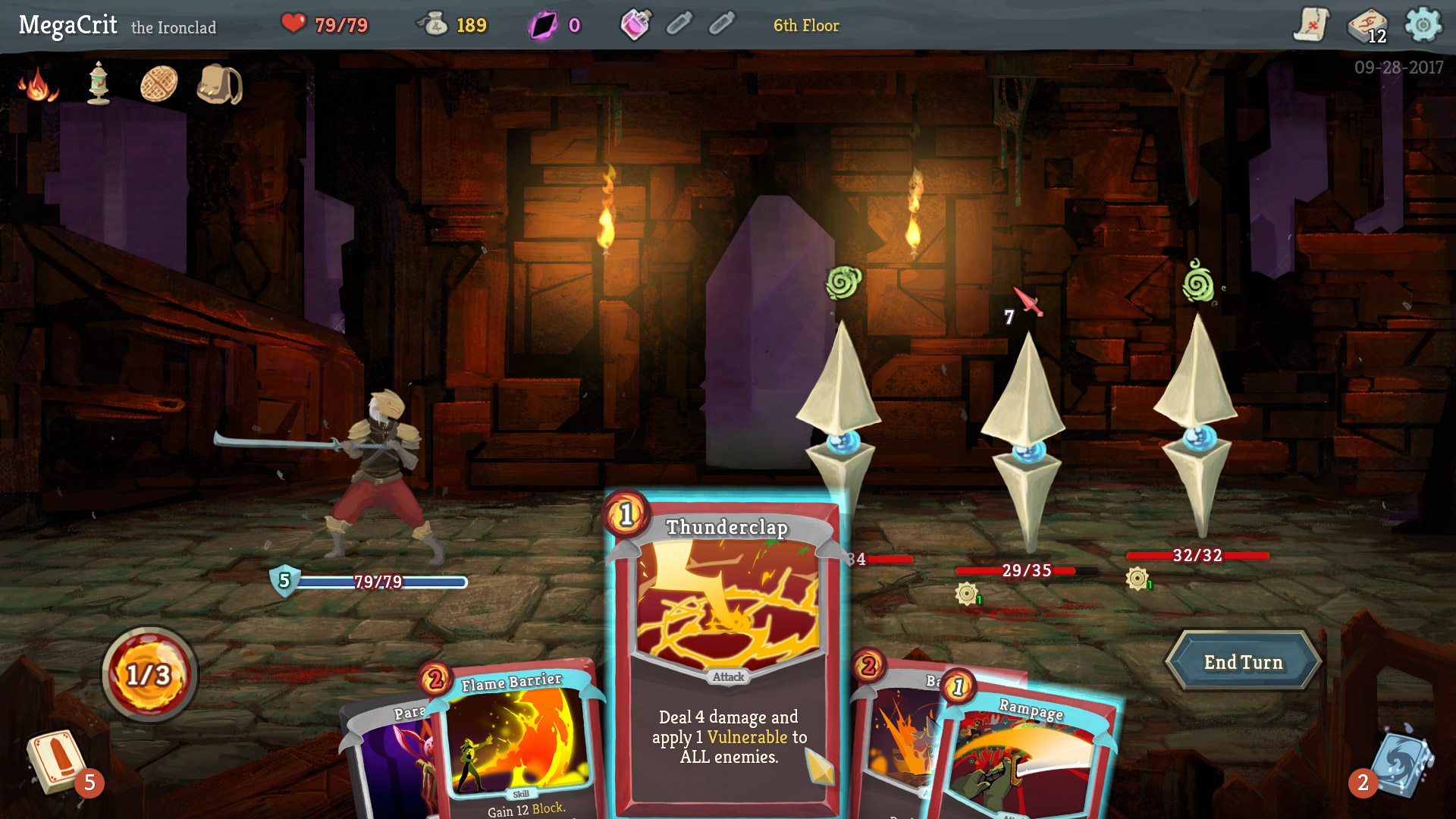
What surprised me was how much information the game actually gives you. Every enemy telegraphs their next move with the Intent system—you can see if they’re about to attack for 12 damage, or buff themselves, or throw debuffs at you. This isn’t a game about surprise mechanics or RNG bullshit killing you out of nowhere. When you die (and you WILL die), it’s because you made bad decisions five floors ago and the game is just now cashing that check.
I expected a chill card game I could play while watching YouTube. What I got was a game that demanded I actually turn my brain on and think two turns ahead, then three turns ahead, then “wait, if I path through these two Elite fights I can get relics to make my deck work but I’m at 32 HP and…” yeah. It’s a whole thing.
The frame rate is locked at 60 FPS and never dipped once, even when I had like 40 cards cycling through my deck with that Chemical X relic (starts you with 2 extra energy but you can’t gain energy anymore). Loading between floors is instant. This is a mechanically SMOOTH game, which matters when you’re making split-second decisions about whether to block for 15 or swing for lethal.
What Actually Works
The Intent System Is Genius
Every enemy shows you what they’re going to do next turn. Gremlin Nob is winding up for a 14-damage attack? You can see it. The Jaw Worm is about to buff its strength? Right there in a little icon above its head. This sounds like it would make the game easy, but it actually creates this incredible risk/reward calculation every single turn.
I remember fighting the Collector in Act 2 (this asshole who summons minions from your discard pile). I could see he was about to spawn another enemy, but I was at 23 HP and his Intent showed he’d attack for 18 next turn. Do I kill the existing minions and block, or do I ignore them and go face to kill him before he snowballs? I went face. I died… But I UNDERSTOOD why I died, and that’s what makes this game addictive instead of frustrating.
The Intent system also enables the entire defensive layer of the game. Block cards (which give you temporary armor for one turn) would be useless if you didn’t know what was coming. But when you can see that the Spire Spear is about to hit you 4 times for 5 damage each, suddenly spending 2 energy on a Flame Barrier (gives block AND damages enemies when they attack you) becomes a genius play instead of a waste.
Relics Make Every Run Feel Different
I had a run last week where I picked up Dead Branch (whenever you Exhaust a card, add a random card to your hand) from an Act 1 Elite. Normally, exhausting cards is a downside—you’re removing cards from your deck mid-combat. But Dead Branch turns it into card generation. I then got Corruption from a boss relic swap (all Skills cost 0 energy but are exhausted when played), and suddenly my entire deck became this infinite value engine where I’d play free Shrug It Offs and Flame Barriers while generating new cards constantly.
That run felt COMPLETELY different from my “Barricade + Entrench” run where I just stacked 300 block and became unkillable, which felt different from my “Perfected Strike” run where I just… hit things really hard with one card over and over.
The game has like 150+ relics, and finding synergies between them and your cards is where the real strategy lives. I’m 30 hours in and still discovering new combinations. Just yesterday I realized that Runic Pyramid (don’t discard your hand at end of turn) + Equilibrium (whenever you draw a Status or Curse, draw 1 card) means you can hold Status cards in hand forever to trigger Equilibrium every turn. My mind was blown.
The Difficulty Curve Respects Your Time
After you beat the game once with a character, you unlock Ascension mode—basically 20 levels of difficulty modifiers that stack. A1 just adds more Elites to the map. By A10, you start with a curse in your deck. By A20, you’re playing a completely different game where enemies have more HP, deal more damage, and you heal less.
What’s smart is that you unlock these incrementally. You beat A1, you unlock A2. You don’t have to choose between “baby mode” and “impossible mode” on your second run. I’m currently stuck on Ascension 7 with Ironclad (normal enemies have more defensive abilities now and it’s kicking my ass), but I can feel myself getting better. The game isn’t gatekeeping content behind skill walls—it’s just giving you harder puzzles as you prove you can solve the easier ones.
The Frustrating Parts
The Archetype Trap Is Real and Nobody Warns You
For my first 10 hours, I kept trying to “build a deck.” I’d see a Shiv card (Silent’s 0-cost attack cards) and think “okay, I’m building Shivs now” and then proceed to take every Shiv-related card I saw for the next 15 floors. This is a trap. The game doesn’t give you enough control over card rewards to force an archetype, especially in Act 1.
I lost SO many runs because I was drafting for a fantasy instead of solving my current problems. Gremlin Nob (the Act 1 Elite that gains 3 Strength every time you play a Skill card) doesn’t care that you’re “building a Poison deck.” He’s going to hit you for 22 damage on turn 3 if you don’t have enough attacks to kill him fast… But I’d skip good Attack cards because they “didn’t fit my build,” then get demolished.
The game never explicitly teaches you this. Every guide says “draft for your current needs, not future plans,” but when you’re IN the run and you see a card that COULD be amazing five floors from now, it’s so tempting to take it. I wish there was an in-game tutorial that actually explained this philosophy instead of just teaching you what Block does.
RNG Can Absolutely Screw You (Even Though People Say It Doesn’t)
Look, I get it. Slay the Spire is a “skill-based roguelike” where good players can win consistently. But sometimes the card rewards are just garbage. I had a run last night where my first 7 card reward screens didn’t offer a SINGLE multi-target attack. Then I hit the Gremlin Gang fight (five enemies that each deal damage separately) with nothing but single-target cards and got absolutely rolled.
Yeah, maybe a pro player would’ve pathed differently, or bought an AoE card from the shop, or found some galaxy-brain solution. But I’m not a pro player, I’m 30 hours in, and it feels BAD when you make good decisions and still lose because the game decided not to give you the tools you needed.
The worst is the Act 3 elites. Giant Head gains 30 block every time you play 3 cards in a turn, which punishes fast cycling decks. Nemesis has an attack pattern that requires specific amounts of block to survive. If you built your deck to counter one, the other can destroy you. And you don’t know which one you’re fighting until you click the Elite node. That’s not “skill,” that’s a coin flip.
The Watcher Breaks the Game’s Rules (and It’s Annoying)
So the fourth character, The Watcher, was added as a free DLC update. She has a “Stance” mechanic where she swaps between Calm (next turn, gain 2 energy) and Wrath (deal double damage, take double damage). She can also go into Divinity (deal triple damage, gain 3 energy) under certain conditions.
Here’s the problem: she’s SO much stronger than the other three characters that playing anyone else feels bad. I beat Ascension 5 with Watcher in like 4 runs. I’m still stuck on Ascension 7 with Ironclad after 20+ attempts. Her ability to manipulate energy and burst damage is just on a different power level.
It’s not game-breaking, but it does create this weird situation where I KNOW I should be practicing with Ironclad to get better at the fundamentals, but why would I bash my head against A7 when I could just play Watcher and feel like a god? It’s a self-inflicted problem, but the balance gap is real.
Real Talk: The Monetization
This is the easiest section I’ve ever written for a review. Slay the Spire costs $24.99 on Steam (I grabbed it for $12 during a sale, it goes on sale constantly). There are NO microtransactions. No DLC. No battle pass. No premium currency. No loot boxes. No cosmetic shop. Nothing.
You pay once, you get the entire game forever. The Watcher character was added as a FREE update. The daily climb challenges? Free. The custom mode where you can modify rules? Free. It’s almost quaint how consumer-friendly this is in 2024.
I can’t emphasize enough how refreshing this is. I never felt like the game was holding back content to sell me later. I never hit a difficulty spike that felt designed to make me buy a “Starter Pack.” The game respects my money and my time, which is apparently a revolutionary concept in modern game design.
If you’re on mobile, it’s $9.99 on iOS/Android, same deal—one purchase, everything unlocked. The mobile version runs great too (I tested it on my phone for a few runs), though I prefer mouse controls for the speed.
Comparing to Similar Games
Monster Train vs. Slay the Spire
I played about 40 hours of Monster Train before this, and it’s the closest comparison. Monster Train has flashier graphics, voice acting, and a more complex board state (you’re defending three floors of a train simultaneously). But it’s also more forgiving—you can usually brute force solutions with enough DPS scaling.
Slay the Spire is tighter and meaner. There’s no board state to hide behind, no second floor to retreat to. You play cards, enemy hits you, repeat until someone dies. That simplicity makes every decision matter more. Monster Train feels like a power fantasy where you build absurd combos. Slay the Spire feels like a puzzle where you’re trying to survive with imperfect tools.
Both are great, but if you want to actually feel like you’re improving at a skill, Slay the Spire is the better teacher.
Balatro Is Vibes, This Is Strategy
Balatro blew up recently as the “poker roguelike,” and it’s fantastic for very different reasons. Balatro is about escalation and dopamine hits—you’re building massive multipliers and watching numbers explode. It’s a slot machine that rewards creative thinking.
Slay the Spire is about constraint and optimization. You’re not trying to build the biggest combo; you’re trying to build the SMALLEST, most efficient deck that can handle 50+ floors of escalating threats. Removing cards from your deck is often better than adding them. That’s a completely different design philosophy.
Play Balatro when you want to feel clever. Play Slay the Spire when you want to actually get better at something.
Bottom Line + FAQ
Slay the Spire is the rare game that makes me feel stupid and addicted at the same time. It’s not trying to be your friend with flashy animations and dopamine-drip rewards. It’s a cold, elegant puzzle box that will absolutely murder you if you don’t think three turns ahead. But when you DO solve it—when you thread the needle between two Elite fights, grab the perfect relic, and ride that momentum to a Heart kill—it feels earned in a way most games never achieve. For $12-25 and zero predatory monetization, this is one of the best value propositions in gaming. Just don’t expect to feel smart for the first 20 hours.
Is this game actually hard or do I just suck?
Both, honestly. The base difficulty is very learnable—I beat Act 3 with Ironclad after about 8 hours once I stopped drafting like an idiot. But Ascension 15+ is genuinely difficult even for experienced players, with A20 requiring near-perfect decision-making across 50+ floors. The skill ceiling is MUCH higher than it first appears.
How long does a single run take?
On my desktop, a full three-act run takes 45-60 minutes if I’m playing at a decent pace, maybe 90 minutes if I’m really thinking through decisions. Runs that end early (dying in Act 1 or 2) can be as short as 15-20 minutes, which makes the “just one more run” addiction very real. Mobile runs take slightly longer because touchscreen controls slow me down, but not dramatically.
Should I start with Ironclad or try other characters?
Start with Ironclad, full stop. He has the most HP, a healing relic, and his cards are straightforward (hit thing hard, gain block, scale with Strength). Silent and Defect require more game knowledge to pilot effectively, and Watcher will teach you bad habits because she’s overtuned. Learn the fundamentals with Ironclad first, then branch out once you understand enemy patterns and card value.
What’s the actual endgame content?
Beating Act 3 unlocks Ascension mode (20 difficulty levels), and collecting three keys during a run unlocks Act 4 and the Heart boss fight, which is the “true” final boss. Beyond that, it’s chasing higher Ascension wins with each character—I’m 30 hours in and still have like 60+ Ascension levels to clear across all four characters. There’s also a Daily Climb with modifiers and leaderboards if you’re into that, plus custom mode for meme runs.
Does this run well on older hardware?
Dude, this game could probably run on a graphing calculator. I tested it on my old laptop (integrated Intel graphics from 2016) and got locked 60 FPS at 1080p with zero issues. The art is 2D hand-drawn stuff, and the particle effects are minimal. If you can run Chrome with 10 tabs open, you can run Slay the Spire. Battery drain on mobile is also very reasonable—maybe 15-20% per hour on my phone, which is great for a premium game.
About the Author