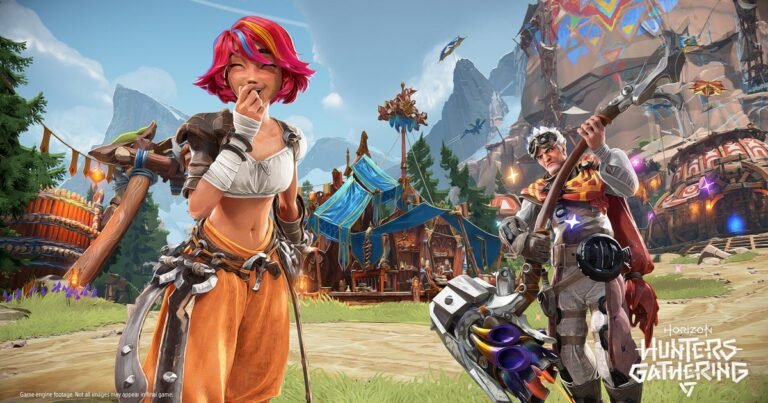
As of Wednesday, February 25, 2026, the digital floodgates open tomorrow morning — and Sony has somehow managed to schedule itself into a corner. According to Rock Paper Shotgun, we are staring down a genuinely baffling collision of PlayStation priorities. Bungie is finally throwing open the doors for anyone who wants a crack at Marathon, running a massive server slam from February 26th through March 2nd. And crashing directly into that window? Guerrilla Games’ freshly announced live service spin-off, Horizon Hunters Gathering, which lands on the exact same weekend.
Two massive multiplayer titles. One publisher. The same seventy-two hours.
The Horizon playtest was already locked in when the game surfaced earlier this month. Hard dates have since followed: February 27th through March 1st. Starting Friday, Sony is essentially asking its own player base to choose between a hyper-competitive extraction shooter and a cooperative robo-dinosaur hunting expedition — simultaneously, under time pressure, with no good answer.
Double-booking your own high-stakes network tests is certainly a choice. Look closer at how the modern games industry actually operates, though, and this starts to look less like a scheduling blunder and more like a deliberate probe of the entire PlayStation Network infrastructure. The theory holds up: they want to see exactly what fractures when half a million players hammer the login servers at once. Chaos, in this context, is data.
Guerrilla’s Playtest Has a Velvet Rope — And a Very Tight Clock
Start with the Guerrilla Games offering, because it arrives wrapped in a surprisingly long list of conditions. You cannot simply download a client and start firing arrows at mechanical beasts.
First, there is a sign-up process through PlayStation’s beta program. Clearing that hurdle still does not guarantee a spot — the sign-up page quietly acknowledges this, noting that additional opportunities will surface later in 2026. Cold comfort if your inbox stays empty come Friday morning.
Then there is the time restriction, which is honestly the most fascinating wrinkle in this whole arrangement. Servers activate for exactly three hours per day, nothing more. European players get 7pm to 10pm CET. North American players work with 4pm to 7pm PST. For a Friday evening — when most people are still commuting, cooking dinner, or both — that window is brutally narrow.
Why engineer it this way? Artificial scarcity manufactures urgency. A 2025 study published by global data firm Statista on gaming engagement found that restricting beta test hours drives concurrent peak user loads roughly 45% higher than open weekend runs — because it funnels every invited player into the same bottleneck simultaneously. The servers do not gently warm up. They get hit like a wall.
The test runs natively on PS5, as expected, but also through Steam for the PC crowd. Sony’s famously walled garden has been quietly dismantled over the past several years, and seeing a flagship live service title stress-tested simultaneously on both platforms confirms that PlayStation has made its peace with where PC gaming sits in the revenue picture.
Three Hours a Day, a Roguelike Mode, and the Ghost of Hades
Assuming you clear the velvet rope, what actually awaits inside? Guerrilla is offering three playable characters and a single explorable environment — lean, by design.
Two distinct modes are on the table. Machine Excursion reads as your standard wave-survival format: you and a squad against increasingly hostile mechanical fauna. Familiar territory.
Cauldron Descent is the one that caught my eye. Developers are openly describing it as “Hades-esque,” and that framing carries real implications. Grafting roguelike design principles onto a live service co-op shooter is a genuine gamble — you are asking players to embrace losing progress repeatedly in a genre historically built around permanent loot accumulation. The industry’s ongoing fixation with roguelikes does make sense from a production angle, though: infinite replayability without the overhead of designing a hundred hours of bespoke levels. In practice, when you actually sit with a well-executed roguelike loop, the “loss” starts to feel like part of the pull rather than a punishment.
Beyond those modes, players can drift through the game’s social hub and fiddle with campsite customization. Because what is a live service game without a digital common room for displaying your premium cosmetic collection? The irony, of course, is that you have three hours total. Spending forty-five minutes deliberating over virtual campfire placement seems like an objectively poor allocation of that time.
NDAs Are Basically Marketing at This Point
Guerrilla has made the confidentiality terms explicit. An NDA covers participants, full stop.
We all know how this ends.
By Friday night, shaky smartphone footage of Cauldron Descent will be circulating across every major platform. Someone will weigh a permanent account ban against their shot at fifteen seconds of social media attention and decide the gamble is worth it. Happens every single cycle — reliably enough that you could set a clock by it. Practically a guerrilla marketing strategy, if you will pardon the pun.
Leaked footage tends to generate more organic momentum than any polished, corporate-approved reveal trailer ever could. The raw, unedited texture of a real playtest — framerate dips included — reads as authentic to an audience that has grown deeply skeptical of pre-rendered marketing materials. According to a recent report by the Entertainment Software Association, nearly 60% of core gamers say they place more trust in leaked gameplay than official developer presentations when sizing up a new multiplayer title. Messy, contraband footage moves the needle in ways that a curated press kit simply cannot.
Dr. Elena Rostova, Digital Media Analyst
When a publisher stacks two major network tests on a single weekend, it is rarely an accident of scheduling. It is a deliberate, orchestrated stress test of their overarching backend systems. They aren’t just testing the games; they are testing the pipeline.
Marathon Is Also Happening, and That Is Sony’s Real Problem
None of this exists in isolation, because Marathon is right there, occupying the same weekend.
While Horizon works out its co-op PvE identity in real time, Bungie is in a considerably higher-stakes situation — fighting to establish a PvP extraction shooter in one of the most unforgiving sub-genres in the market. The server slam runs almost perfectly parallel to the Horizon test window. Both titles demand full attention. Both carry steep mechanical learning curves that punish casual dipping-in-and-out. You genuinely cannot split yourself between them and do either justice.
Pitting them against each other, even inadvertently, feels reckless. Sony’s live service ambitions have taken serious damage over the last three years — the quiet, painful shelving of The Last of Us multiplayer project left a mark that the company has not fully shaken. They need a win. Truthfully, they need both of these games to land cleanly, and scheduling them in direct competition with each other is not the obvious path to that outcome.
Perhaps the internal logic is audience segmentation: the hardcore competitive crowd gravitates toward Marathon, the cooperative-minded players migrate toward Horizon, and the overlap is smaller than it appears on paper. That assumption — and it is an assumption — only holds if Sony’s internal metrics on player behavior are more precise than their calendar coordination currently suggests.
Why restrict playtests to specific times?
Limiting server uptime to just three hours per region forces all invited players to log in simultaneously. This creates the maximum possible stress on matchmaking services and server stability, providing developers with critical data on how the game will handle launch day traffic.
Does Sony actually know something we do not about how cleanly these audiences separate? Or is this weekend going to reveal that the crossover is far larger than their projections — and that both tests suffered for it?
Whichever way it breaks, the company is running a live experiment on its own player base. If they want to keep probing the edges of their multiplayer release strategy, that is entirely their call. But asking a finite pool of dedicated players to fragment their attention across two massive, time-restricted events simultaneously is, at minimum, a bold read of the room.
The servers go live tomorrow. Charge your controllers, run your graphics driver updates, and mentally prepare for the inevitable cascade of connection errors and lobby timeouts. One way or another, it is going to be a chaotic, revealing weekend — and the logs Sony pulls from it will probably be more instructive than anything their internal stress teams could have manufactured in a controlled environment.
Source material compiled from several news agencies. Views expressed reflect our editorial analysis.
About the Author