I’ve spent the better part of the last week completely submerged in the neon-tinted fever dream that is Romeo is a Dead Man, and I’ll be honest: my brain feels like it’s been tossed into a high-speed centrifuge and come out the other side wearing sunglasses. It is genuinely rare these days for a game to make you feel like you’ve been catapulted back to a time when developers weren’t terrified of being “too much”—and I’m not talking about that calculated, corporate-approved “weird” we see in marketing campaigns. I’m talking about the kind of “what-on-earth-did-I-just-witness” weird that makes you question if you’re actually awake. According to the Eurogamer.net Latest Articles Feed, this latest offering from the team at Grasshopper Manufacture is a joyous return to form for Goichi Suda (the legendary Suda51), and after living through it, I’m inclined to say it’s actually much more than just a return. It’s a loud, proud statement of intent.
The game kicks off with an opening sequence that absolutely defies any attempt at a sober summary. Imagine, if you can, the entire cosmos floating inside a giant fish tank while high-energy Japanese rap blares in the background. Before you can even process that, you’re thrust into a stop-motion miniature town, followed immediately by a zombie attack while trapped in a police car. And then, just when you think you’ve seen the peak, our hero, Romeo Stargazer, is resuscitated by a grandfather on a motorbike using what I can only describe as an eyeball syringe. If that sounds like a lot to take in, well, it is. But in an era where major releases often feel like they’ve been focus-grouped into a state of beige, safe neutrality, this level of creative abandon is a massive breath of fresh, albeit slightly hallucinogenic, air. It’s the kind of game that reminds you why you fell in love with this medium in the first place—for the sheer, unadulterated surprise of it all.
Trading the Punk Aesthetic for a Sophisticated Jazz Riff
For years, Suda51 has famously described his design philosophy as “punk.” It was a fitting label: his games were jagged, loud, and often intentionally abrasive to the mainstream palate. But with Romeo is a Dead Man, he’s pivoted to what he’s now calling “jazz.” It’s a subtle shift on paper, but in practice, it feels profound. Where earlier titles like No More Heroes or Killer7 felt like a giant middle finger directed at the industry’s conventions, Romeo feels like a sophisticated, improvisational riff. It has less of that raw, sharp edge and more of a rhythmic, confident soul. It’s still creatively untamed—don’t get me wrong—but there’s a new fluidity here. It suggests a master creator who is finally comfortable just playing the notes that feel right to him, regardless of whether they follow the traditional sheet music or the expectations of a modern audience. It’s loose, it’s cool, and it’s undeniably Suda.
This “jazz” approach is most visible in the game’s core loop, which is a hyper-kinetic third-person hack-and-slasher available across the board on PS5, Xbox Series X/S, PC, and Nintendo Switch. If you’ve spent any time with Killer is Dead or the No More Heroes trilogy, the DNA here is unmistakable. The combat is viscerally intense, a constant blur of sword swings and neon-colored arterial sprays that should, by all rights, be a total visual mess. Yet, somehow, it works beautifully. The combo-based system is satisfyingly rhythmic, punctuated by these psychedelic special attacks that feel less like scripted events and more like show-stopping solos in the middle of a long, late-night jam session. You find yourself falling into a trance, reacting to the beats of the music and the flashes of light in a way that feels incredibly natural once you find the groove.
“Romeo is a Dead Man isn’t just a game; it’s a frantic, neon-soaked rebellion against the predictable rhythms of modern AAA development.”
Editorial Analysis, February 2026
What’s truly fascinating is how this chaotic energy fits into the broader industry landscape right now. A 2024 Statista report noted that the “AA” gaming segment—those games sitting in that sweet spot between massive, billion-dollar blockbusters and tiny, two-person indies—saw a 15% increase in player engagement. Why? Because audiences are clearly starting to look for more distinct, auteur-driven experiences. People are getting genuinely tired of the 100-hour open-world checklists and the “map-clearing” chores that have come to define the modern gaming experience. They want something with a pulse, even if that pulse is as erratic as a heart on a caffeine overdose. They want to see the hand of the creator in the work, even if that hand is a bit shaky or prone to drawing outside the lines.
A Beautiful, Unfiltered Mess of Systems That Actually Works
If the combat is the anchor that keeps the game grounded, the rest of the experience is a wild, wonderful mess of interlocking systems that probably shouldn’t exist in the same zip code, let alone the same piece of software. You’ve got a full-blown farming component on your spaceship, presented entirely as a top-down pixel-art RPG, where you grow “Rotters” to assist you in battle. Then, there’s a katsu curry mini-game styled like a high-budget prestige anime. There’s even a scanning game that’s essentially a quadruple-paddle version of Pong. It’s absurd, it’s overstuffed, and it’s frequently hilarious. It feels like Suda and his team at Grasshopper had a million ideas and decided that “no” wasn’t a word they wanted to use during development.
And yet, this is exactly why Romeo is a Dead Man succeeds. It flatly rejects the modern corporate idea that a game must be one specific thing to be marketable. In a 2025 Newzoo study, researchers found that “genre-mashing” titles—those games that blend seemingly disparate mechanics together—recorded 20% higher player retention rates than traditional single-genre titles. It turns out that players today are more digitally literate than we often give them credit for. We can handle switching from a high-speed hack-and-slash to a space-flight sim to a Pac-Man-style leveling screen without losing the narrative thread. Grasshopper Manufacture seems to understand this better than almost anyone else in the business, trusting the player to keep up with their frantic pace.
Building a World Out of the Absurd and the Beautiful
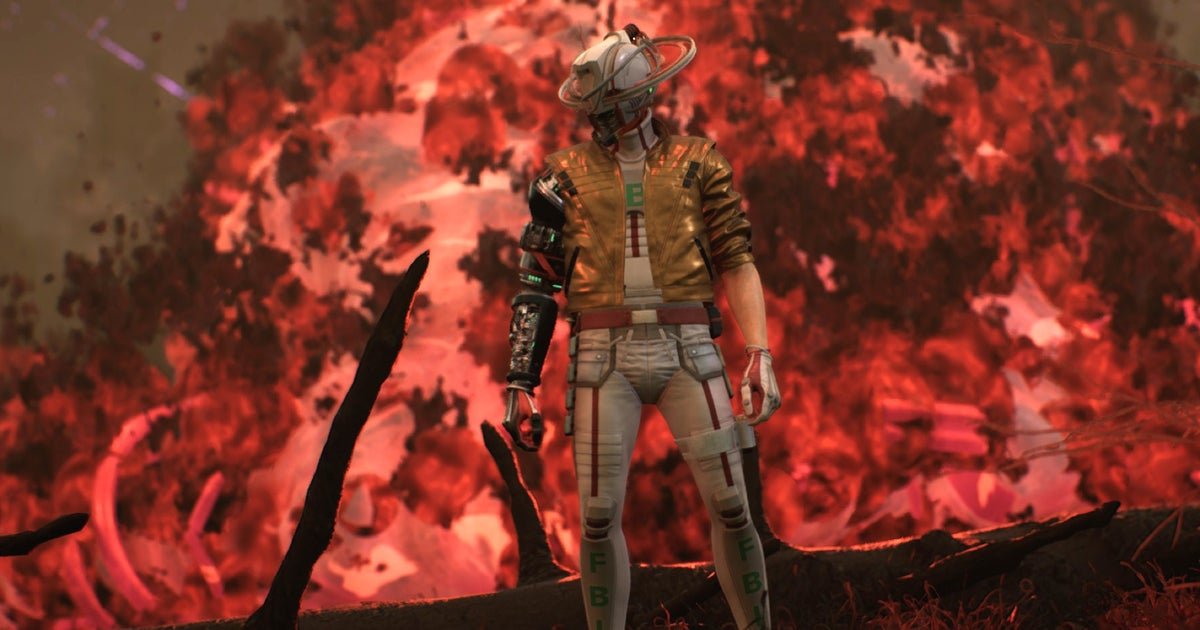
As you catapult through time as a fresh recruit for the FBI’s space-time division, you’ll find yourself visiting everything from 1980s neon malls to 1960s brutalist government buildings. These aren’t just empty backdrops; they are lovingly rendered, atmospheric spaces that practically beg you to explore their weirdest corners. The “Soulslike” rhythm—using fast-travel save points that reset enemies—keeps the tension high and the currency flowing, giving the exploration a sense of consequence. But it’s the trans-dimensional overlays that really steal the show. Interacting with floating, jazz-spewing TVs whisks you away to a polygonal otherworld, adding platforming and puzzle elements that keep the gameplay from ever feeling stale or repetitive. You never quite know what’s through the next door, and that’s a rare feeling in 2026.
Is it perfectly realized? Probably not in the traditional sense. There’s a persistent, nagging feeling that Grasshopper’s massive ambitions might have slightly outpaced their actual budget, which, to be fair, has been a hallmark of the studio’s history since day one. But I’ll take a game that fails while reaching for the stars over one that succeeds by never leaving the ground any day of the week. The script is buoyant and witty, the gags are joyfully stupid, and the central love story involving Romeo’s dimension-hopping girlfriend, Juliet, is surprisingly affecting. Beneath all the gore and the “jazz,” there’s a real human heart beating at the center of this game, and that’s what makes the rough edges so easy to forgive.
Why We Desperately Need the “Suda Barrier”
There has always been what fans call the “Suda barrier”—that specific point where the sheer, unadulterated “batshit” nature of his work alienates players who prefer more conventional, linear narratives. Romeo is a Dead Man isn’t going to change that reality. If you didn’t like his previous work, you likely won’t find a foothold here, and that’s perfectly okay. But for those of us in the “love” camp, this feels like a long-overdue celebration. It’s a reminder that video games are a medium of infinite, weird possibility, not just a series of KPIs and engagement metrics to be optimized by a board of directors. It’s art that is allowed to be messy, and that’s a beautiful thing.
We live in a time where a Pew Research Center survey from late 2025 suggested that a staggering 62% of gamers feel that major franchises have become “too predictable” and “formulaic.” In that specific context, a game that features a sentient jacket patch and explosive zombie poop isn’t just a quirky curiosity; it’s a cultural necessity. It challenges our expectations, breaks our habits, and reminds us why we started playing games in the first place: for the thrill of the genuine surprise. It’s a reminder that games can be more than just content; they can be experiences that stick with you long after you’ve put the controller down.
Is Romeo is a Dead Man a sequel to No More Heroes?
No, it’s a completely original IP, though I should mention it shares a massive amount of stylistic and mechanical DNA with Suda51’s previous work at Grasshopper Manufacture. Think of it more as a spiritual successor that trades the old-school punk aesthetic for a smoother, more experimental “jazz” feel. If you’re a fan of Travis Touchdown, you’ll feel right at home here, but you don’t need to have played the older games to understand what’s going on.
Which platforms can I actually play it on?
The game has been released across all the major platforms you’d expect, including PlayStation 5, Xbox Series X/S, PC (available via both Steam and the Epic Games Store), and even the Nintendo Switch. It’s surprisingly well-optimized for the Switch, too, considering how much is happening on screen at once.
How long is the game, honestly?
If you’re just blasting through the main story, you’re looking at roughly 12-15 hours of gameplay. However, if you get sucked into the various mini-games, the farming mechanics, and the side quests—which you probably will—you can easily push that playtime past the 25-hour mark. It’s a game that really rewards completionists who want to see every weird thing it has to offer.
Finding a Coherent Whole Inside the Chaos
Ultimately, Romeo is a Dead Man is something of a miracle of cohesion. It’s brilliant, it’s stupid, it’s spectacular, and it’s surprisingly clear-eyed all at once. It manages the impossible task of taking a hundred disparate, clashing ideas and fusing them into a singular, consistent experience that feels like it could only have come from one specific mind. It’s been a long time since a game has kept me this delightedly enthralled, constantly making me wonder what kind of insanity was waiting just around the next corner. It makes you feel like a kid again, discovering a secret world that wasn’t meant for everyone, but was definitely meant for you.
The truth is, they really don’t make games like this anymore—not at this scale, and certainly not with this much heart and soul poured into every frame. Grasshopper Manufacture has delivered something that feels both like a nostalgic relic of a wilder, less regulated past and a potential blueprint for a more imaginative, risk-taking future. If this is what “jazz” gaming looks like, then I am more than ready for the encore. I’ll be over here, growing my Rotters and listening to Japanese rap, waiting to see what Suda does next.
This article is sourced from various news outlets. Analysis and presentation represent our editorial perspective.
About the Author