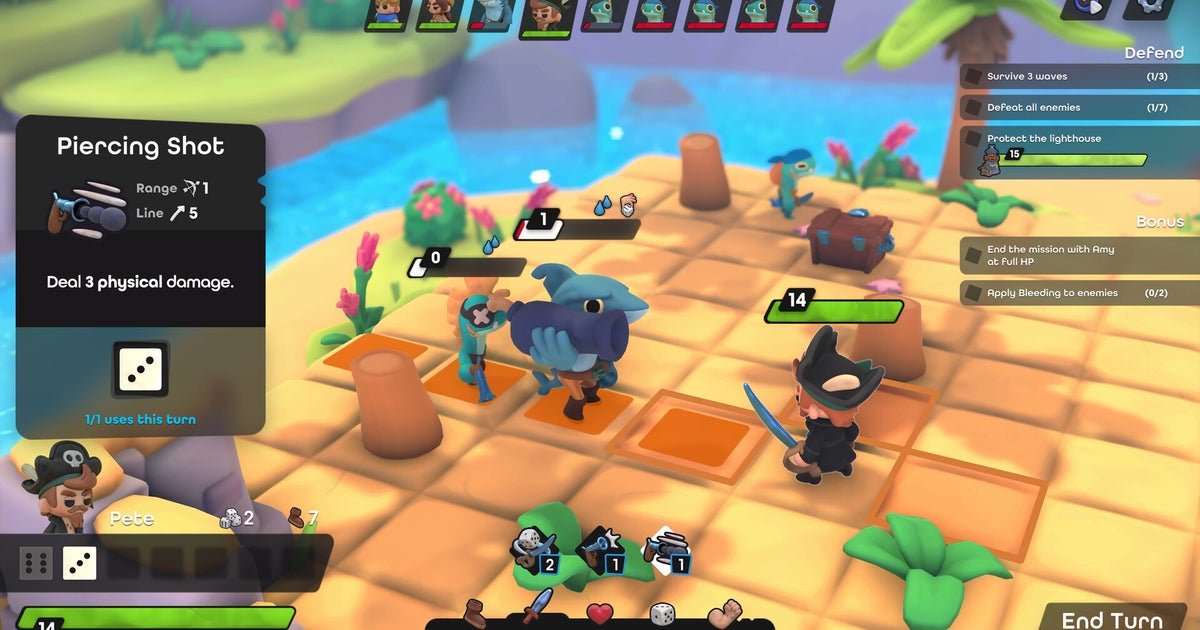
There is something remarkably grounding about spotting a fingerprint on a digital object. In our current landscape of hyper-polished, AI-smoothed visuals, seeing a tiny, pixelated whorl on the side of a playdough sword feels like a quiet act of rebellion. I found myself leaning in toward my monitor this morning—actually squinting at the pixels—when I noticed it: that faint, glimmering texture. It wasn’t some rendering glitch or a compression artifact; it was entirely intentional. And honestly? That little detail is the beating heart of Dobbel Dungeon.
If you’ve been keeping an eye on the Rock Paper Shotgun Latest Articles Feed, you’ll know that this turn-based tactics gem officially hit Steam today, February 17, 2026. It’s landing at what I’d call a fascinating crossroads for the genre. We’ve spent most of the last year watching these massive, sprawling, incredibly complex strategy epics dominate our time and our headlines. But beneath all that “high-stakes” grand strategy, there’s been this quiet, persistent craving for something that feels… well, physical. We want games that look like we could reach out and squish them between our fingers, and Gamepie—the clever developers behind this project—clearly understood that assignment from day one.
I’ll be the first to admit that I’ve spent the better part of the last few months mentally bracing myself for the release of Mewgenics. If you’ve been following Edmund McMillen’s latest project, you know exactly what I mean. It’s “a lot” to process. It’s brilliant, of course, but it’s also designed to be intentionally “appalling” in that very specific, visceral way he’s known for. In that context, Dobbel Dungeon feels like the perfect, necessary antidote. It’s the digital equivalent of a warm cup of tea after you’ve spent three hours walking through a freezing thunderstorm. It’s sweet, meticulously crafted, and almost aggressively unthreatening—and I think my cortisol levels are genuinely grateful for its existence.
The Art of the Imperfect: Why Digital Games Are Finally Embracing the Human Touch
The visual direction Gamepie chose here is so much more than just a surface-level gimmick. We’re living in an era where “photorealism” has started to cause a strange kind of visual fatigue; everything is so perfect that it starts to feel sterile. Because of that, the arts-and-crafts aesthetic is making a massive, well-deserved comeback. We saw the beginnings of this with Mashina last year, and Dobbel Dungeon takes those ideas and refines them into something even more tactile. There is a very specific, almost nostalgic joy in seeing a metallic sword that looks like it was fashioned out of silver-painted clay by a hobbyist. It gives the whole experience a “tabletop” feel that most self-described “digital tabletops” actually miss because they’re too busy trying to look like high-budget cinema instead of, well, a board game.
I actually caught myself wishing my laptop had some sort of advanced biometrics—the kind of tech that could track my own fingerprints and “degrade” the character models as I played. Imagine having a high-level warrior who looks slightly greasy and smooshed because you’ve manually dragged them through fifty different battles. It’s a ridiculous, over-the-top idea—a “Crysis-grade” simulation for a game that features clay bunnies—but it really speaks to how physically present this world feels. You don’t just play Dobbel Dungeon; you feel like you’re a giant hovering over a physical board tucked away in a cozy witch’s cottage somewhere in the woods.
And then there’s the story, which is wonderfully, refreshingly low-stakes. A witch’s cottage blows up (accidents happen!), and the local wildlife gets transformed into slightly grumpier, humanoid-looking versions of themselves. It’s simple, it’s effective, and it perfectly sets the stage for a series of mission-battles across various islands. There’s no looming, world-ending threat that requires you to read a 40-page lore primer before you can enjoy yourself. You’re just a club-wielding critter trying to sort out a localized mess, and that’s more than enough motivation for me.
“The shift toward tactile, ‘physical’ aesthetics in digital gaming isn’t just about nostalgia; it’s a reaction to the hyper-cleanliness of modern UI. Players want to see the ‘mess’ of creation.”
— Gaming Trend Analysis Report, 2025
Rolling the Bones: Why Your Dice Results Aren’t Just Math Anymore
Let’s dig into the “twist,” because let’s be real: every tactics game needs a unique hook these days if it wants to survive the relentless Steam algorithm. In Dobbel Dungeon, your abilities aren’t just buttons you click when the cooldown is up; they’re essentially boxes you have to fill. Every turn, your character flings a handful of dice across the screen. You then have to manually slot those dice into specific ability boxes. If you drop a 5 into a fireball slot, you’re dealing 5 damage. It’s a system that turns every single turn into a mini-puzzle of probability and resource management. It’s not just about what you want to do; it’s about what the dice are actually allowing you to do.
It’s such a clever way to handle RNG. Instead of the game just coldly informing you that you had a “15% chance to miss”—which we all know is XCOM-speak for “you are definitely going to miss this shot and lose your favorite soldier”—the game hands you the raw materials of your failure or success right at the start of the turn. You see the dice. You know exactly what you have to work with before you commit to a move. There’s a specific kind of tension in deciding whether to use a mediocre 3 on a healing spell now to stay safe, or use your one allowed reroll to fish for the 6 you desperately need to one-shot a boss. It makes the player feel like they have agency over the chaos.
According to a 2024 Statista report, indie titles now account for nearly 40% of all units sold on Steam, and a huge driver of that growth has been the innovation in “micro-mechanics” just like this one. We’re collectively moving away from these sprawling, 100-hour campaigns that feel like a second job, and toward these tight, mechanically satisfying loops that actually respect the player’s time. Dobbel Dungeon fits right into that pocket. It doesn’t want to consume your entire life; it just wants to be the thing you play for a very satisfying forty-five minutes before you head to bed.
The Ethics of the “Nudge”: When Cheating Becomes a Core Mechanic
There’s a specific feature in this game that I find both hilarious and probably a little polarizing for the hardcore crowd: the ability to “gently nudge” your dice. Through various items and skill tree unlocks, you can essentially manipulate the results if you really don’t like what Lady Luck handed you. The developer, Gamepie, is basically inviting us to cheat—or at least, to engage in some light “creative accounting” with the laws of physics. It’s a bold move, and I kind of love it.
Now, I’m sure some purists out there will hate this. They’ll argue that it cheapens the “tactics” part of turn-based tactics. But I completely disagree. In a game that looks like it was painstakingly made in a kindergarten classroom, why shouldn’t we be able to nudge the dice a little? It adds a layer of “trickster” gameplay that feels incredibly thematic. It reminds me of the old days of playing board games with my siblings, where a subtle “bump” of the table was a legitimate, if heavily frowned-upon, strategy. It’s that human element again—the idea that the rules are really just a suggestion if you’re clever (or desperate) enough.
And let’s be real for a second: the game isn’t exactly a walk in the park. While the presentation is laidback and the music has that infectious, Viva Piñata-style bounce to it, the later mission-battles require some genuine tactical thought. You have your hub town, your gear merchants, and your branching skill trees—all the genre standards you’d expect—but they’re all executed with a buoyancy that keeps things from ever feeling like a chore. It’s “genre-standard” done with a high level of craftsmanship and a lot of heart.
The “Cozy-Tactical” Revolution: Finding the Sweet Spot Between Comfort and Complexity
We’re currently seeing a significant shift in who is actually playing these kinds of games. A 2025 Pew Research Center study found that the “cozy gaming” demographic has expanded by a whopping 30% over the last two years. Interestingly, those players are now migrating toward more mechanically dense genres like tactics and deckbuilders. People who used to only spend their time in Animal Crossing or Stardew Valley are now looking for games that offer that same aesthetic comfort but with a bit more “crunch” to the gameplay. They want to be challenged, but they want to feel safe while it’s happening.
Dobbel Dungeon is the perfect bridge for that transition. It’s approachable enough for someone who just wants to look at cute clay animals and enjoy the vibes, but the dice-slotting mechanic offers more than enough depth to satisfy the *Slay the Spire* veterans who live for optimization. It’s part of what I’ve been calling the “Cozy-Tactical” revolution. We don’t need every single game to be a grimdark struggle for survival in a post-apocalyptic wasteland. Sometimes, we just want to roll some dice, nudge them when no one is looking, and watch a playdough bird launch a fireball at a grumpy clay frog.
Is Dobbel Dungeon available on consoles?
As of its launch today, the game is primarily available on PC via Steam. However, given its tabletop nature and the clean, controller-friendly interface design, it feels like a perfect candidate for a Nintendo Switch or PS5 port later this year. We haven’t had any official word from Gamepie yet, but I’d be surprised if it didn’t make the jump eventually.
How does it compare to Mewgenics?
Honestly? They are polar opposites in terms of vibe, even if they share some DNA. While both involve animals and tactical combat, Mewgenics leans heavily into the “gross-out” humor and high-complexity simulation that Edmund McMillen is famous for. Dobbel Dungeon, on the other hand, prioritizes charm, accessibility, and that “squishy” tactile aesthetic. They’re both great, but they serve very different moods.
Can you play it on the Steam Deck?
Absolutely. In fact, I’d argue it’s the best way to play it. The “leisurely” pace of the turn-based combat and the clean UI make it an ideal handheld experience. It’s the kind of game that feels right at home on a Steam Deck while you’re curled up on a real-life couch, which only adds to the whole “cozy” experience.
Final Reflections: Why “Small” Games Often Leave the Biggest Impression
I think we often fall into this trap of thinking that for a game to be “important” or “worth our time,” it has to be massive. We think it needs a 200-person dev team and a marketing budget that could fund a small nation. But Dobbel Dungeon proves the exact opposite. By focusing on the small things—the glimmer of a fingerprint on a sword, the specific sound of dice hitting a wooden table, the satisfying “squish” of a clay model moving across the screen—it creates an emotional connection that many AAA titles completely miss in their pursuit of perfection.
It’s out today, and if you have even a passing fondness for the genre—or if you just need a break from the more stressful games in your library—you should absolutely give it a look. Even if you just play the demo (which is still up for now, though who knows for how long?), it’s worth it just to see the art style in motion. It’s a wonderful reminder that gaming can be gentle. It can be playful. And it can be, quite literally, shaped by human hands.
As for me, I’ll be spending my evening in the hub town, buying some new gear for my “clayfaced critter clubbers” and trying my hardest to resist the urge to nudge my dice too often. But then again, if Lady Luck happens to be looking the other way, who’s to say a 3 can’t become a 6 with a little bit of playdough magic? I think the witch would approve.
This article is sourced from various news outlets, including the Rock Paper Shotgun Latest Articles Feed. The analysis and presentation here represent our own editorial perspective on the game and the current state of the industry.
About the Author