Magic: The Gathering is currently navigating the deep, nostalgic, and occasionally treacherous waters of the Lorwyn Eclipsed era, but if you listen closely, you can already hear the rhythmic splashing of four very famous turtles in the distance. According to IGN Video Games, the secondary market is in a state of absolute, chaotic flux as players scramble to react to the latest ban and restricted announcement—or, perhaps more accurately, the glaring lack of one in certain high-stakes corners of the format. It’s a fascinating, if slightly terrifying, intersection of genuine gameplay demand and the kind of raw, naked speculation that would make a seasoned Wall Street day trader blush. We’ve seen these cycles before, but there’s something about the current climate that feels particularly volatile, isn’t there?
The headline of the week isn’t actually what got the axe, but what didn’t. The “unban gamble” has morphed into a meta-game of its own, and this time around, the house definitely won. If you’ve been keeping even a casual eye on the secondary market, you know that the “will they, won’t they” drama surrounding Jeweled Lotus has finally reached its breaking point. It’s a classic, textbook case of the community convincing itself of a narrative that the developers at Wizards of the Coast simply weren’t ready to sign off on. And while the speculators are currently back home licking their wounds, the actual players are left trying to figure out if they can even afford to sit at the table anymore without a massive bankroll.
When the Hype Hits the Fan: The Lotus Heartbreak and the Biorhythm Shocker
Let’s talk about the elephant—or rather, the shiny black flower—in the room. Jeweled Lotus has essentially doubled in price recently, hitting a staggering $75. Why? Because the collective hive mind of the Commander community decided, with almost religious fervor, that it was 100% getting unbanned. For the uninitiated, it’s a zero-cost artifact that you can crack for three mana of any one color, but only to cast your Commander. In a format that has slowed down slightly thanks to recent nerfs to fast mana, the prospect of a Lotus return sent people into a literal buying frenzy. But the unban never came. Now, we’re seeing a classic “buy the rumor, sell the news” scenario play out, except the “news” was a big fat nothing-burger. It’s a dangerous game to play with your hobby budget, and a lot of people just got burned.
On the flip side, we actually did get an unban that absolutely nobody—and I mean nobody—had on their 2026 bingo card: Biorhythm. For those who haven’t had the pleasure (or pain) of seeing this card in action, it is the stuff of actual nightmares in a multiplayer setting. It sets every player’s life total to the number of creatures they control. Imagine playing this right after a board wipe that leaves you with a single 1/1 token while everyone else has an empty board. You win. Instantly. It’s scary, it’s swingy, and it’s exactly the kind of “feel-bad” card that was locked away in the ban-vault for years. Yet, here we are, and the card has rocketed from under $10 to nearly $30 in a matter of weeks. It signals a real shift in philosophy; Wizards seems more willing to let these “I win” buttons exist in the wild, perhaps acknowledging that the power creep of the last few years has made Biorhythm feel less like an outlier and more like just another standard finisher.
“The volatility we’re seeing in the TCG market isn’t just about the cards; it’s about the erosion of the ‘safe’ investment. When a card can jump 300% on a rumor, the game stops being about the gathering and starts being about the grind.”
— Editorial Analysis, February 2026
This volatility isn’t just a fluke; it’s backed by some pretty heavy broader trends. According to a 2024 report by Market Decipher, the global collectibles market was projected to grow at a compound annual rate of nearly 10% through the early 2030s. We are seeing that play out in real-time. Magic isn’t just a game played on your kitchen table or via PC and Mac on MTG Arena anymore; it’s become a high-velocity asset class. And honestly? That’s a bit depressing. When I’m looking at a card like Biorhythm, I want to be thinking about how it fits into my Sultai Arisen deck, not whether I should have bought ten copies three weeks ago just to help pay my rent. The transition from “game” to “investment” is a slippery slope we’re all sliding down together.
Beyond the Multiverse: Why Warhammer and Turtles are Swallowing the Market
If you thought the Warhammer 40,000 crossover was just a one-off experiment, the current market trends for Nurgle’s Rot and Hancock, Ghoulish Mayor should set you straight. These “Universes Beyond” cards are proving to have incredible staying power. Nurgle’s Rot has jumped from a measly $2 all the way to $10. It turns out that a steady stream of demons is pretty good when you’re out there slaying monsters left and right. Similarly, Hancock, Ghoulish Mayor—a standout from the Fallout crossover—has moved from bulk-bin status to nearly $2. He’s a zombie and mutant lord, and with the resurgence of these tribes in the Lorwyn Eclipsed meta, people are frantically digging through their old precon decks to find him. It’s a testament to how well these cards are designed, even if they don’t look like “traditional” Magic cards.
And then, of course, there’s the green machine. The Teenage Mutant Ninja Turtles (TMNT) set arrives next month, and the hype is already distorting the market in strange ways. Amazon has already started playing its usual games with the pricing, settling on a Play Booster Box price of $125.99. Honestly, for a specialty crossover set in 2026, that’s not terrible. We’ve seen boxes for high-demand sets like Modern Horizons 4 push way past the $200 mark at launch. But the fact that we’re already tracking “all-time lows” for a set that hasn’t even had its prerelease yet tells you everything you need to know about the modern consumer experience. We are constantly in a state of pre-order anxiety, wondering if we should lock in a price now or wait and see if the market crashes. It’s exhausting.
What’s really interesting is how these crossovers affect the “soul” of the game. A Statista report from 2025 noted that Hasbro’s Wizards of the Coast segment has consistently outperformed its traditional toy divisions, often accounting for over 70% of the company’s operating profit. This financial pressure is exactly why we see TMNT, Warhammer, and Fallout inside our fantasy card game. It works. People buy them. But as a long-time player, seeing Tyvar the Bellicose (a $18 powerhouse right now) fighting alongside a Ninja Turtle feels… well, it feels weird. Tyvar is thriving because of the Elf synergy in Lorwyn Eclipsed, giving his pointy-eared friends deathtouch and massive buffs. He’s a 5/4 for four mana that actually feels like a Magic card. I just hope the Turtles don’t completely drown out the flavor of the planes we actually care about in the long run.
Survival of the Fittest in Lorwyn: Who’s Winning (and Who’s Just Bulk)?
While the big money is busy chasing unbans and crossovers, the actual Lorwyn Eclipsed set is settling into its mid-life crisis. Moonshadow, which features some of the most hauntingly beautiful art I’ve seen in years, has dropped to $18 from its $20 launch price. It’s a 7/7 that comes in weak and grows as things die—classic graveyard synergy. It’s a great card, but it’s a victim of a crowded market. There’s just too much “stuff” coming out all at once. When you have a new set or a new “Secret Lair” drop every two weeks, even the heavy hitters like Moonshadow struggle to maintain their value. It’s a buyer’s market for the patient, but a nightmare for anyone trying to trade up.
Then you have the budget gems that everyone seems to be overlooking. Doran, Besieged by Time is currently a measly dollar. A dollar! This is a legendary creature that makes your high-toughness, low-power creatures cheaper to cast and then buffs them based on the difference. If you’re building an Abzan Armor deck, this is a mandatory inclusion, no questions asked. The fact that it’s so cheap is a testament to how much product is being opened right now. We are in an era of “extreme accessibility” for most cards, contrasted by “extreme exclusivity” for the chase variants. It’s a two-tier economy that benefits the casual player who just wants to build a deck, but frustrates the collector who wants their cards to hold value.
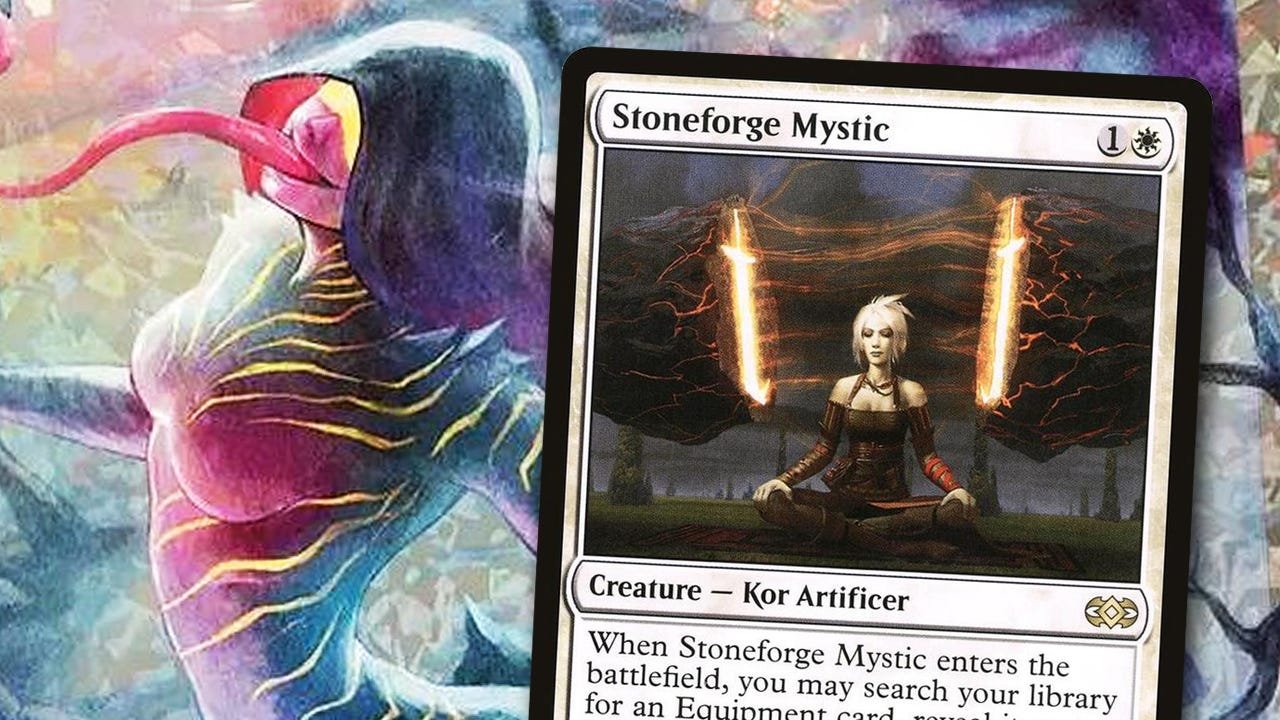
And we can’t ignore the fall of Stoneforge Mystic. Once the undisputed queen of equipment decks, she’s down to $28 from $35. It’s still not cheap, but it’s a clear sign that the meta is moving away from traditional “tutor and cheat” strategies. In a world where Biorhythm is legal and Tyvar is making every creature a deadly threat, waiting until turn three or four to cheat out a Batterskull feels almost… quaint. The game is getting faster, meaner, and far more unpredictable than it was even two years ago. If you aren’t doing something broken by turn three, you might as well not be playing.
The Breaking Point: Can Our Wallets Survive the Turtle Invasion?
Looking ahead to the TMNT launch next month, I can’t help but feel a bit of “release fatigue” setting in. We just finished with Tarkir Dragonstorm, we’re in the middle of Lorwyn Eclipsed, and now we’re already pivoting to Saturday morning cartoons. The market is holding steady for now, with cards like Colossal Grave-Reaver (up to $7 from $4) showing that there’s still a healthy appetite for big, splashy dragons that can cheat the graveyard. But how much can the average player’s wallet take? It’s a question that Wizards of the Coast and Hasbro seem content to ignore as long as the line on the graph keeps going up. But lines don’t go up forever, and the fatigue is real.
The real winners in this current market aren’t the people buying Jeweled Lotus at $75 and crossing their fingers for a miracle. They’re the ones picking up Teval, the Balanced Scale for $3. Teval is a absolute powerhouse in the Sultai Arisen precon, milling cards and ramping you with lands while creating 2/2 tokens. It’s a solid, dependable card that actually lets you play the game without needing a second mortgage. In a world of $125 booster boxes and $30 unban-speculation spikes, maybe the best move is to stop looking at the price tags and start looking at the cards again. Remember when we used to just play for fun?
Why did Jeweled Lotus fail to get unbanned?
While speculators were desperately hoping for a return to high-speed Commander, Wizards of the Coast seems focused on maintaining a slightly slower, more deliberate meta. Unbanning Lotus would have reversed several recent bans aimed at curbing fast mana, creating a contradictory message for the format’s long-term health. Basically, they didn’t want to break the format again so soon.
Is the TMNT Play Booster Box a good investment at $125.99?
Historically, Universes Beyond products hold their value quite well due to the crossover appeal with non-Magic fans and collectors. However, with the high print runs of 2026, it’s more of a “buy to play” item than a “buy to flip” asset. If you want the cards, buy the box; if you want to make money, there are probably better places to put your cash.
What is the best budget deck right now?
The Abzan Armor precon is the clear winner here. Especially when you upgrade it with cheap Lorwyn Eclipsed cards like Doran, Besieged by Time, it offers the best power-to-dollar ratio in the current environment. You can compete with high-tier decks without spending a fortune, which is a rare win in today’s market.
Ultimately, the Magic market in 2026 is a reflection of our broader culture: it’s fast, it’s chaotic, and it’s heavily influenced by the next big “event.” Whether you’re genuinely excited for the Ninja Turtles or you’re just trying to finish your Elf tribal deck in peace, the advice remains the same: play what you love, and don’t bet the house on a BMR announcement. Because for every Biorhythm that makes it out of jail and makes someone a small fortune, there
About the Author