I still vividly remember the first time I actually sat down to play Titanium Court. It was one of those rare, quiet evenings where you finish a gaming session, lean back until your chair groans, and just find yourself staring at the ceiling for a good five minutes. “Huh.” That was the only word I could muster. It wasn’t a “huh” of confusion, though—at least not entirely. It was that specific, breathless “huh” you let out when you’ve just watched a magic trick that actually, impossibly worked. If you’ve been following the Rock Paper Shotgun latest articles feed, you know they’ve been tracking this thing for a while, calling it a bit of a shapeshifter. And they’re right. It’s a stage play, a match-three puzzler, a hardcore strategy sim, and a fever dream all wrapped into one weird, metallic burrito that somehow tastes like the future of indie gaming.
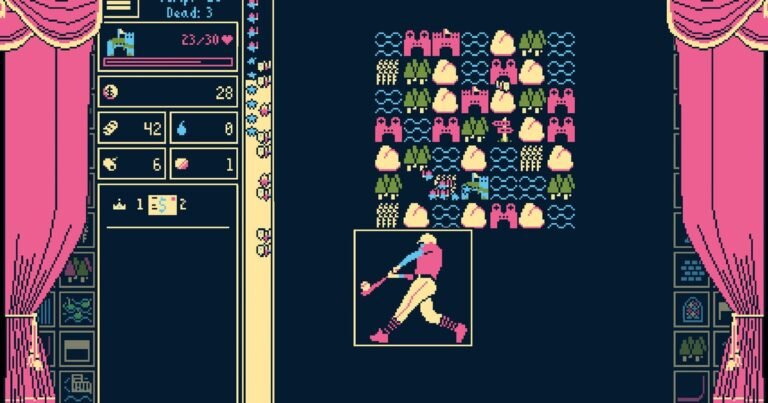
Now that we’re sitting here in February 2026, looking back at the massive ripples this title has made across the indie scene, it’s much easier to see why it stuck. But at the time? Man, it felt like trying to catch smoke with your bare hands. The game presents itself as a play, and I don’t mean that in a metaphorical “all the world’s a stage” kind of way. I mean it literally. There’s a physical stage, there are heavy velvet curtains, and there’s this immediate, almost aggressive demand for a suspension of disbelief. It’s a narrative vehicle where the laws of physics and reality are secondary to the rules of the performance. If the script says you’re a queen, you’re a queen, no questions asked. If the stage directions declare that the mountains are currently trying to murder you, well, you’d better stop complaining and start matching some tiles before the set collapses.
Beneath the Velvet: Where Strategy Meets a Very Specific Kind of Cruelty
Let’s dig into the actual “game” part of this experience for a second. Because beneath those velvet curtains and the layers of cryptic, poetic dialogue, there is a very sharp, very mean strategy game lurking in the shadows. You’re positioned right at the center of the Titanium Court, represented as a single, solitary tile on a sprawling, unpredictable field. Surrounding you is a landscape of mountains, dense forests, and winding rivers. And then, of course, there are the “Them.” These are the rival, nasty, and frankly evil courts that want nothing more than to see your little production canceled permanently—and they aren’t looking for a graceful closing night.
The gameplay loop is nothing short of fascinating. At its core, it’s a match-three system, but let’s be clear: this isn’t the kind of game you pull out to kill time while waiting for the bus. You’re matching tiles to gather resources, and you’re doing it against a ticking clock that feels like a heartbeat in your ears. Once that timer hits zero, the “play” shifts. All those resources you just scrambled to gather? They are your literal lifeblood. You have to decide, and decide quickly: do you send out farmers to scavenge for more supplies, or do you dispatch your soldiers to push back the encroaching darkness? It’s a brutal, relentless cycle of gather, build, defend, and die. Or win, if you’re lucky and fast. But in the world of Titanium Court, winning often feels just as unsettling and hollow as losing.
“The brilliance of Titanium Court isn’t in the individual mechanics, but in how it uses the familiarity of a match-three grid to ground a world that is otherwise entirely untethered from logic.”
— Editorial Analysis, 2026
This hybrid approach wasn’t just some developer’s gimmick to stand out in a crowded market. Looking back at a 2024 Statista report, the global puzzle game market—which is dominated by those match-three giants we all know—was projected to reach over $12 billion. Smart developers realized early on that the “casual” and addictive nature of matching tiles could be effectively weaponized. They used it to trick players into staying engaged with much more complex, hardcore strategy loops that they might otherwise find intimidating. Titanium Court took that data point, looked it in the eye, and ran screaming into the woods with it. It uses the dopamine hit of a good match to keep you tethered to a world that is trying its hardest to push you away.
The Joy of Not Having a Clue What’s Going On
If you’re the kind of player who needs a game to hold your hand, give you a gold star, and whisper sweet tutorials in your ear every five minutes, you have definitely walked into the wrong theater. Titanium Court is what I’ve started calling “Hylicsian.” For those who haven’t spent time in that particular corner of the internet, it means the world simply doesn’t care if you understand it. It exists, it functions according to its own bizarre internal logic, and it’s entirely up to you to figure out why the man standing in the corner only answers questions you haven’t even asked yet. Or why there’s a very hungry, very regal cat that seems to hold significantly more political power than you do as the supposed queen.
Don’t get me wrong, there is a tutorial for the basic mechanics. You’ll eventually figure out how to move your soldiers and manage your grid. But the game will never tell you why the world looks like it was painted by a sentient oil spill during a fever dream. This total lack of exposition is a bold, refreshing choice in 2026. In an era where so many AAA titles are constantly criticized for over-explaining every single plot point and “yellow-painting” every ledge you’re supposed to climb, Titanium Court leans hard into the Lynchian. It’s weird, it’s alluring, and it treats the player like a capable adult who can handle a little bit of narrative ambiguity without having a meltdown.
And then there’s that unmistakable “Alice in Wonderland” quality to the whole thing. You play as a nameless woman—an understudy, really—who has been suddenly thrust into the high-stakes role of a queen. The other characters don’t really talk to you; they talk at you, or perhaps through you. They pile these massive, world-ending expectations onto your shoulders that you never asked for and certainly aren’t prepared for. It’s a brilliant, if stressful, metaphor for the player’s experience in almost any game. We step into these pre-defined roles, we dutifully follow the script someone else wrote, and we just hope we don’t forget our lines before the final curtain falls and the lights go dark.
Why We’ve All Suddenly Fallen in Love with the Uncomfortable
So, why does any of this matter in the grand scheme of things? Because Titanium Court represents a genuine shift in how we’re starting to consume digital art. A 2025 report from Newzoo highlighted a fascinating trend: “genre-hybridization” and “experimental aesthetics” were the leading drivers of growth for indie titles on Steam over the last few years. It turns out that players are getting a little tired of the same three flavors of open-world RPG. We’re hungry for something that makes us feel a little bit uncomfortable, something that challenges our expectations of what a “game” is even supposed to look like.
The success of this game, and others that have followed in its wake, proves that there is a massive, underserved audience for “dream-logic” gaming. We don’t always need a 50-page lore codex or a wiki page to enjoy a world. Sometimes, the mystery itself is the entire point. The fact that I’m still sitting here thinking about that hungry cat two years after the game’s peak popularity says more than any high-budget cinematic trailer ever could. It’s the kind of game that takes up permanent real estate in the back of your brain.
Finding the Sweet Spot Between a Flow State and a Panic Attack
Truthfully, is it a dream or a nightmare? It’s both, and that’s the secret sauce. Titanium Court is so compelling because it perfectly balances the zen-like, rhythmic flow of matching tiles with the high-stakes, stomach-churning dread of a survival strategy game. It’s a game that, on paper, absolutely shouldn’t work. If you saw “Match-3 Strategy Play” on a design document, you’d assume it was a pitch generated by a malfunctioning AI having a stroke. But in practice, it’s a cohesive, haunting, and deeply intentional experience that stays with you long after you’ve closed the tab.
The game is pretty much everywhere now—you can find it on PC, PS5, Xbox, and the Switch—and even the post-launch DLC has managed to maintain that same level of “what on earth is happening?” energy. I really respect that the developers didn’t try to “fix” the weirdness or nerf the difficulty after the game went viral. Instead, they leaned into it. They understood that the friction—the part where the player struggles to understand the world—is exactly where the fun lives. It’s the resistance that makes the experience feel real.
If you haven’t sat down with it yet, you’re honestly missing out on one of the most unique performances in the history of the medium. Just a word of advice: don’t expect the man who answers unasked questions to give you any straight answers. He’s far too busy being a part of the play, and honestly, after a few hours, you will be too.
Is Titanium Court a roguelike?
That’s a fair question, but the answer is a bit nuanced. While it definitely shares some DNA with the genre—like the punishing difficulty and the need for tight resource management—it’s more of a structured narrative strategy game. It plays out in fixed theatrical “acts” rather than the procedurally generated, infinite loops you’d find in a traditional roguelike. Every performance has a beginning, a middle, and a very definite end.
Can I play this on the Nintendo Switch?
You absolutely can. In fact, the game has been expertly ported to the Switch. I’d even argue that the touch-screen controls make the match-three segments feel incredibly natural—there’s something very satisfying about physically sliding the tiles around while the world falls apart on screen.
How long does a typical playthrough take?
A standard “performance” of the main story usually clocks in at about 10 to 12 hours. However, because the mechanics are so experimental and the world is so dense with secrets, you might find yourself spending much longer than that just trying to decipher the environment or find every interaction with that enigmatic cat.
Ultimately, Titanium Court serves as a powerful reminder that games can be so much more than just a way to pass the time. They can be art installations. They can be interactive poems. They can be confusing, frustrating, and beautiful all at once. And sometimes, they can just be a really great way to spend a rainy afternoon matching tiles while a digital cat judges your every move with silent, aristocratic disdain.
This article is sourced from various news outlets and industry reports. The analysis and presentation here represent our editorial perspective on the 2026 gaming landscape.
About the Author