“Hell is not other people. Hell is yourself.” That’s the Ludwig Wittgenstein quote that kicks things off, and honestly, it’s the perfect mood-setter for what Tarsier Studios has cooked up here. According to IGN Video Games, Reanimal isn’t just a spiritual successor to the Little Nightmares series; it’s a refined, more visceral evolution of everything that made that franchise a household name in horror. It starts with a group of children staring into a hole—an abyss, really—and it doesn’t let up until it’s thoroughly crawled under your skin. It’s the kind of game that makes you want to look away, yet you find yourself leaning closer to the screen just to see what kind of nightmare is waiting in the shadows.
I remember sitting down to play this for the first time, and the atmosphere hits you like a physical weight. You’re dropped into a boat adrift at sea, surrounded by a fog so thick it feels claustrophobic despite the open water. A boy in a hood, with a literal noose around his neck, is at the helm. You don’t know where he’s going, and frankly, neither does he. But the red lights peeking through the fog—the buoys—become your only compass in a world that feels entirely indifferent to your arrival. It’s lonely, it’s quiet, and it’s terrifyingly vast. Then, you find the girl. She’s wearing a hare mask, and the reunion isn’t a warm hug; it’s a desperate, violent scramble for survival. “I thought you were dead,” the boy says. It’s the kind of opening that tells you exactly what kind of story this is without holding your hand through a single tutorial or bit of forced exposition.
When the Grotesque Becomes Beautiful: Tarsier’s New Visual Language
For those who’ve been following the industry, Tarsier’s move away from the Little Nightmares IP (which is now in the hands of Supermassive Games) was a bit of a shock. But seeing Reanimal in action on PS5 and Xbox Series X/S, it’s clear the move was a blessing in disguise. By stepping away from the “Numbered Sequel” treadmill, the team was able to lean harder into the “Grotesque Industrial” vibe they’ve mastered over the years. According to a 2024 Statista report, the global horror games market has seen a steady 7% annual growth as players seek more immersive, atmospheric experiences over traditional jump-scares. Tarsier isn’t just following that trend; they’re leading it by the throat.
The game is a genuine masterclass in visual composition and restraint. Because there’s no HUD—no health bars, no mini-maps, no “Press X to Jump” prompts cluttering your view—you’re forced to actually look at the world and interpret it. The camera is often fixed, acting like a cinematic director that shows you exactly what you need to see, and more importantly, what they want you to fear. Sometimes that’s a beautiful, jagged cliffside bathed in sickly moonlight. Other times, it’s a giant industrial building looming out of the fog like a tombstone for a civilization that died long ago. It feels less like a “video game” and more like an interactive nightmare you can’t wake up from, where every frame could be a haunting piece of concept art.
“Reanimal is less a game you play and more a world you move through and experience without the obvious artifice of a digital product.”
Editorial Analysis, February 2026
Shared Trauma: Why This Journey Needs a Partner on the Couch
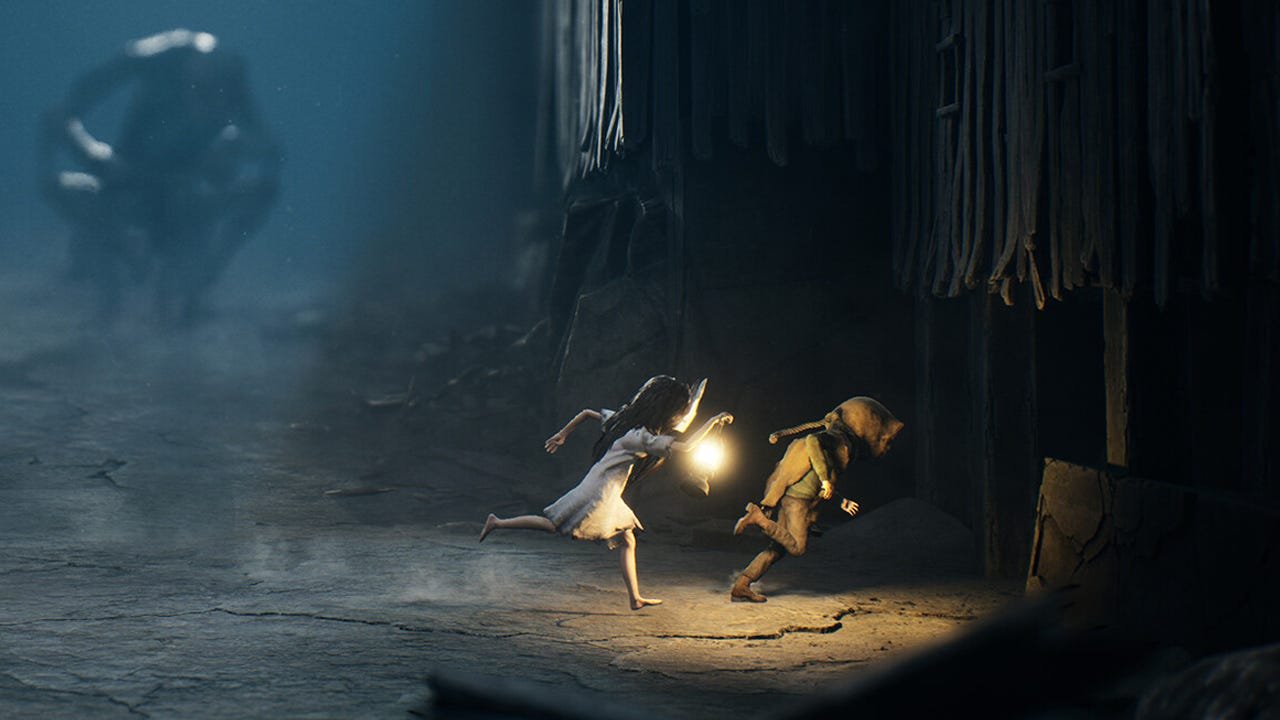
One of the most interesting and bold choices Tarsier made was the heavy focus on co-op. You can play alone, sure, but Reanimal is clearly designed for two living, breathing humans to experience together. I played as the boy, and my partner played the girl, and we quickly realized that survival isn’t just about quick reflexes—it’s about communication. There’s a subtle mechanical difference that changes how you approach every room: the girl has a lantern she can clip to her hip, leaving her hands free to carry objects or climb. The boy has a lighter, but he has to put it away if he wants to use both hands. It sounds like a small thing on paper, but when you’re in a pitch-black forest with things skittering in the brush, that choice of who carries what becomes a frantic, life-or-death conversation.
In an era where local co-op has largely been abandoned in favor of online-only experiences, seeing a high-fidelity horror title embrace the “couch play” dynamic is incredibly refreshing. A 2023 Newzoo report highlighted that 46% of Gen Z and Millennial gamers prioritize “social connection” and “cooperative play” in their purchasing decisions. Reanimal taps into this by making the relationship between the characters something you feel through gameplay rather than something you’re just told in a cutscene. They boost each other to ledges, they comfort each other after a narrow escape, and they work together to lift heavy, rusted trapdoors. It creates a genuine bond between players that a computer-controlled AI simply can’t replicate, making every narrow escape feel like a shared victory.
The Anatomy of a Nightmare: Monsters That Stick With You
Let’s talk about the monsters, because Tarsier has always been good at this, but Reanimal takes it to a much darker, more “human-adjacent” place. Early on, you’re searching for wheels for a handcar to move through a desolate area. You find a body leaning against a wall, its belly a gaping, hollow hole. You use a plunger on a toilet—classic adventure game logic, right?—and pull out a key along with the deflated, pig-like skin of what used to be a man. It’s disgusting. It’s visceral. And then, the real horror starts when those skins start slithering after you like snakes. It’s the kind of body horror that makes your skin crawl because it feels grounded in something recognizable yet utterly perverted.
And that’s not even the worst of it. The first “human” you meet is a spindly, impossibly tall creature with a sagging skin mask and empty, weeping eye sockets. He doesn’t walk; he skitters like a giant spider. If he catches you, he bites your head off in a way that is shockingly abrupt. There’s no cinematic transition, no dramatic “Game Over” screen—just a quick, brutal end before you’re dumped back at the last checkpoint. It’s the kind of horror that sticks with you long after you’ve turned off the console because it feels so wrong. It’s not a ghost or a zombie; it’s a perversion of the human form that taps into deep-seated uncanny valley fears.
Finding Freedom in a Dying World: Beyond the Linear Path
While the first half of the game feels like a meticulously guided tour through a haunted house, the second half opens up in a way that genuinely surprised me. You get back on that boat, and suddenly, the world is yours to explore. You can find flooded ruins, active warzones that offer a jarring and hellish tonal shift, and hidden islands tucked away in the mist. This is where Reanimal rewards the curious and the brave. You can find new masks and collectible concept art, but it never feels like “busy work” or padding. It feels like you’re a digital archaeologist, piecing together the history of a world that has already ended while you weren’t looking.
There’s a theory mentioned in the game that hell is just the worst moments of your life replayed forever. Looking at these kids—who clearly escaped this place once and chose to come back to save their friends—it makes you wonder about the nature of their journey. Are they heroes, or are they just as trapped as the monsters they’re running from? The game doesn’t give you an easy answer, and that’s why it’s so effective. It respects your intelligence enough to let you fill in the gaps and come to your own terrifying conclusions about what this world actually is.
Is Reanimal a sequel to Little Nightmares?
Technically, no. It’s a completely new IP developed by Tarsier Studios and published by THQ Nordic. However, it shares the same “horror-puzzle-platformer” DNA and distinct art style as their previous work, so fans of those games will feel right at home—if “home” is a terrifying industrial wasteland.
Can I play Reanimal entirely solo?
Yes, you can. If you choose to play solo, a computer-controlled AI takes over the second character. While the AI is surprisingly competent and rarely gets in the way, the developers (and we) strongly recommend playing with a friend for the best emotional and mechanical experience.
What platforms is Reanimal available on?
As of its release, the game is available on PC via Steam and Epic, as well as PlayStation 5 and Xbox Series X/S. There is currently no native Nintendo Switch version, likely due to the high-fidelity lighting and atmospheric effects that are central to the game’s identity.
The Verdict: A New Standard for the Genre
By the time the credits finally rolled, I was exhausted—in the best way possible. Reanimal doesn’t try to reinvent the wheel; it just makes the wheel much sharper and covers it in rusted spikes. It’s a game that understands that the most effective horror isn’t what’s jump-scaring you from around a corner with a loud noise, but the lingering feeling of being small and vulnerable in a world that is very, very big and entirely indifferent to whether you live or die. It’s about the crushing weight of the atmosphere and the tension of knowing that something is watching you from the fog.
If you’re looking for a game that pushes the boundaries of environmental storytelling and makes you actually care about the person sitting on the couch next to you, this is it. Tarsier has proven beyond a doubt that they didn’t need the Little Nightmares name to make a masterpiece. They just needed their own twisted, brilliant imagination and a boat to carry us into the dark. And maybe a few pig-men to keep us on our toes. It’s a haunting achievement that will likely be talked about for years to come.
This article is sourced from various news outlets. Analysis and presentation represent our editorial perspective.
About the Author