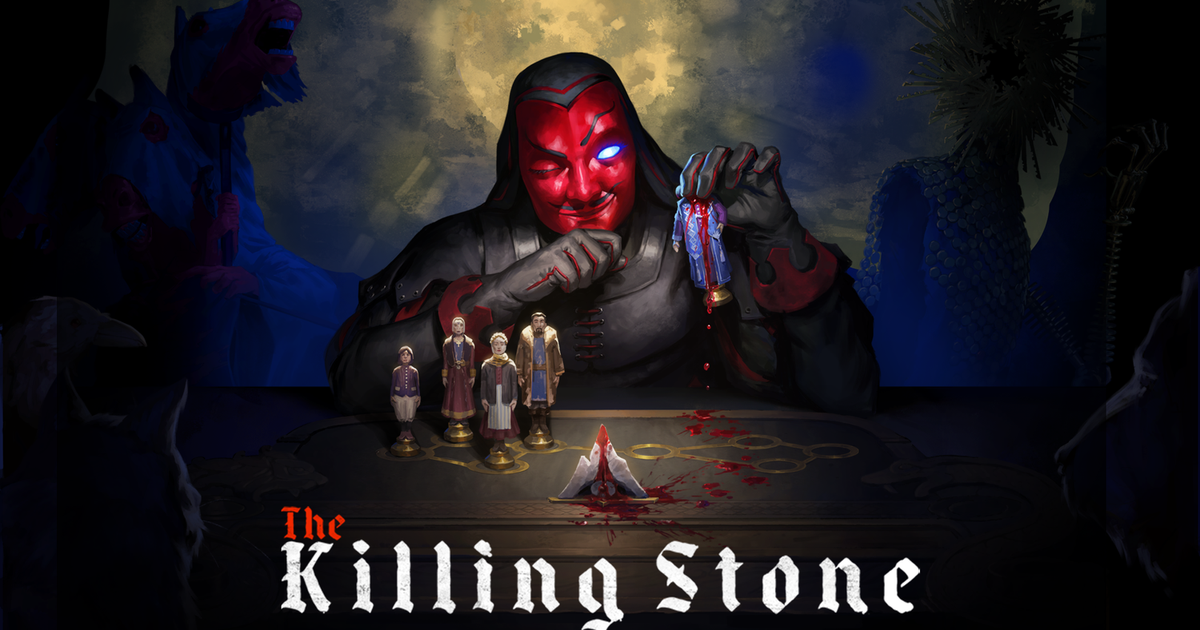
Look, I’ll be the first to admit it: my inbox has basically become a graveyard for deckbuilding card battlers. For a while there, it felt like every indie developer with a deck of cards and a dream was trying to catch that same lightning in a bottle that Slay the Spire left behind years ago. You know the feeling—you see another “roguelike deckbuilder” tag on Steam and your eyes just glaze over. But then something happens that actually makes you sit up, rub your eyes, and wonder if your “third eye” was just trying to protect you from something far too dense to handle. According to the latest reports coming out of the Rock Paper Shotgun feed, that “something” is a game called The Killing Stone, and it officially clawed its way into Steam Early Access today, February 19, 2026.
Usually, when I see the words “deckbuilder” and “Early Access” in the same sentence, my brain instinctively slides into a very comfortable, very deep coma. I’ve played them all, or at least it feels that way. But this isn’t just any developer throwing cards at a wall to see what sticks. We’re talking about Question Games. If that name doesn’t immediately ring a bell, their pedigree certainly should. These are the creative minds who gave us the brilliantly meta, fourth-wall-shattering The Magic Circle and that weirdly ambitious, eerie suburbia-sim The Blackout Club. More importantly, the studio was founded by industry veterans who cut their teeth on legendary titles like BioShock, Thief, and Dishonored. When people with that kind of immersive sim DNA baked into their bones decide to make a card game, you don’t just look—you stop and stare. You want to see how that philosophy of “player agency” and “atmospheric storytelling” translates to a 2D hand of cards. It’s a pivot that feels both unexpected and, in a strange way, perfectly logical for a team that loves to play with player expectations.
Why Does the World Need Another Card Game? Well, This One Has Teeth
It’s a bold move, honestly. The market isn’t just crowded; it’s practically suffocating. If you look at a 2025 SteamDB analysis, nearly 15% of all new releases on Steam now incorporate “roguelike” or “deckbuilding” tags. We are effectively living in the era of “Peak Card.” You can’t throw a digital rock without hitting a procedurally generated map or a shopkeeper selling a +1 defense card. Yet, The Killing Stone feels like it’s operating on a completely different frequency than its peers. It’s tuned to a very specific, very dark wavelength of 17th-century occultism and Arctic isolation. It’s not just about the cards you’re holding; it’s about the “hellish goings-on” surrounding the very table those cards are being played on. It’s the difference between playing a game of poker in a bright casino and playing it in a basement with a ghost who has a knife. One is a game; the other is an experience you’re trying to survive.
I think what draws me in here is the setting. The Arctic in the 1600s is such a miserable, lonely, and terrifying place to be. There’s no help coming. There’s just the ice, the wind, and whatever demons you’ve managed to invite inside to keep the frost at bay. When you combine that with the mechanical tightness of a deckbuilder, you get something that feels heavy. It feels like every card you play has the weight of a physical object. It’s not just math; it feels like a ritual. And that’s exactly what Question Games seems to be going for here—a sense that the game itself is a cursed object you’ve found in the attic of a dead relative.
It’s Not Just What’s on the Table, It’s What’s Behind You
The immediate comparison everyone is making—and for very good reason—is Inscryption. There’s this specific, prickly brand of dread that comes from being trapped at a table, forced to play a game against something that clearly doesn’t have your best interests at heart. In The Killing Stone, you aren’t just playing for high scores; you’re facing off against literal demon lords with the souls of the cursed Svangård family as the stakes. But the real genius here isn’t just in the card play itself; it’s in what happens the moment you stand up from the table. This is where that immersive sim heritage really starts to shine through the cracks.
Between rounds, the game shifts into a full first-person exploration of a 17th-century Arctic mansion. It’s creaky, it’s dark, and it’s filled with people (and things) you probably shouldn’t trust. You’re chatting with the family members, hanging out with animal familiars that definitely know more than they’re letting on, and trying to piece together the mystery of Mariken—an old friend who seems to have been the one to invite this whole mess into the house in the first place. It’s that dual-layer storytelling that elevates a simple card mechanic into something much more cinematic. You aren’t just managing a deck; you’re actively investigating a haunting in real-time. You might find a clue in a bedroom that changes how you interpret a card’s flavor text, or a conversation with a family member might give you the edge you need in the next match. It makes the world feel interconnected in a way most deckbuilders just don’t bother with.
“The Killing Stone is the game we’ve always wanted to make.”
Question Games, Steam Early Access Launch Note
This “game within a game” trope is quickly becoming a hallmark of high-end indie design, and honestly, I’m here for it. It reflects a growing desire among players for narrative context in genres that are traditionally seen as “mechanics-first.” We don’t just want to win; we want to know why winning matters. A 2024 report from Newzoo found that 62% of PC gamers cite “narrative depth” as a primary reason for sticking with an indie title for more than ten hours. By anchoring these card battles in a tangible, creepy, and historical environment, Question Games is betting that we care more about *why* we’re playing the cards than the actual cards themselves. They’re betting on the atmosphere to carry us through the grind, and given their track record, that’s a bet I’m willing to take.
Two Dialects and a Whole Lot of Occult Density
One of the most fascinating details I’ve come across while digging into the Early Access build is the writing style. Question has implemented two very distinct dialects: “period 17th-century English” and “a more modern prose.” And here’s the kicker—both are fully voice-acted. That is a massive undertaking for an indie studio. It’s not just a gimmick; it suggests a level of world-building that goes far beyond the typical “flavor text” we usually see on a +2 Attack card. It’s about immersion. It’s about making the player feel like they are truly out of time, trapped in a cold, dark corner of history where the rules of the modern world simply don’t apply.
I’ve been thinking a lot about the “occult density” that the RPS crew mentioned in their initial impressions. Is it a barrier to entry, or is it the game’s greatest strength? Personally, I think it’s the latter. We live in an era of “snackable” content and games designed to be played while you’re half-watching a YouTube video, but there’s a segment of the audience—myself included—that craves something that feels heavy. Something that requires you to actually lean in and pay attention to the dialogue and the environmental cues. If the writing can successfully bridge the gap between the archaic and the modern, it might just create an atmosphere that other deckbuilders can’t even touch. It’s that feeling of reading a dusty old book and realizing, halfway through, that the words are starting to make a terrifying kind of sense.
But let’s address the “creaky” factor for a second. The Blackout Club was a game I desperately, desperately wanted to love. It had so many cool ideas, but as critics like Nic Reuben noted back in the day, it could feel a bit “lumpish” in practice. It was exciting in short bursts but sometimes struggled to hold that allure over long, repetitive sessions because the stealth mechanics could be finicky. The transition to a card battler might actually be the smartest thing Question Games has ever done to solve this. Card games are, by their very nature, structured and rhythmic. They provide a solid, mathematical skeleton that might support Question’s wilder narrative impulses much better than a physics-heavy stealth game ever could. It gives them a foundation to build their weirdness upon without the whole thing collapsing under its own weight.
What’s Actually in the Early Access Box?
If you’re thinking about jumping in today, here is the breakdown of what the developers have packed into this initial release. It’s surprisingly robust for a day-one Early Access title:
- Three Primary Story Acts: These aren’t just levels; each is centered on a specific Svangård family member and features a unique deck that reflects their personality and “sins.”
- Three Demon Lords: These are the heavy hitters, the bosses you’ll need to outsmart at the table. They aren’t just stat-blocks; they have their own rules and psychological tactics.
- 6-8 Hours of Playtime: This is just for the “main” path. For an Early Access build, that’s a very solid start, especially considering the branching narrative paths.
- Ritual Missions: These are optional side-content for the players who want to dive deeper into the occult mechanics and perhaps unlock some of the darker secrets hidden in the mansion.
The Long Road to 1.0 and “The Reckoning”
Question Games isn’t planning on sitting in Early Access forever. They’re aiming for a full 1.0 release in about six months. That’s a pretty ambitious timeline, especially with their plans to add more story beats, additional languages, and even more expanded voice acting. But the most intriguing part of their roadmap—the thing that really has me curious—is something they’ve cryptically titled “The Reckoning.” They’re calling it their planned endgame content, and while details are currently thinner than Arctic ice in summer, the name alone implies a sense of finality that fits the high-stakes theme of trading souls. Is it a final boss? A permanent world state? A total narrative reset? We’ll have to wait and see.
Is it already too late for us to turn back? Usually, once you start reading about 17th-century demons and Arctic mysteries, the hook is already set deep. Currently, the game is a PC-first experience on Steam. And while there’s no official word on PS5, Xbox, or Switch ports just yet, the developer’s history of bringing their games to consoles suggests they’ll want this on as many screens as possible once the “creaks” are ironed out and the balance is perfected. Given that indie games now account for nearly 40% of total playtime on the Nintendo Switch according to a 2025 industry survey, a port feels like an inevitability rather than just a possibility. I can already imagine playing this under the covers at night, which is exactly how a game like this should be experienced.
I’m coming at this with a sense of cautious optimism. I’ve been burned by “the next big deckbuilder” more times than I care to count, but the pedigree here is simply undeniable. There’s a soul in this game—perhaps literally, given the plot—that feels completely absent from the more clinical, math-heavy entries in the genre. If Question Games can successfully balance the “hellish table-top” mechanics with the “hellish world” exploration, they might just have a masterpiece on their hands. It’s about finding that sweet spot where the cards feel like tools and the story feels like a threat.
Is The Killing Stone a roguelike?
Technically, yes. It definitely incorporates those familiar roguelike elements we’ve come to expect—procedurally influenced card drafts, permanent progression across the story acts, and the “one more run” mentality. However, it places a much heavier emphasis on a linear, unfolding mystery than your typical “run-based” battler. You aren’t just cycling through random encounters; you’re moving through a scripted, atmospheric nightmare.
How much does the narrative actually affect the gameplay?
It’s not just window dressing. The narrative is the core. Between your card matches, you explore the mansion in a first-person perspective. Your interactions with the Svangård family members and your animal familiars directly influence the story’s progression and the specific mysteries you’re able to unravel. It’s possible that a choice you make in a hallway could come back to haunt you at the card table.
Will there be any kind of multiplayer?
As of right now, no. The focus is strictly on delivering a deep, atmospheric, single-player narrative experience. Question Games has been very vocal about the “mystery” and “occult” aspects of the project, which traditionally thrive much better in a solo setting where the player can feel truly isolated. Adding a second player would probably kill the mood they’re working so hard to create.
Final Thoughts: A Gamble That’s Actually Worth Taking
At the end of the day, The Killing Stone represents the best kind of indie risk. It’s a team of industry veterans taking a “safe,” popular genre and injecting it with so much weirdness, historical texture, and atmospheric dread that it becomes something entirely new. It’s not just a game about playing cards; it’s a game about the crushing weight of history, the literal cost of a human soul, and that terrifying, oppressive silence you only find in the deepest parts of the Arctic. It’s ambitious, it’s strange, and it’s exactly the kind of thing the genre needs right now.
If you’ve been shying away from deckbuilders lately because you’re tired of the same old tropes, I totally get it. I really do. But some stones are worth overturning, even if you know there’s something deeply unpleasant waiting underneath. I’ll see you at the table; just try to keep a straight face, and for heaven’s sake, don’t let the demons see what you’re holding.
This article is sourced from various news outlets and industry reports. Analysis and presentation represent our editorial perspective and deep-dive research into the current state of indie gaming.
About the Author