The gaming community nurses a strange, almost pathological obsession with executive authenticity. We want the people running our favorite plastic boxes to be exactly like us — to feel the gut-punch of a poorly timed weapon nerf, the quiet euphoria of a perfectly executed roguelike run, the slow agony of waiting for a highly anticipated DLC that keeps getting pushed back. Relatable, sure. Reasonable? Not quite.
Demanding that a corporate vice president be a hardcore gamer is a trap. And recently, Xbox’s leadership walked straight into it.
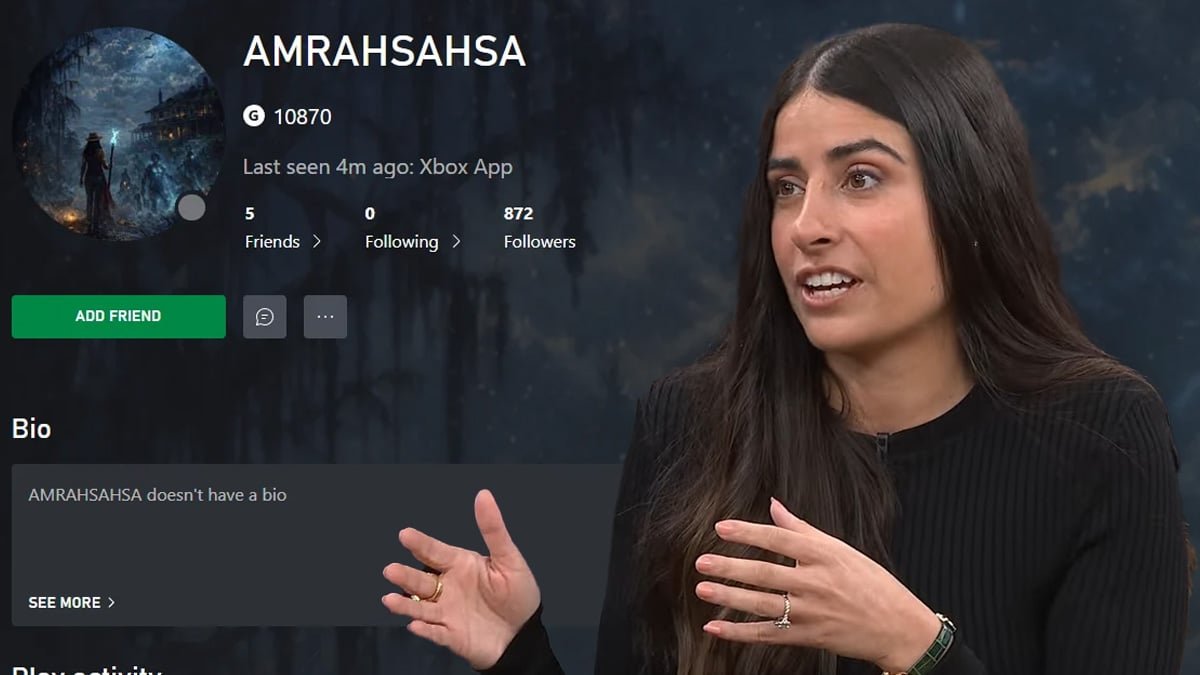
Per reporting from Gamebrott.com, the latest drama centers on Xbox executive Asha Sharma. In an attempt to connect with the community, she publicly shared her Xbox gamertag: “AMRAHSAHSA.” Meant as a digital handshake — a way of signaling, hey, I’m in the trenches with you — it was, on its face, a standard PR gesture. A pretty unremarkable one, at that.
Just one problem. The internet is undefeated at forensic accounting.
When Gamers Run the Numbers — and the Math Doesn’t Lie
Within hours of the gamertag going public, players began auditing her account with the methodical zeal of IRS investigators. They catalogued the games. They cross-referenced achievement timestamps. And the picture that emerged didn’t add up.
The account was roughly a month old, yet it showed an unnatural progression rate across sprawling, time-consuming titles — Fallout 76, Forza Horizon 5, Halo Infinite, Borderlands 2. Racking up that many achievements in that compressed a window would require someone essentially chained to a screen around the clock, which sits awkwardly against the minor detail that Sharma runs a major division of Microsoft for a living.
Suspicions caught fire fast. Was she paying someone to boost the account? Using developer-side tools to unlock achievements artificially? The backlash arrived swift, predictable, and deafening.
Responding to IGN’s Ryan McCaffrey on X — the platform most of us still reflexively call Twitter — Sharma finally cleared the air. Her explanation was refreshingly mundane.
Faking progression in this community is a terrible idea and it never works. The reality is much simpler: I created the account to learn the ecosystem, and then it became a shared family profile across multiple devices.
Asha Sharma
She’d been playing with her family. The rapid achievement unlocks were the cumulative output of multiple people in her household working through different games on the same profile. Once everyone finally migrated to their own individual accounts, the original profile was left looking like the fever dream of a speedrunner who hadn’t slept in a week.
Perfectly plausible. Genuinely common, in fact. According to the Entertainment Software Association’s recurring Essential Facts data, over 70% of parents who play video games do so alongside their children — often sharing a primary console profile before anyone gets around to setting up proper child accounts. Sharma wasn’t running a con. She was navigating the same chaotic domestic reality most gaming households know well.
Phil Spencer Built a Persona Nobody Else Can Actually Afford to Maintain
To understand why gamers reacted with such hostility, you have to trace it back to the culture Microsoft itself engineered. For the better part of a decade, Xbox has been defined by Phil Spencer. His “P3” gamertag has taken on near-mythological status. He’s known for genuinely logging serious hours across a wide range of titles — often surfacing in achievement feeds late at night, responding to fans between sessions.
Spencer cultivated the definitive “gamer-first” executive persona, and it was exactly what Xbox needed after the catastrophic, TV-obsessed reveal of the Xbox One in 2013. He rebuilt community trust the hard way: by demonstrating, repeatedly and visibly, that he was one of them.
That persona set an impossibly high bar. Worse — an entirely unnecessary one.
Every new executive stepping into the Xbox hierarchy now carries the unspoken pressure to prove their gamer credentials. It has calcified into a peculiar litmus test: if you can’t hold your own in a Call of Duty lobby, how could you possibly be trusted with the platform’s future? It’s the kind of logic that sounds vaguely reasonable until you stress-test it for about thirty seconds.
We don’t expect the CEO of Boeing to personally fly commercial routes on weekends to prove they understand aviation. Nobody demands that the head of Netflix binge forty hours of K-dramas weekly as proof they respect entertainment. Why, then, does the gaming press treat a shared family Xbox account like evidence of corporate malfeasance?
The Org Chart Doesn’t Have a K/D Ratio
Here in 2026, the video game business has grown genuinely ferocious in its complexity. Thin margins, brutal competition, and a content pipeline that never stops — it’s an industry that rewards cold, precise business judgment above almost everything else.
Xbox is currently managing a sprawling portfolio of acquired studios absorbed through the Activision Blizzard and Bethesda deals. The team is executing a deliberately controversial multiplatform push, routing major first-party titles to rival hardware including the PS5 and Nintendo Switch. Simultaneously, they’re threading the needle on Game Pass economics while keeping PC players from drifting to Steam permanently. These aren’t bullet points on a roadmap — they’re billion-dollar logistical headaches.
Consider the actual stakes. Based on findings published by the UK’s Competition and Markets Authority during the Microsoft-Activision regulatory hearings, modern AAA development budgets routinely clear $300 million, with marketing expenditure pushing total investment toward half a billion dollars per major release.
Half a billion dollars. When that figure is attached to a single title, the question of whether the executive greenlighting the budget knows the current Overwatch 2 meta becomes — and I mean this sincerely — completely irrelevant. What matters is whether they can structure resource allocation well enough that a studio doesn’t have to gut 300 developers when a launch underperforms.
The Gamebrott report also surfaced internal friction worth noting: rumors that Xbox President Sarah Bond has been perceived by some employees as “hard to work with.” Whether that reflects genuine leadership dysfunction or simply the turbulence of a massive corporate restructuring — and those two things can look identical from the inside — it underscores where the real challenges at Microsoft actually live. Not in gamertag timestamps. In org charts, studio relationships, and the grinding difficulty of pivoting one of the world’s largest entertainment divisions mid-cycle.
They are trying to turn an ocean liner in a storm. The leadership team is tasked with returning Xbox to creative credibility, scaling distribution intelligently, and shoring up the brand before the next console generation forces another reckoning. Unpopular decisions come with that territory. A certain operational detachment is not a character flaw — it’s a job requirement.
Suits Ruining Games Is a Real Pattern — Which Is Exactly Why This Situation Matters
Here’s the counterargument, and it deserves a fair hearing.
Gamers aren’t paranoid without cause. Historically, when non-endemic executives take the wheel at gaming companies, the outcomes range from mediocre to genuinely damaging. The record is well-documented. Predatory microtransactions forced into single-player titles. Talented studios abandoned beloved franchises to chase live-service trends — only to watch those games collapse within six months of launch. Players treated not as a community but as a revenue stream with a pulse.
When an executive has no personal relationship with the medium, they tend to miss the emotional circuitry underneath it. They don’t register why a seemingly minor tweak to a game’s economy reads as a betrayal to the player base. Empathy for the user experience — the hands-on reality of actually sitting with a game for forty hours — doesn’t come from quarterly reports.
So the “gamer test,” crude and imperfect as it is, functions as the only rough heuristic players have. A proxy signal for respect. And when an executive appears to be faking it? The alarm bells are entirely rational. If someone inflates their Borderlands 2 achievement count, what else might they be comfortable misrepresenting? Server closure timelines? Studio independence agreements? The slippage from one small deception to larger ones isn’t a paranoid leap — it’s pattern recognition.
The community has been burned enough times to know what the early warning signs look like.
Sharma Passed the Only Test That Actually Counts
Which is precisely why her handling of this particular situation reads as a genuine positive signal for Xbox.
Rather than doubling down on a fabricated persona, she came clean. No spin, no PR-polished deflection — just a straightforward account of what actually happened. She acknowledged that performing the role of the ultimate gamer wasn’t her agenda. Her stated focus: making Xbox the best place to play, strengthening product distribution, and building something durable for the brand’s future. Boring? Maybe. Honest? Unambiguously.
There’s also something worth examining in how she used that account before the scrutiny hit. She created it to learn the ecosystem firsthand. She shared it with her family to observe how real people navigate the console interface, the storefront, the subscription tiers — the friction points that show up in user research only after someone actually lives with the product. That’s not performative engagement. That’s product research conducted through genuine use.
According to consumer behavior analysis from Statista’s digital media division, ease of use and interface navigation consistently rank among the top factors driving console retention among casual players. By experiencing the messy, multi-user reality of a shared family account — the confusion, the overlapping profiles, the ecosystem friction — Sharma likely absorbed more actionable insight into the Xbox user experience than she ever would have grinding toward a solo platinum trophy.
Lived experience with a product’s rough edges is worth more than a polished achievement list. Any good product leader knows that.
Retire the executive gamer credibility test. It pressures capable leaders into performative theater designed to satisfy a vocal minority on social media — theater that, when it inevitably unravels, damages both the executive and the brand. Xbox doesn’t need its leadership to be esports-ready. It needs them to be competent, transparent, and relentlessly focused on getting great games into players’ hands.
If Asha Sharma can help steer Microsoft’s gaming operation toward a sustainable, creatively healthy future — and her response here suggests she at least understands the value of honesty under pressure — then who actually unlocked those Fallout 76 achievements is, frankly, nobody’s business.
Let the executives run the business. We’ll handle the gaming.
Based on reporting from various media outlets. Any editorial opinion is that of the author.
About the Author